Kinds of dinosaurs

Dinosaur eggs

Every dinosaur started life the same way: inside an egg. Even the giants, the ones longer than three school buses, hatched from eggs you could hold in your two hands.

Read on to find out how big dinosaur eggs were, what color they were, who sat on them, and what the babies looked like.

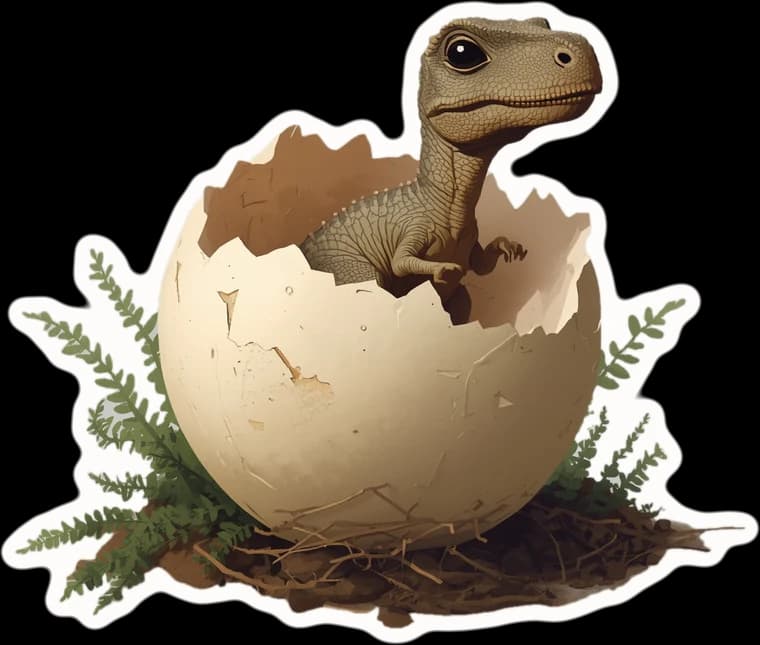
A baby dinosaur hatching out of a cracked egg in a nest, a paper cut-out

Is it morning yet?

The short answer

  • Every dinosaur hatched from an egg, the way birds still do.
  • Even a giant long neck's egg was only about 15 centimeters (6 inches) wide, like a grapefruit.
  • Some dinosaur eggs were blue-green. And the egg in your fridge was laid by a dinosaur!

Drawn to scale

How big was a dinosaur egg?

Smaller than you'd think. The smallest were about the size of a tennis ball. The largest were like giant footballs, nearly half a meter long. Some were round, and some were long and thin.

The funny thing is who laid the small ones. The giant long necks, the biggest animals that ever walked on land, laid eggs only about 15 centimeters (6 inches) wide. They made up for it by laying lots: 30 or 40 at a time.

  1. The smallest eggslike a tennis ball
  2. A giant long neck's eggabout 15 cm (6 in) widelike a grapefruit
  3. Baby Yingliang's egg17 cm (about 7 in) longwith a curled-up baby inside
  4. A school ruler30 cm (12 in)
  5. The biggest eggs knownup to 45 cm (18 in) longlaid by a giant bird-like dinosaur
The tennis ball, the long neck's egg and “nearly half a metre” from the Natural History Museum, London; Baby Yingliang's egg from the University of Birmingham; the biggest eggs measured in Nature Communications (2017).

Shells and colors

What color were dinosaur eggs?

For a long time everyone thought they were plain white. Then, in 2017, scientists tested the eggs of a bird-like dinosaur from China, and found they were a deep blue-green.

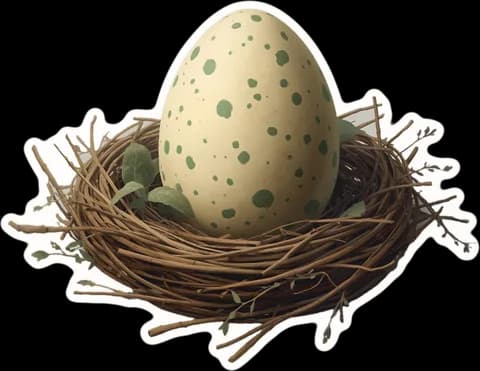
A plain egg, and a blue-green one like the eggs of Heyuannia, a bird-like dinosaur. Drawings, not photographs.

Speckles started with dinosaurs

Colored and speckled eggs began with the small bird-like meat-eaters, the group that Velociraptor belonged to. Birds still paint their eggs with the same two colors, a red one and a blue one.

Hard shells and soft shells

Many dinosaur eggs had hard shells, built like a bird's. But the very first dinosaur eggs were soft and leathery, like a turtle's, and they were buried in the ground.

The dinosaur egg in your fridge

Birds are living dinosaurs. So a hen's egg is a dinosaur egg, and an omelet is a very, very old recipe.
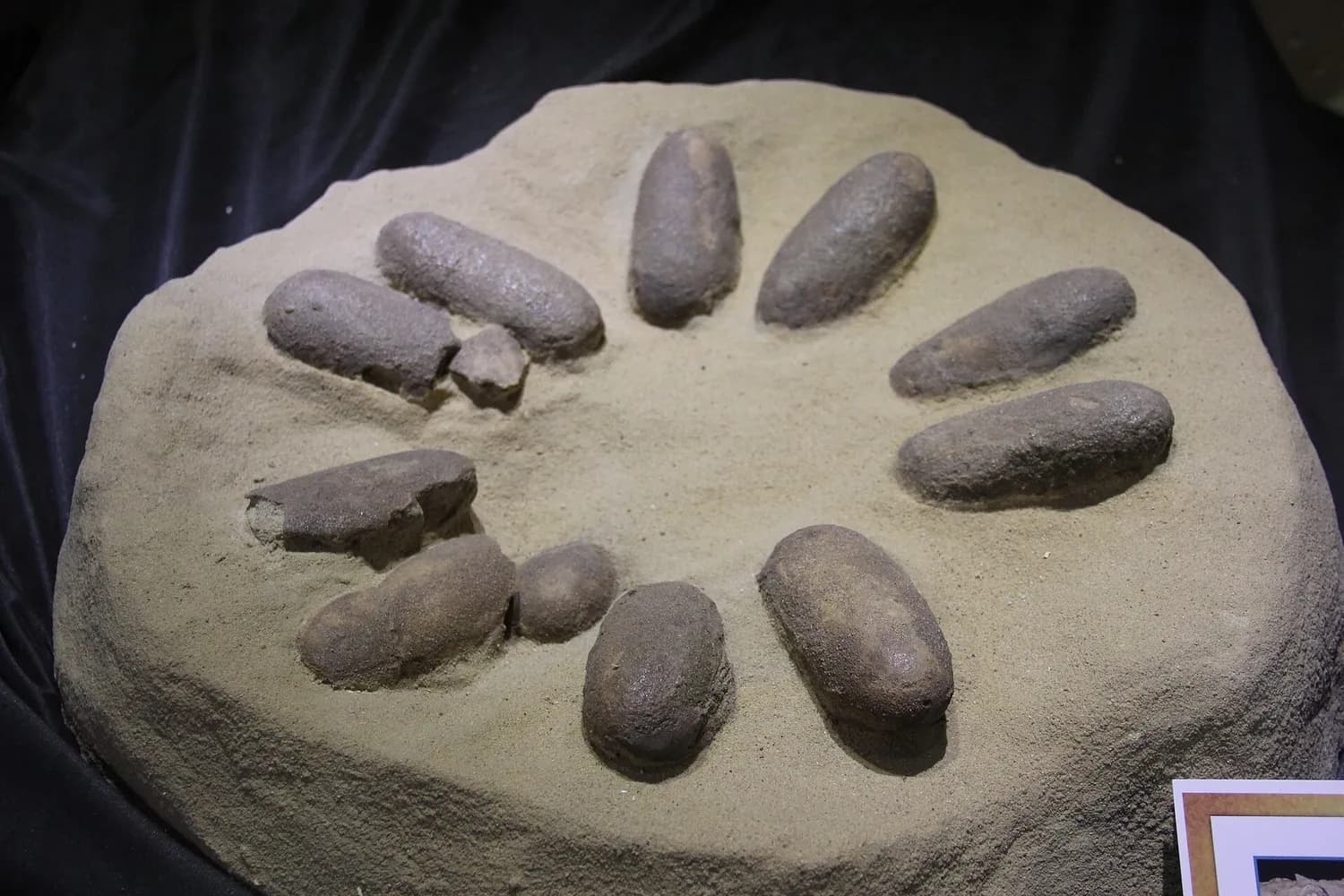
A nest of long fossil dinosaur eggs laid in a ring, in a museum
A nest of dinosaur eggs laid in a ring, at the Central Museum of Mongolian Dinosaurs. Photo: Gary Todd.

Dinosaur nests

Nests, and who sat on them

Most dinosaurs laid their eggs in nests of mud, or in hollows scooped in the sand. Some covered the nest and left it. Others sat on their eggs to keep them warm, the way most birds do.

The bird-like dinosaurs laid their eggs in a wide ring, with room for the parent in the middle. That way a heavy dinosaur could keep its eggs warm without squashing them.

The good mother lizard

Maiasaura, a duck-billed dinosaur, has a name that means “good mother lizard”. Its fossils gave some of the first signs that dinosaurs looked after their young. At Egg Mountain in Montana, scientists found 14 of its nests in one place.

Too big to sit down

The giant long necks could never have sat on their eggs. It looks as if they laid them and left the babies to look after themselves.

92 nests in one go

In India, scientists dug up 92 nests and 256 eggs of the giant long necks in a single study.

A case of mistaken identity

The egg thief that wasn't a thief

In the 1920s, scientists in the Gobi Desert found a dinosaur with a nest of eggs. They thought the eggs belonged to another dinosaur and that this one had come to steal them. So they named it Oviraptor, which means “egg thief”.

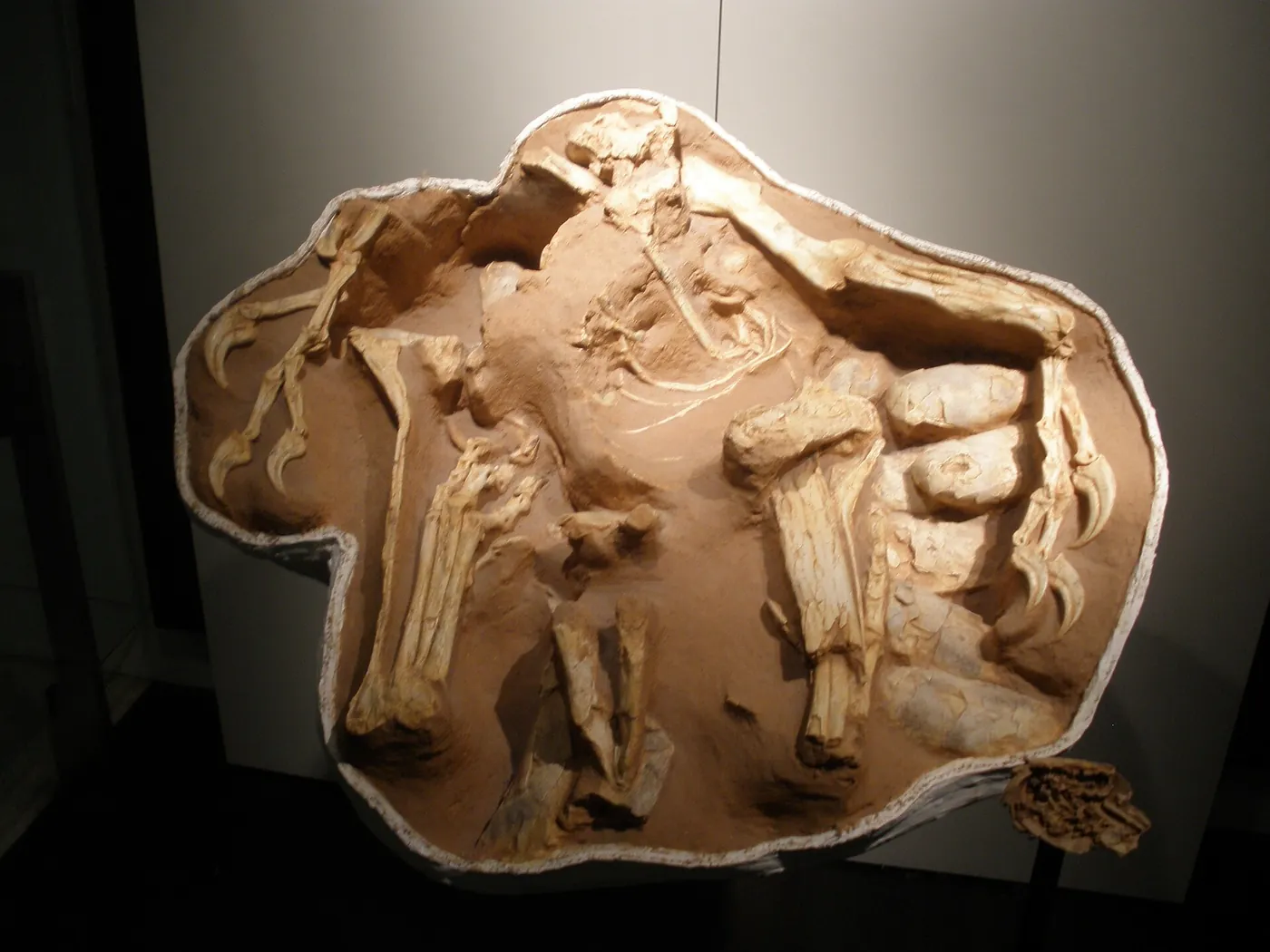
They were wrong. The eggs were its own. Years later a close cousin turned up in Mongolia, sitting on top of its own nest, like a bird. It is nicknamed Big Mama, and it was shown to the world in 1995.

Poor Oviraptor. It has been called a thief for a hundred years, and it was only minding its eggs.

The fossil of a bird-like dinosaur sitting on its nest, its arms spread around a ring of eggs
A fossil of Citipati, a cousin of Oviraptor, sitting on its nest. Photo: Ghedoghedo.

Baby dinosaurs

Inside the egg

Most fossil eggs are empty shells. A baby still inside is very rare, and very exciting.

Baby Yingliang

A fossil egg from southern China has a baby dinosaur curled up inside it, just like a chick. The baby is 27 centimeters (11 inches) long, folded into an egg of 17 centimeters (7 inches).

Teeth tinier than a toothpick tip

Scientists can look inside an egg without breaking it, with powerful X-rays. Unhatched babies already had teeth, each one smaller than the tip of a toothpick.

A tooth for getting out

Baby long necks had an egg tooth, a little point for breaking the shell when it was time to hatch. Chicks have one too.

Cheep, not roar

Baby dinosaurs had big heads, big eyes and short snouts, like puppies or baby birds. One scientist thinks the sound from a nest wasn't a growl. It may have been cheeps.

And then they grew. And grew.

Apatosaurus was a giant dinosaur that could grow up to 23 meters (75 feet) long! It took several years to grow that big.
Katia, in Dinosaurs Are Back

Apatosaurus facts for kids · From a grapefruit to a giant

Dinosaur egg fossils

Who found the first dinosaur eggs?

The Gobi Desert, 1923

A team from the American Museum of Natural History dug up the first fossils that everybody agreed were dinosaur eggs. They were in the Gobi Desert, in Mongolia.

The egg in the drawer

The Natural History Museum in London had a dinosaur egg all along. It was collected in India long before anyone knew what a dinosaur egg looked like, perhaps before the word “dinosaur” even existed. It was kept with the minerals, as a pretty stone.

All over the world

Dinosaur eggs have been found at more than 200 places, with important ones in the USA, China, France, Argentina and India.

Can a dinosaur egg still hatch?

No. A fossil egg is stone all the way through. Whatever was inside rotted away millions of years ago, and minerals slowly filled the space. Bones can last that long. The living stuff inside an egg can't.

Can you buy a real dinosaur egg?

Real ones are rare, and they belong in museums. One famous nest, with a baby called Baby Louie, spent years abroad before it was sent home to China. And round stones fool people all the time.

Looking for a present? A dig kit is plaster, not a fossil, but digging is half the fun. We made a list of dinosaur gifts that aren't toys: real fossils from museum shops, sleepovers, fossil hunts.

Free to print

Play a dinosaur egg hunt

Eleven clue cards from the dinosaurs Spike meets on his adventure. Hide them around the house, hide an egg at the end, and send your little explorers after it. It works at Easter or on any rainy day.

Two egg jokes, each with a true bit

Dinosaur jokeAges 6 and up

What's the smallest thing about the biggest dinosaur?

Tell me!

Its egg!

The true bit: A titanosaur, one of the biggest animals ever to walk the Earth, hatched from an egg about the size of a grapefruit. (Natural History Museum, London)

Dinosaur jokeAges 6 and up

Knock knock.Who's there?Egg.Egg who?

Tell me!

Egg-cited to meet you! I just hatched!

The true bit: Dinosaur eggs can turn into fossils, just like bones and teeth. (American Museum of Natural History)

More: dinosaur jokes for kids.

Questions kids ask

Quick answers

Did all dinosaurs lay eggs?
As far as scientists know, yes. Like birds, which are the dinosaurs we can still see today, the dinosaurs of long ago hatched from eggs.
How big were dinosaur eggs?
The smallest were about the size of a tennis ball. The largest were like giant footballs, nearly half a meter (about a foot and a half) long. Even the giant long necks hatched from eggs only about 15 centimeters (6 inches) wide, about the size of a grapefruit.
What color were dinosaur eggs?
Some were blue-green! In 2017 scientists found that the eggs of a bird-like dinosaur from China were a deep blue-green. Colored and speckled eggs began with the small bird-like meat-eaters, the group Velociraptor belonged to. Many other dinosaur eggs had no color.
What is the biggest dinosaur egg ever found?
The biggest are nearly half a meter long. They were laid by Beibeilong, a giant bird-like dinosaur whose name means baby dragon from China.
Which dinosaur was called the egg thief?
Oviraptor. Scientists found it with a nest in the 1920s and thought it was stealing the eggs, so they named it egg thief. Later they worked out that the eggs were its own.
Can a dinosaur egg still hatch?
No. A fossil egg is stone inside. Whatever was in it rotted away millions of years ago, and minerals filled the space.
Is a chicken egg a dinosaur egg?
Yes! Birds are living dinosaurs, so every egg in your fridge was laid by a dinosaur.
Can you buy a real dinosaur egg?
Real fossil eggs are rare and belong in museums: one famous nest, with a baby called Baby Louie, was sent back to China after years abroad. Round stones are often mistaken for eggs, too. For a present, a dig kit is the safe choice: it's plaster, not a real fossil.
Keep sorting

More kinds of dinosaurs

Got a big question instead? The biggest, the fastest, the fliers and the long necks. Or meet ten dinosaurs, one page each, with a fun fact and a riddle.

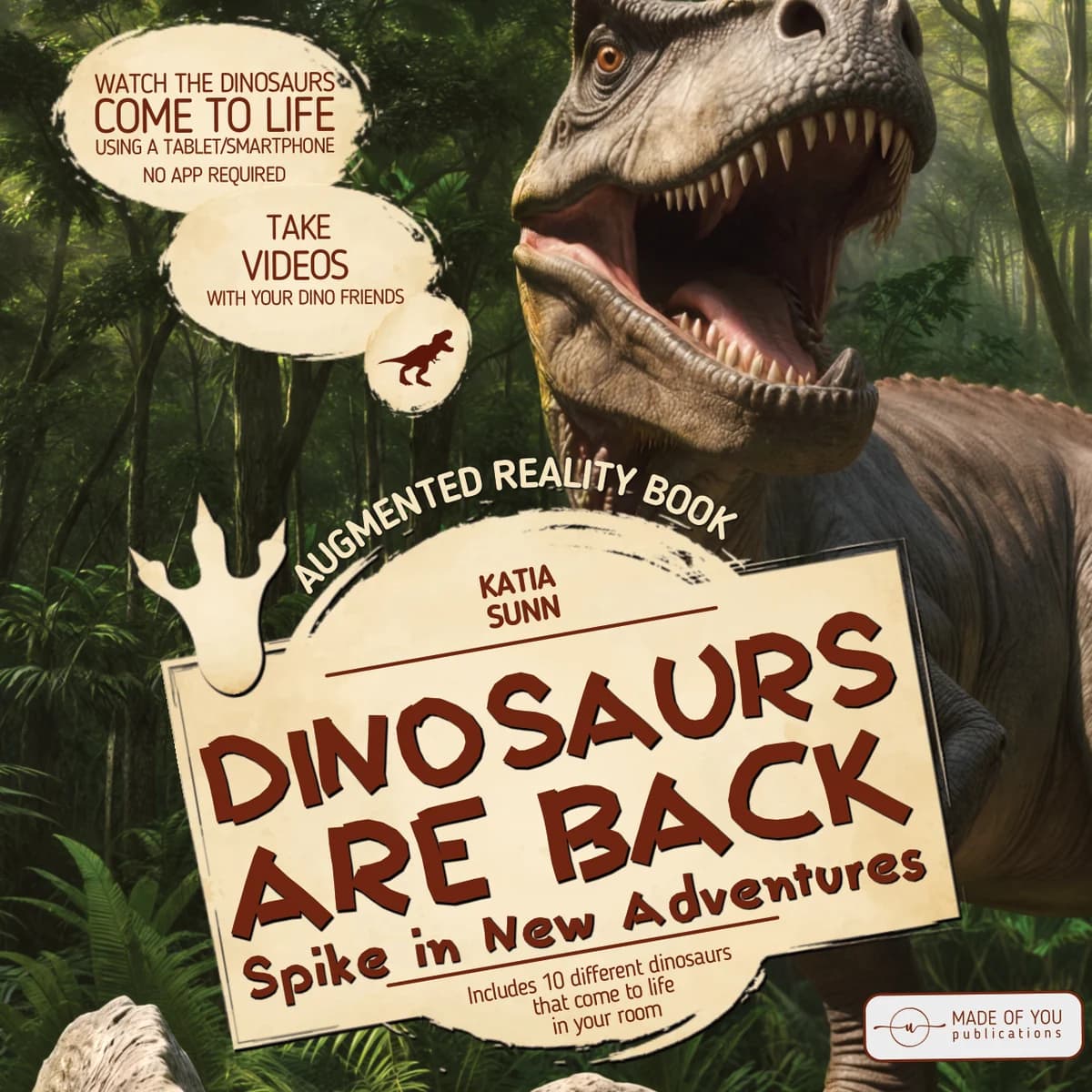
Cover of Dinosaurs Are Back, an interactive 3D dinosaur book in augmented reality

Our own bookA picture book · ages 6 to 10

Dinosaurs Are Back

This whole story starts with an egg. Spike's baby brother Fino is still inside his when it goes missing, and soon other nests are empty too. Spike sets off to find out why. Ten dinosaurs step off the page with a phone or tablet.

Where these facts come from

Katia's facts are from the fact page near the end of Dinosaurs Are Back. Everything else was checked on these pages on October 1, 2026.

Picture credits