Kinds of dinosaurs

Dinosaurs with horns

Lots of dinosaurs had horns. The most famous one, Triceratops, had three. But there was one with a single horn, one with fifteen, and a meat-eater with horns like a bull.

And one had no horns at all, just a head as hard as a helmet. Here's how to tell them apart.

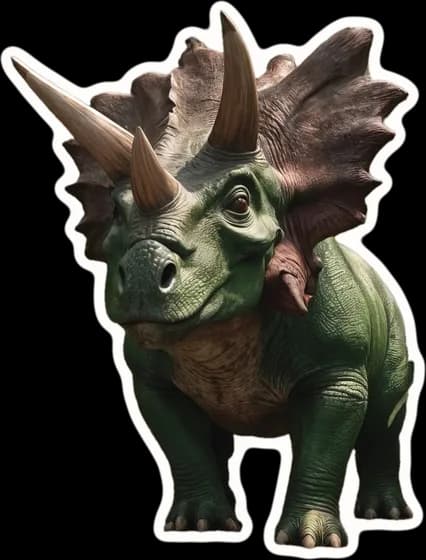
The Triceratops from Dinosaurs Are Back, a paper cut-out

One, two, three horns. Count them! I'll wait.

The short answer

  • The dinosaur with three horns is Triceratops. Its name means “three-horned face”.
  • The dinosaur with horns that eats meat is Carnotaurus, the “meat-eating bull”. You can put it in your room.
  • The dinosaur with the hard head is Pachycephalosaurus. No horns: a thick dome of bone instead.

Three horns

The dinosaur with three horns

One horn on its nose and two above its eyes: that's a Triceratops (say it: try-SERR-a-tops). Behind the horns sat a big frill of bone, like a shield for its neck.

Triceratops had a nose horn so sharp, it could probably cut through wood, and a head the size of a small car! It lived at the same time as its biggest enemy, the mighty Tyrannosaurus rex.
Katia, in Dinosaurs Are Back

Triceratops facts for kids, with a short video.

The horn that healed

A Triceratops fossil collected in 1997 has a horn that was bitten off by a T. rex. The horn healed afterwards. So that Triceratops got away!

Sharper than the fossils

The horns had a coat of keratin, the stuff your fingernails are made of. That made them longer and sharper in life than the fossils show.

A giant bison?

The first Triceratops horns were found in 1887. The scientist who studied them thought they belonged to a giant bison.

The horned faces

More dinosaurs with horns

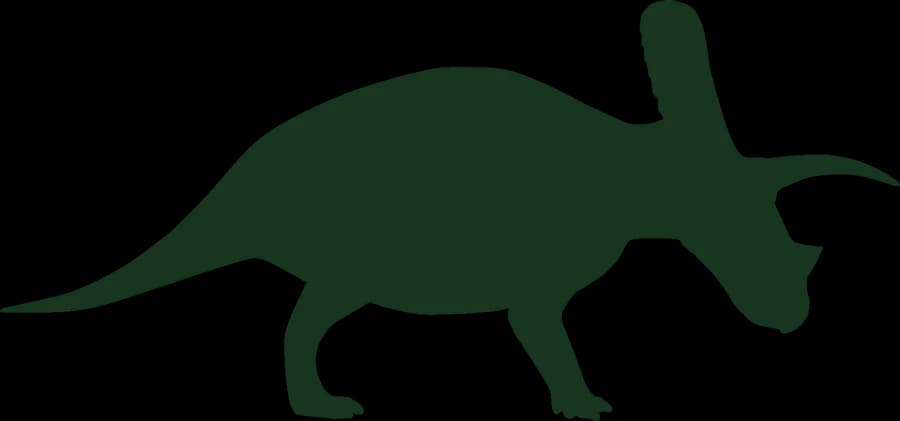
Triceratops had a big family. Scientists call them ceratopsians, which means “horned faces”. They all ate plants, and they all had a beak like a parrot's and a frill of bone. The horns are how you tell them apart. (The pictures aren't to scale.)

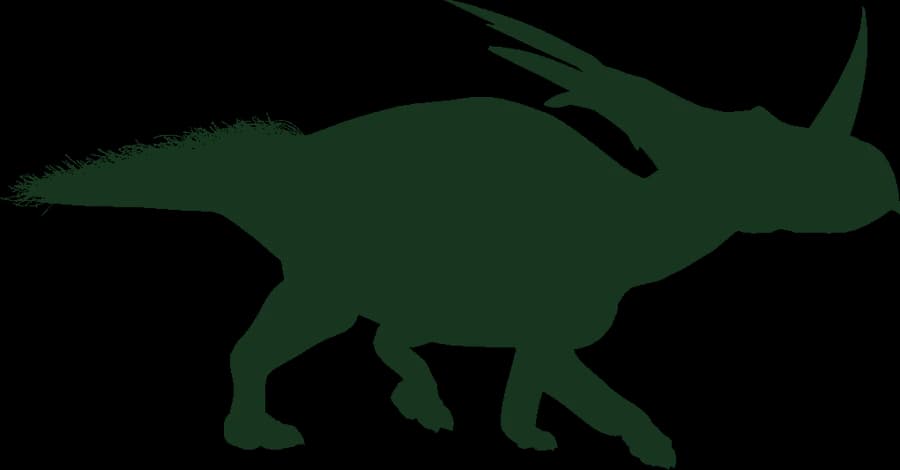
  • Styracosaurus, an outline

    Styracosaurus

    Say it: sty-RAK-oh-sore-us · “spiked lizard”

    Look for: One long horn on its nose, and long spikes all around its frill.

    Some skulls have six spikes on the frill, and some have eight. It was about 5.5 meters (18 feet) long.

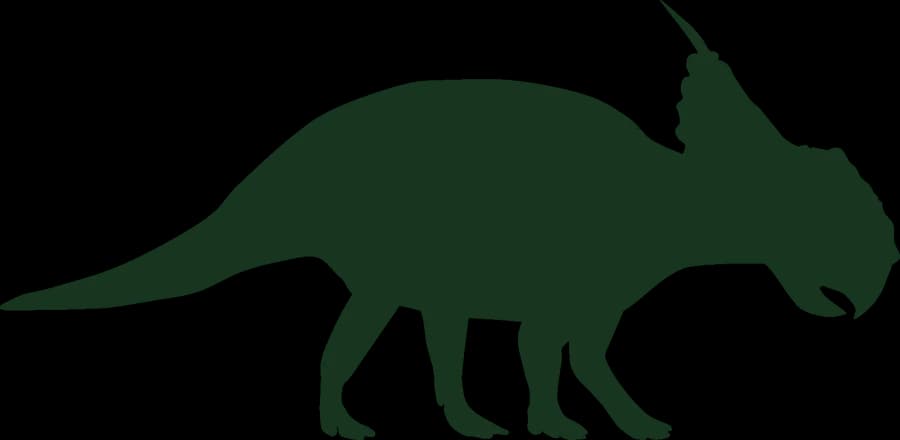
  • Pachyrhinosaurus, an outline

    Pachyrhinosaurus

    Say it: pack-ee-RINE-oh-sore-us · “thick-nosed lizard”

    Look for: No nose horn at all! A big, flat, bony bump instead.

    The bump is called a boss. This dinosaur was about as long as two cars parked nose to tail.

  • Torosaurus, an outline

    Torosaurus

    Say it: tor-oh-SORE-us · “bull lizard”

    Look for: Horns like a Triceratops, and a VERY long frill.

    It had the largest frill of any horned dinosaur.

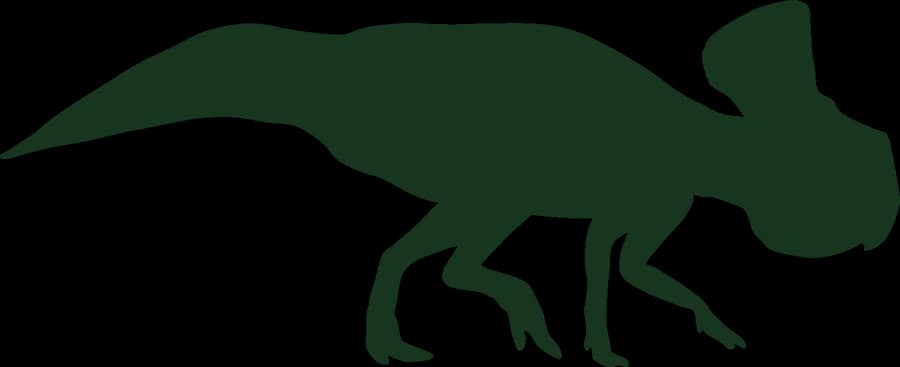
  • Protoceratops, an outline

    Protoceratops

    Say it: pro-toe-ker-ah-tops · “first horned face”

    Look for: A beak and a frill, but no horns. It was small, about as long as a tall grown-up.

    One was fossilized in the middle of a fight with a Velociraptor!

How many horns?

  1. Pachyrhinosaurusnone: a bony bump instead
  2. Styracosaurusone nose horn, and six or eight spikes on its frill
  3. Carnotaurustwo, above its eyes
  4. Triceratopsthree: its name says so
  5. Kosmoceratops15 horns and spikes on one head

A full dot is a horn. A ring is a spike on the frill. Kosmoceratops, from Utah, had ten of its 15 on the frill.

The dinosaur with a frill

What were the horns and the frill for?

To fight off a T. rex

Triceratops and T. rex lived at the same time, and they did fight. The frill might have helped to protect the neck. It didn't always work: some fossil frills have T. rex bite marks right through them.

To fight each other

Other frills have holes made by Triceratops horns. So they used their horns on each other too.

Horns, and it eats meat

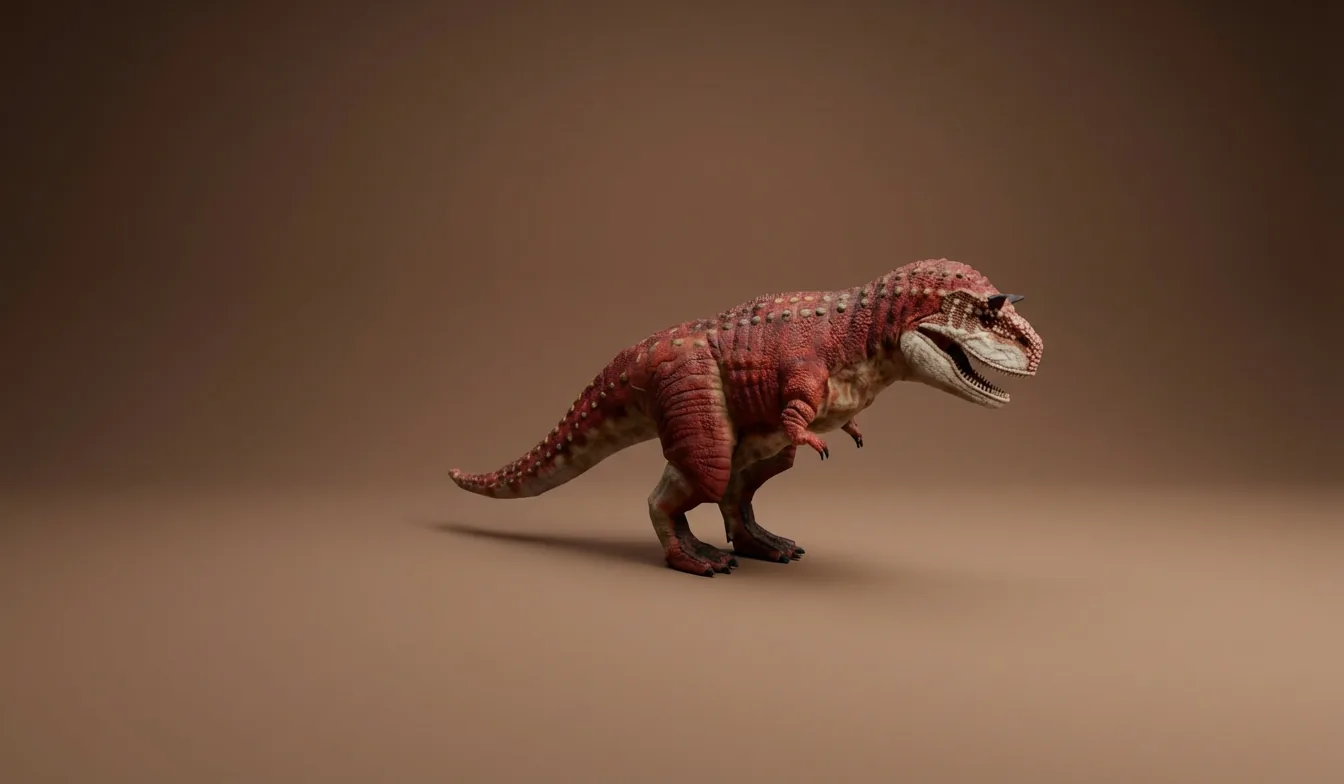
A meat-eater with horns like a bull

Almost every horned dinosaur ate plants. Not Carnotaurus (say it: kar-noh-TORE-us). Its name means “meat-eating bull”, because of the two short horns above its eyes.

Carnotaurus was a fast, meat-eating dinosaur with remarkably short arms. It was one of the fastest dinosaurs, capable of swallowing its prey in a single gulp!
Katia, in Dinosaurs Are Back

It is the only dinosaur of its family known to have two horns on its head, and nobody is quite sure what they were for. Maybe to fight rivals, maybe to attack its prey.

Turn it with your finger or mouse and find the horns. On a phone or tablet, tap “See it in your room” and it stands on your floor.

Carnotaurus facts for kids

3D Carnotaurus from Dinosaurs Are Back, ready to stand in your room in augmented reality
Drag to spin. On a phone or tablet this opens AR.

One more: Ceratosaurus, the “horned lizard”, was a meat-eater with a small horn on its snout.

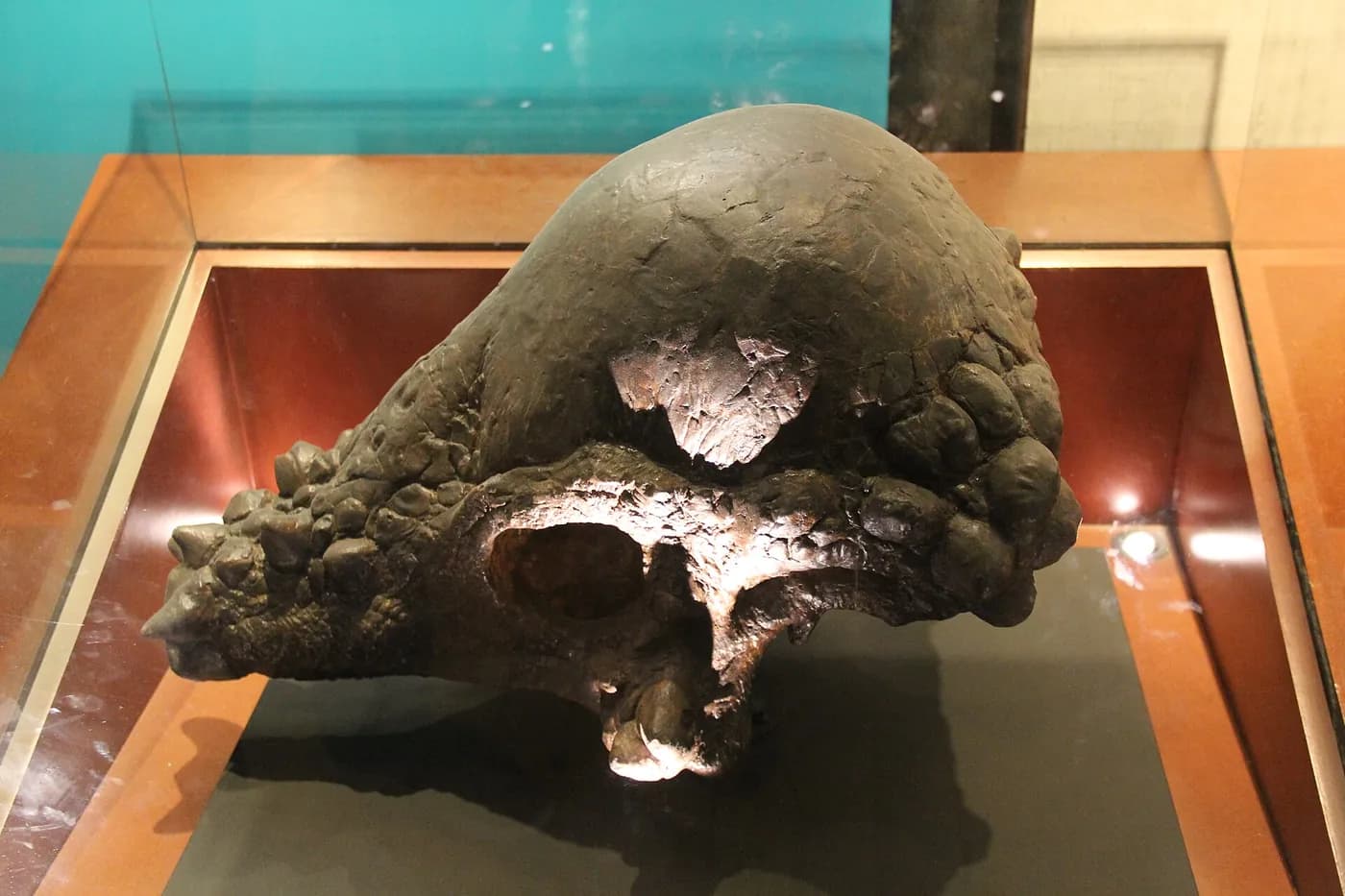
The skull of a Pachycephalosaurus in a museum case: a smooth dome of bone with bumps and short spikes around it
A real Pachycephalosaurus skull at the Natural History Museum in London. Photo: Gary Todd.

No horns, a helmet

The dinosaur with the hard head

Pachycephalosaurus (say it: pack-ee-KEF-ah-lo-SORE-us) means “thick-headed lizard”. It had a big dome of bone on top of its head, with spikes and bumps all around it. It walked on two legs and was about 3 meters (10 feet) long.

Nobody knows for sure what the dome was for. Some scientists think these dinosaurs butted heads, the way rams do with their horns. Others think it was for showing off.

The dragon king of Hogwarts

One skull got a name of its own: Dracorex hogwartsia, “dragon king of Hogwarts”. Some scientists now think it was simply a young Pachycephalosaurus.

Not a horn: a crest

The dinosaur with a crest on its head

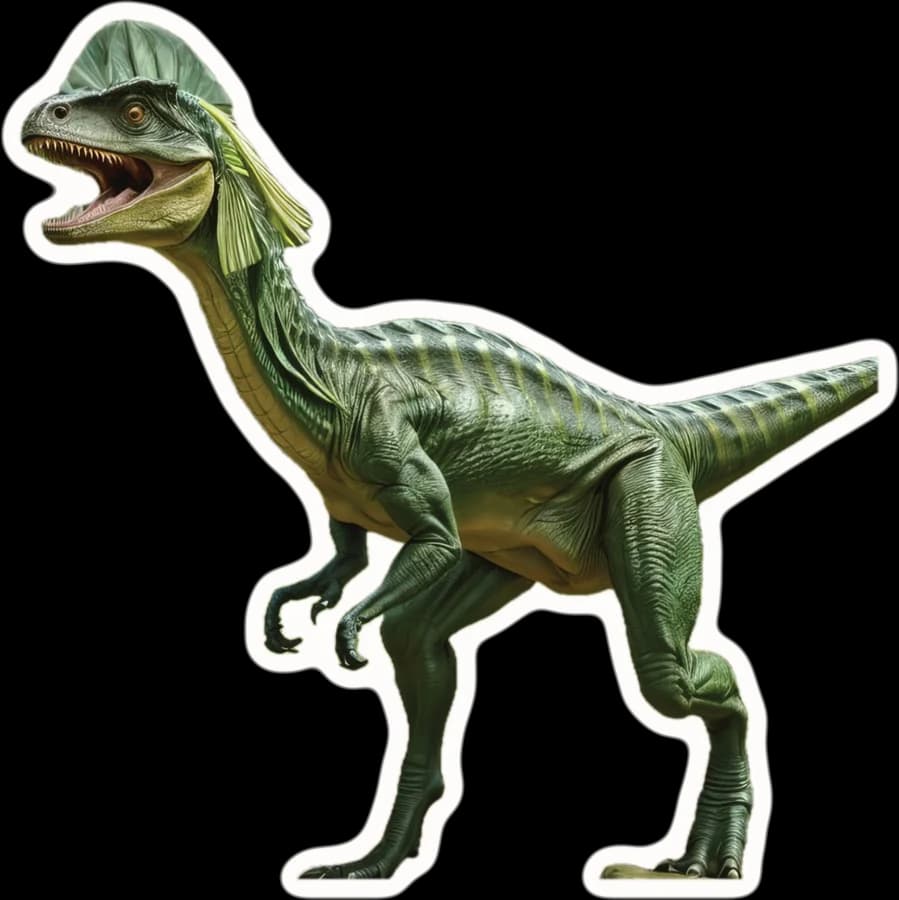
Dilophosaurus (say it: die-LOAF-oh-SORE-us) means “two-crested lizard”. Two thin crests ran along the top of its head, side by side. It was the first meat-eating dinosaur ever found with crests.

Some plant-eaters had crests too: the duck-billed dinosaurs. One had a crest like a helmet, one like a hatchet, and one had a long hollow tube.

The Dilophosaurus from Dinosaurs Are Back, a paper cut-out

Free, no sign-up

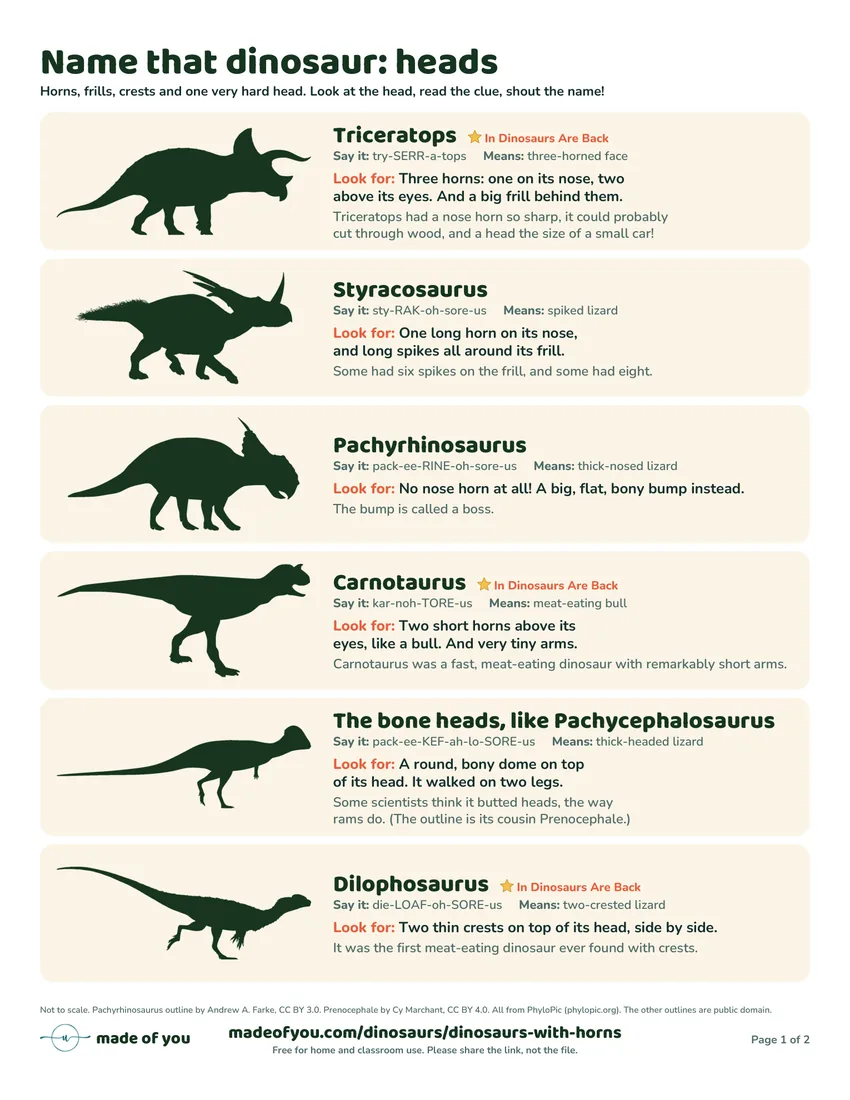
Print the “Name that dinosaur” card

Two pages. One for heads (horns, frills, crests and the hard head), one for backs and tails (plates, spikes, armor and clubs). Each dinosaur comes with a “look for” clue.

Take it to a museum, or play it at home with the toy box. There's a black and white version to color in.

ColorUS LetterA4

Black and whiteUS LetterA4

Free for home and classroom use. Please share the link to this page rather than the file.

The free printable Name that dinosaur card: six dinosaurs told apart by their horns, crests and hard heads

Riddle · who am I?

Who has three of them?

My head is as big as a small car, they say,and T. rex and I lived in the very same day.
Need another clue?
My name says it all: three horns on my face.A young one like me went on a big egg chase!
Who am I? Tap to see
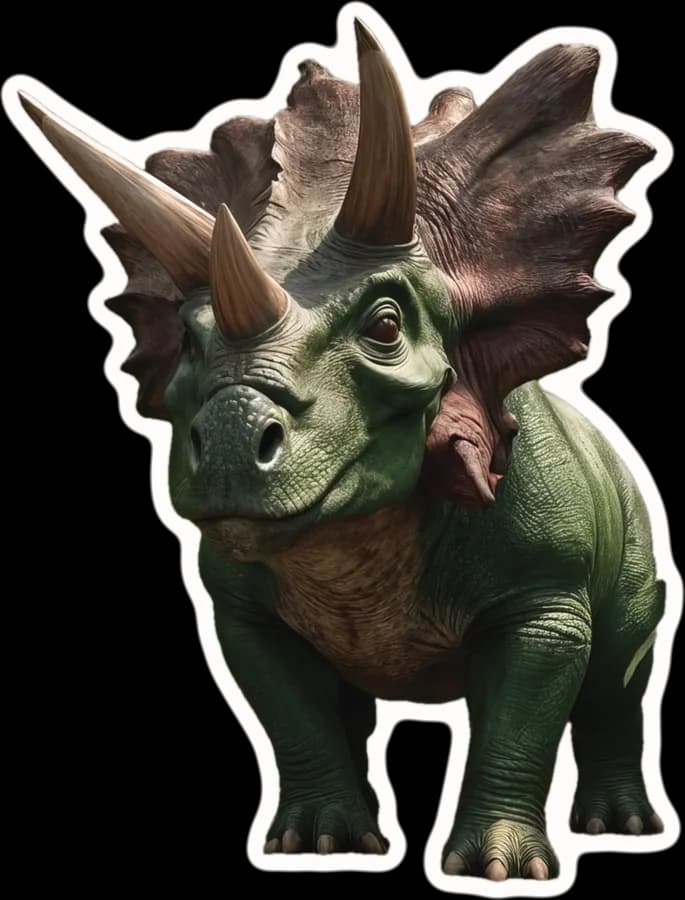
The Triceratops, a paper cut-out

Triceratops!

The true bit: “Triceratops” means “three-horned face”. (Natural History Museum, London) From our book Dinosaurs Are Back: the egg chase is Spike's story.
More like this: all the dinosaur riddles and dinosaur jokes for kids.

Questions kids ask

Quick answers

What dinosaur has three horns?
Triceratops. Its name means three-horned face: it had one horn on its nose and two above its eyes.
What is the dinosaur with horns that eats meat?
Carnotaurus, the meat-eating bull. It had two short horns above its eyes, like a bull's, and it is the only dinosaur of its family known to have two horns on its head.
What dinosaur has one horn?
Styracosaurus and Centrosaurus each had one long horn on the nose. Styracosaurus also had six or eight long spikes around its frill.
What dinosaur has 15 horns?
Kosmoceratops, a cousin of Triceratops found in Utah. It had 15 horns and spikes on its head, ten of them on its frill.
What is the dinosaur with the hard head called?
Pachycephalosaurus (say it: pack-ee-KEF-ah-lo-SORE-us), the thick-headed lizard. It had a large bony dome on top of its head, with spikes and bumps all around it.
Did Pachycephalosaurus butt heads?
Maybe. Some scientists think it used its hard dome in head-butting contests, the way rams use their horns. Others think the dome was for showing off.
What was the frill of a Triceratops for?
It might have helped to protect its neck. But some fossil frills have T. rex bite marks right through them, so it didn't always work.
What dinosaur has a crest on its head?
Dilophosaurus had two thin crests, side by side, on top of its head. Some duck-billed dinosaurs had crests too, shaped like a helmet, a hatchet or a long tube.

Keep sorting

More kinds of dinosaurs

Got a big question instead? The biggest, the fastest, the fliers and the long necks. Or meet ten dinosaurs, one page each, with a fun fact and a riddle.

Cover of Dinosaurs Are Back, an interactive 3D dinosaur book in augmented reality

Our own bookA picture book · ages 6 to 10

Dinosaurs Are Back

The hero of this story is Spike, a young Triceratops with three horns and a baby brother to find. He meets ten dinosaurs on the way, and every one of them steps off its page with a phone or tablet.

Where these facts come from

Katia's facts are from the fact page near the end of Dinosaurs Are Back. Everything else was checked on these pages on October 1, 2026.

Picture credits