Times tables · free · no sign-up
Multiplication chart
Tap any square and hear the answer.
Here is the whole chart, from 1 × 1 to 12 × 12. Tap a square: its row and its column light up, and a girl's voice says the fact. Further down you can print it, fill in a blank one, or go all the way up to 20 × 20.
| × | 1 | 2 | 3 | 4 | 5 | 6 | 7 | 8 | 9 | 10 | 11 | 12 |
|---|---|---|---|---|---|---|---|---|---|---|---|---|
| 1 | ||||||||||||
| 2 | ||||||||||||
| 3 | ||||||||||||
| 4 | ||||||||||||
| 5 | ||||||||||||
| 6 | ||||||||||||
| 7 | ||||||||||||
| 8 | ||||||||||||
| 9 | ||||||||||||
| 10 | ||||||||||||
| 11 | ||||||||||||
| 12 |
Tap a square
Its row and its column light up, and you hear the answer.
Free, no sign-up
Print the multiplication chart
Six charts, each in a US paper size and a UK one: Letter and A4, or tabloid and A3 for the poster. Black and white is listed first, because that is what most printers at home do best. The color charts are drawn on the blackboard from our book. They use a lot of ink, so keep them for the wall.
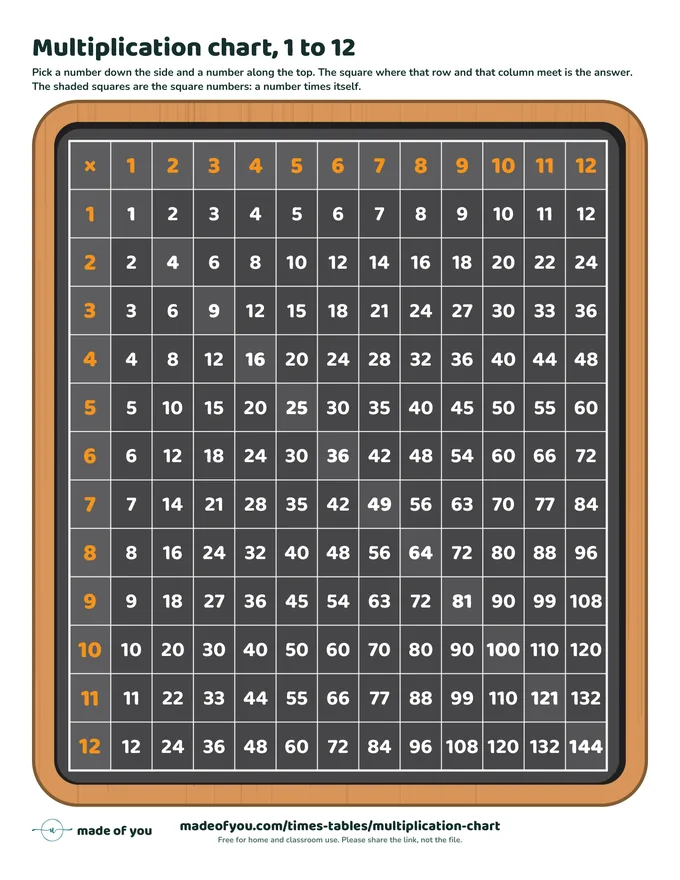
Multiplication chart, 1 to 12
The full chart, from 1 × 1 to 12 × 12. The square numbers are shaded.
1 page · PDF
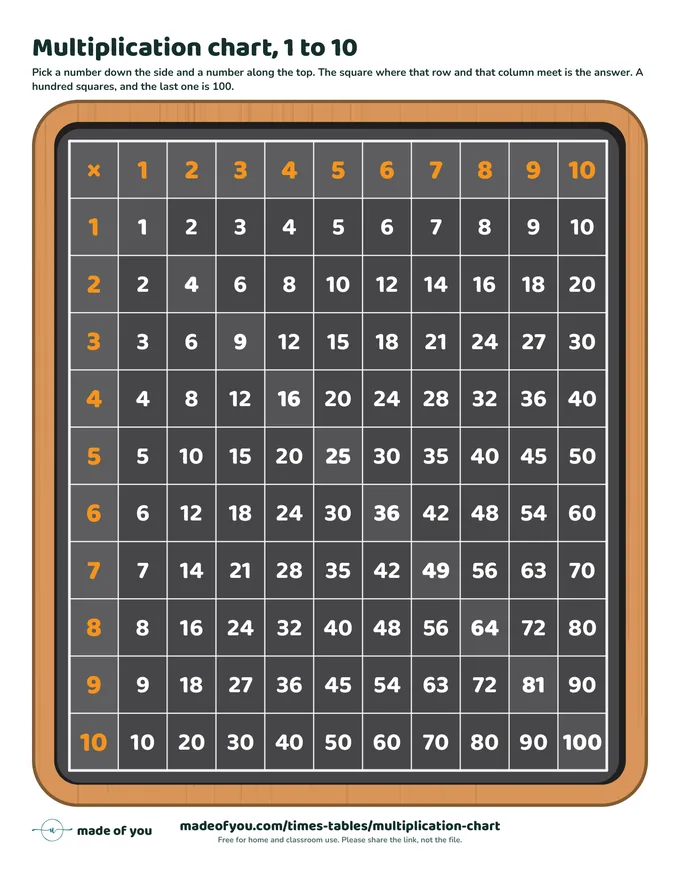
Multiplication chart, 1 to 10
A hundred squares, with answers from 1 to 100. Bigger numbers, easier to read.
1 page · PDF
The 45 facts chart
The 45 answers that are really new stand out, and the ones a child knows already are faded. The order to learn the tables in runs along the foot.
1 page · PDF
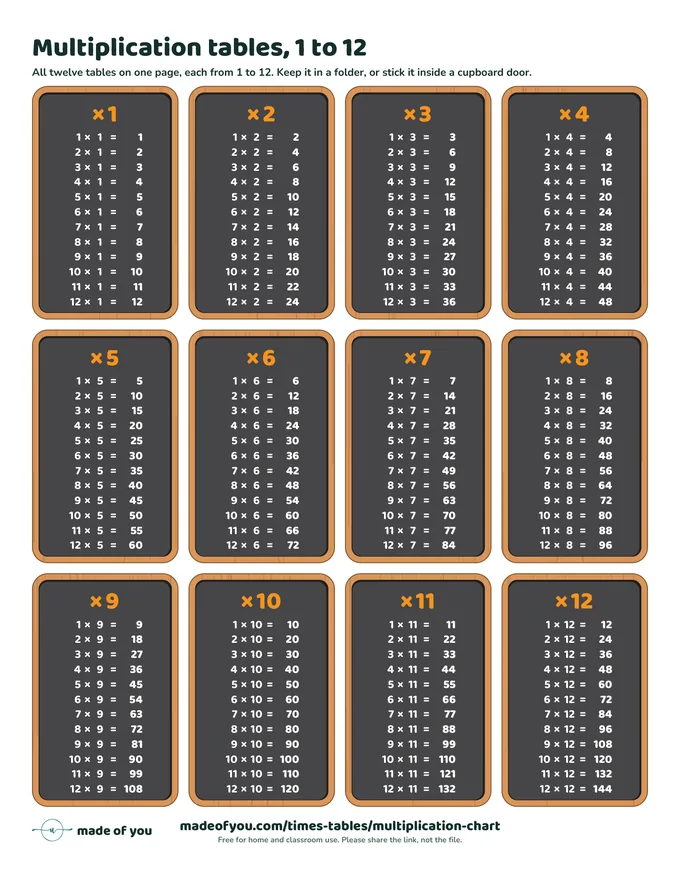
All twelve tables on one page
Twelve small tables side by side, each from 1 to 12. This is the layout many UK schools hand out.
1 page · PDF
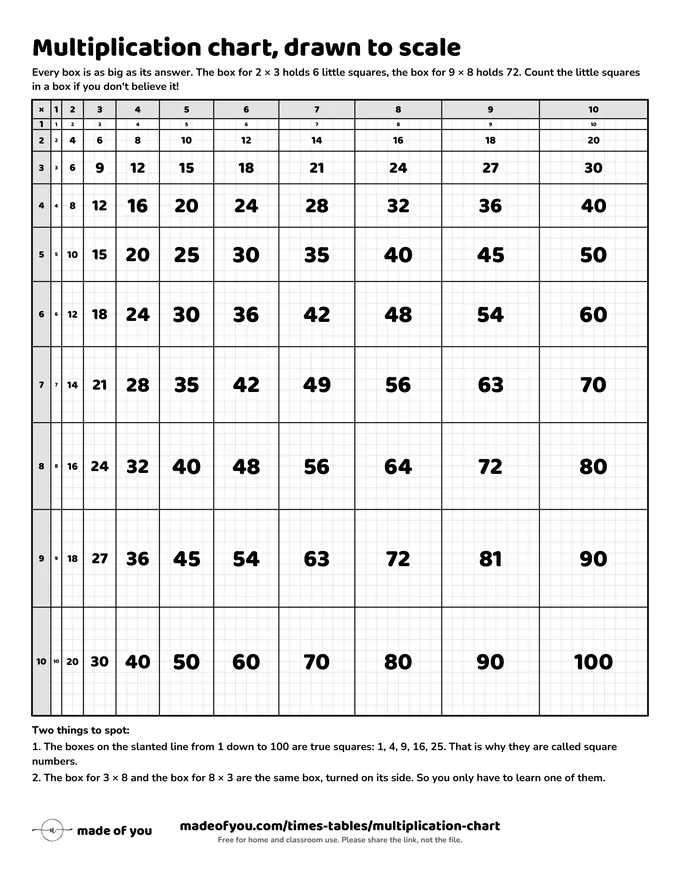
The chart, drawn to scale
Every box is as big as its answer, so 9 × 8 really is a big box of 72 little squares.
1 page · PDF
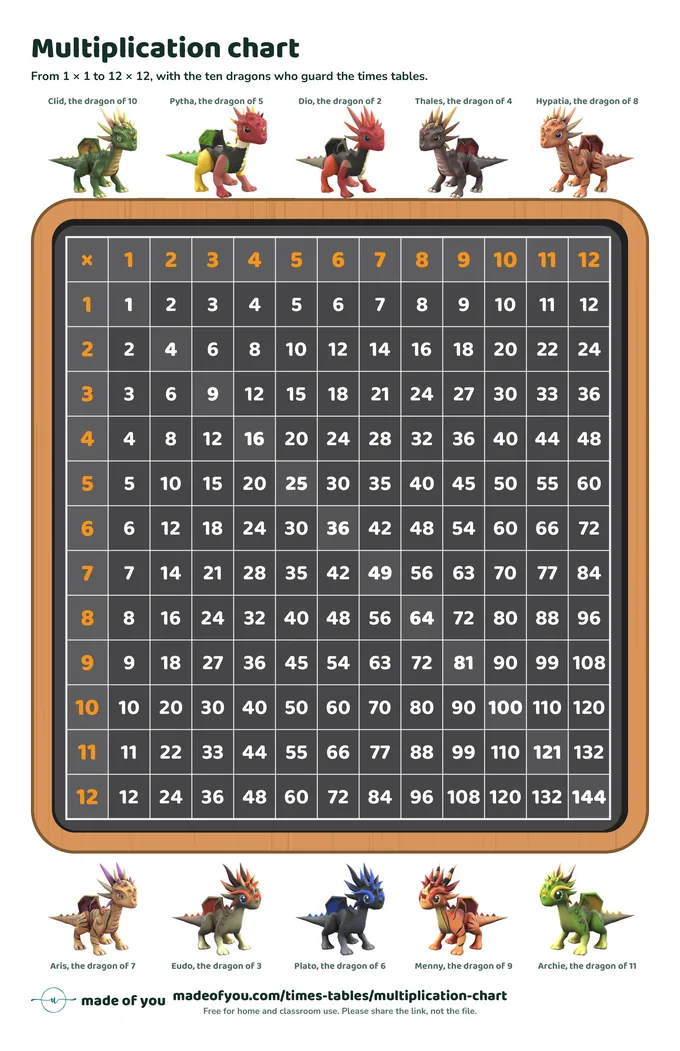
Multiplication chart poster
The 1 to 12 chart for the wall, with the ten dragons and their names around it. Print it on tabloid or A3 paper.
1 page · PDF
Free for home and classroom use. To pass them on, please share the link to this page and not the file.
To fill in
Blank multiplication chart
A blank multiplication chart has the numbers along the top and down the side, and nothing in the middle. Filling one in shows you quickly which answers a child knows by heart and which ones they have been reading off the wall.
The whole chart, against the clock
There is a line at the top for the time, so next week's try has something to beat.
One table at a time
Fill in only the row and the column of the table you are learning. The other squares stay empty until you get to them.
Page 2 of each file has every answer, for marking.
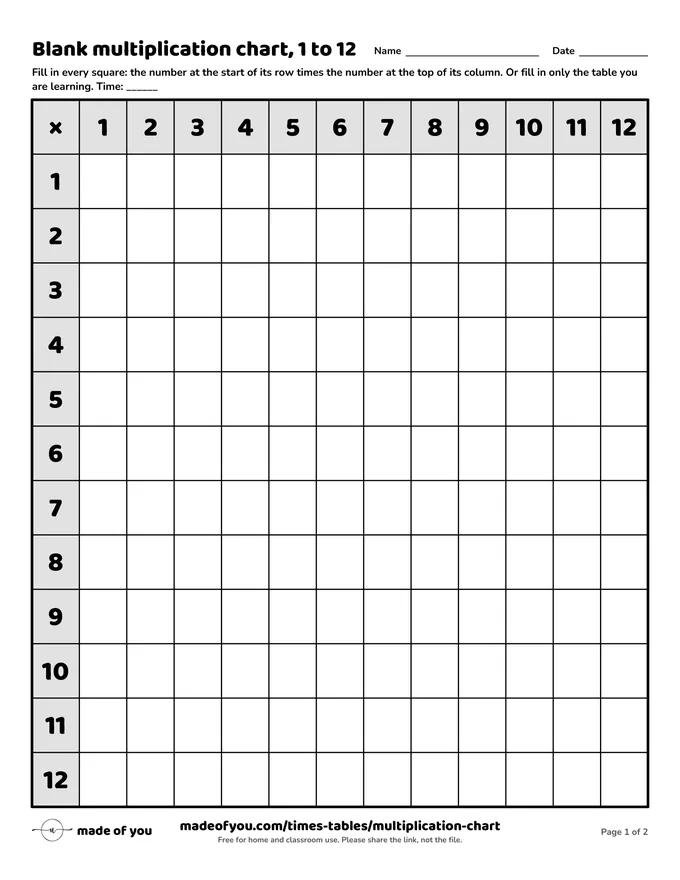
Blank multiplication chart, 1 to 12
The numbers along the top and down the side, and 144 empty squares. The answers are on page 2.
2 pages · PDF
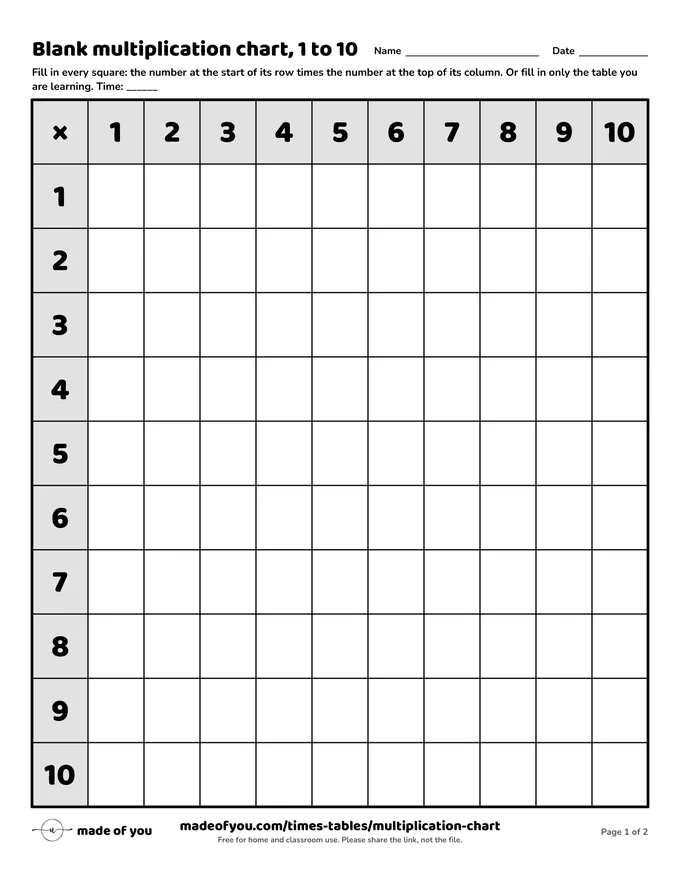
Blank multiplication chart, 1 to 10
A hundred empty squares, for a first try or a quick race. The answers are on page 2.
2 pages · PDF
Row, column, meet
How to read a multiplication chart
- 1Pick the two numbers you want to multiply. Let's say 4 and 6.
- 2Find the 4 down the left side. That is your row.
- 3Find the 6 along the top. That is your column.
- 4Slide along the row and down the column. They meet at 24, so 4 × 6 = 24.
It works the other way round too. The 6 row and the 4 column also meet at 24.
For readers in the UK
Times table grid, multiplication square: the same thing
In the UK this chart goes by other names: a times table grid, a times tables square, a multiplication grid or a multiplication square. All four are the chart at the top of this page.
England's national curriculum has Year 4 pupils “recall multiplication and division facts for multiplication tables up to 12 × 12”, so the grid to 12 is the one most UK families want. Our A4 files carry the UK names in their headings.
Source: National curriculum in England: mathematics programmes of study, GOV.UK, read on 2 October 2026.
- Times table grid, 1 to 12A4 · black and whiteA4 · color
- Times tables square, 1 to 10A4 · black and whiteA4 · color
- Blank times table grid, 1 to 12A4 · black and white
- Times tables, 1 to 12A4 · black and whiteA4 · color
- Times tables posterA3 · color
Look closer
Three things to spot on the chart
Each button takes you back up to the chart and colors it in.
The slanted line of square numbers
Run a finger from the top left corner down to the bottom right. You pass 1, 4, 9, 16 and 25, and each of them is a number times itself. They are called square numbers. In our book every one of them sits on a star.
The mirror
Fold the chart along that slanted line and every answer lands on its twin. 3 × 8 and 8 × 3 are one answer, printed twice. So nearly half of the chart is a copy of the other half.
The easy edges
The 1s are the number itself, and the 10s are the number with a 0 behind it. Up to 9 × 11, the 11s are the number written twice. That makes three rows and three columns you know before you start.
Past 12 × 12
Bigger charts: 1 to 20, and “1 to 100”
The chart to 20 is for a child who has the 12s and wants more, and for anyone who needs 17 × 6 in a hurry. It has 400 squares and still prints clearly on one page.
What a multiplication chart 1 to 100 is
Most people who ask for a multiplication chart 1 to 100 mean the 10 by 10 chart. It has 100 squares, and its answers run from 1 up to 100. That is our 1 to 10 chart.
A few people mean a chart whose tables go all the way up to 100. That one would need 10,000 squares, far too many to read on a sheet of paper, so the biggest chart we print stops at 20.
Multiplication chart, 1 to 10
A hundred squares, with answers from 1 to 100. Bigger numbers, easier to read.
1 page · PDF
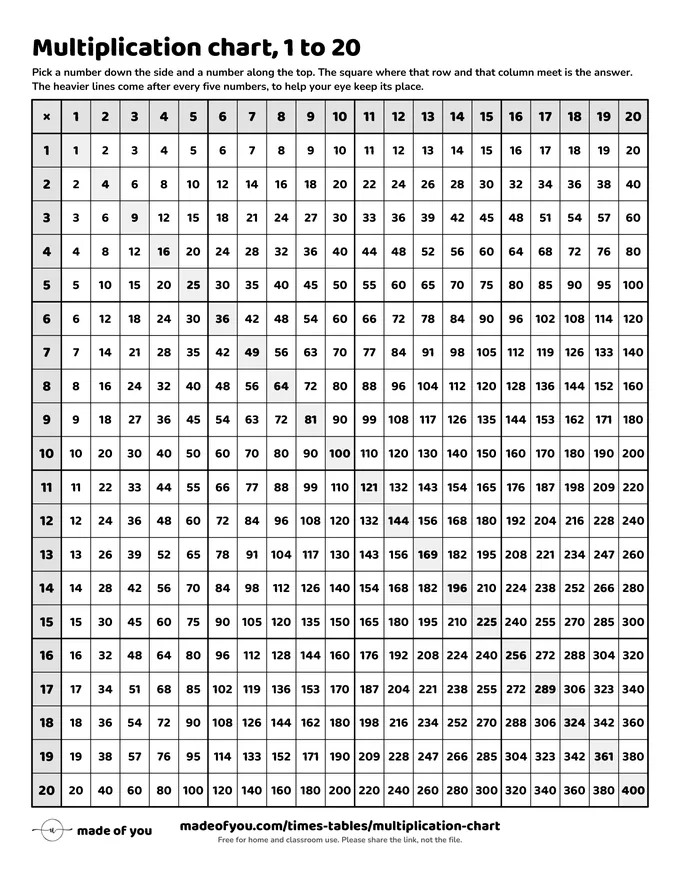
Multiplication chart, 1 to 20
Four hundred squares, up to 20 × 20 = 400. A heavier line after every five numbers helps your eye keep its place.
1 page · PDF
Less than it looks
Only 45 to learn
The chart to 10 has 100 squares, but a child who learns the tables in the right order meets only 45 new answers. Every other square is in the 1s, or is an answer they already know with its two numbers swapped.
One at a time
Each table on its own
Every table from 2 to 11 has a page of its own, with each row read aloud, one trick, and a dragon to set free. They stand here in the order we teach them.









Questions
Grown-ups ask
- What is a multiplication chart?
- A multiplication chart is a grid that holds the answer to every multiplication up to a certain number, most often 10 × 10 or 12 × 12. The numbers run along the top and down the left side. Each square inside shows the number of its row times the number of its column.
- Is a multiplication chart the same as a times table?
- Nearly. A times table is one list, such as the 8 times table from 1 × 8 to 10 × 8. A multiplication chart puts all of those lists into one grid, so every row and every column of the chart is a times table. In the UK the chart is also called a times table grid or a multiplication square.
- Does a multiplication chart go to 10 or to 12?
- You will meet both. England's national curriculum has Year 4 pupils learn the multiplication tables up to 12 × 12. In the United States the Common Core standards ask children to know all products of two one-digit numbers from memory by the end of Grade 3, which is the chart up to 9 × 9, although many classroom charts go to 12 anyway. Print the one that matches the sheets your school sends home. (Both documents read on 2 October 2026.)
- What is a blank multiplication chart for?
- For practice. The numbers along the top and down the side are printed and the squares are empty, so a child writes the answers in. Fill in the whole chart against the clock, or only the row and the column of the table you are learning. Our blank charts have the answers on page 2.
- What is a multiplication chart 1 to 100?
- Most often it is the 10 by 10 chart, which has 100 squares and answers that run from 1 up to 100. A chart whose tables went all the way up to 100 would need 10,000 squares. For bigger numbers than 12 × 12, print the chart to 20.
- Why does the chart say some squares aloud and not others?
- The voice is a girl who recorded the tables from 2 to 11, each from 1 to 10. A square outside those recordings stays silent: 1 × 1, 11 × 11, and everything in the 12s.
- Can I print the charts for a whole class?
- Yes, as many copies as you need. The charts are free for home and classroom use and there is no sign-up. If another teacher wants them, please send the link to this page and not the file.
Our own book
The 45, with a dragon for every table
For grown-ups · it comes out in November 2026
Our times tables book teaches the tables in the order that leaves only 45 answers to learn. Each table gets its blackboard, its tricks and its dragon, and the book opens the second half of the cube game on this site.
More times tables
 Times tables with dragonsTen tables, ten dragons, one free cube game.
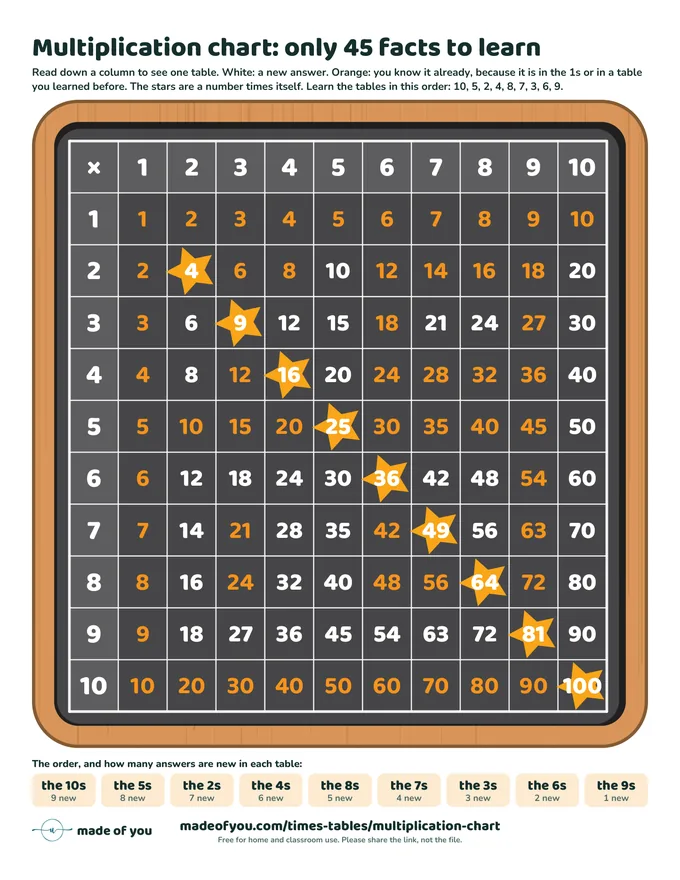 How to learn the times tablesOnly 45 facts, and the order to learn them in
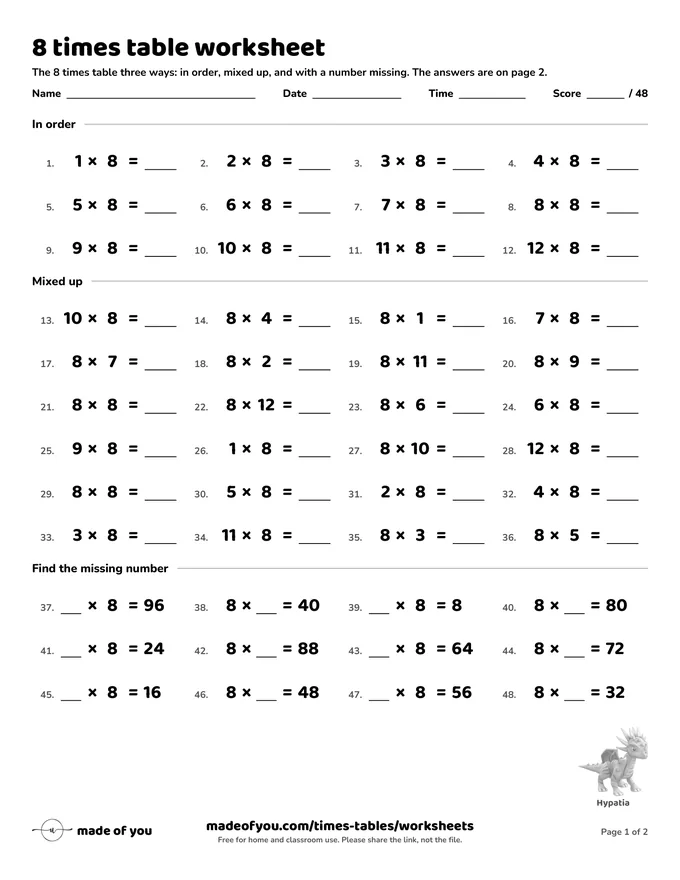 Times tables worksheetsMake a fresh sheet, or print a ready one
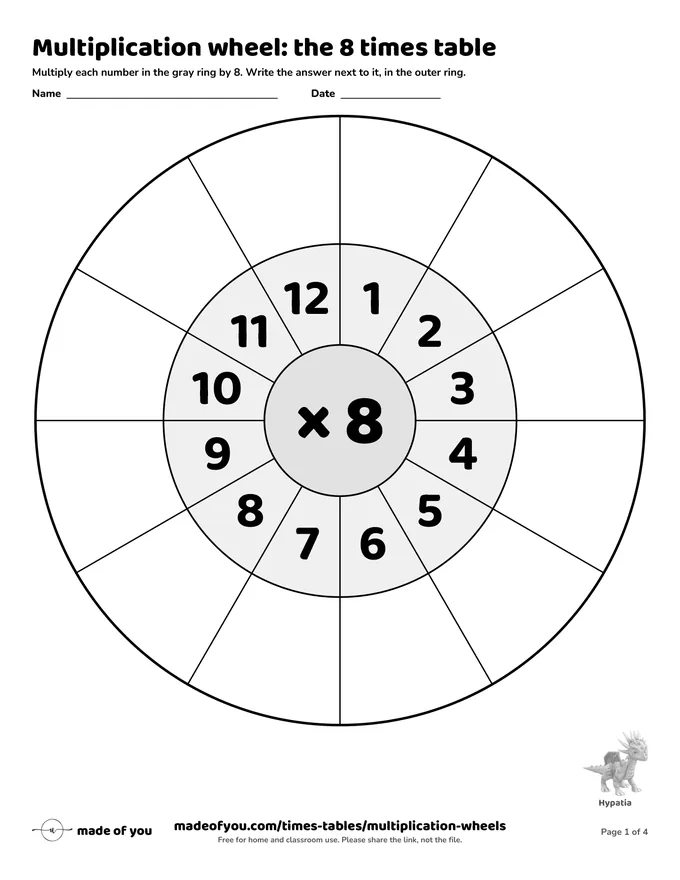 Multiplication wheelsFill one in on the page, or print the twelve
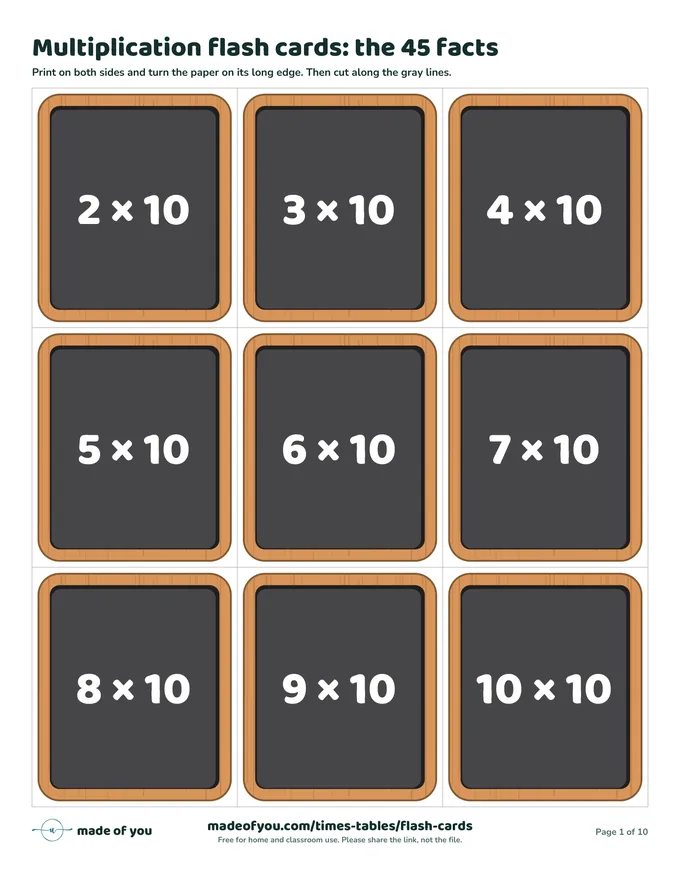 Multiplication flash cardsCards that remember the hard ones, and decks to print
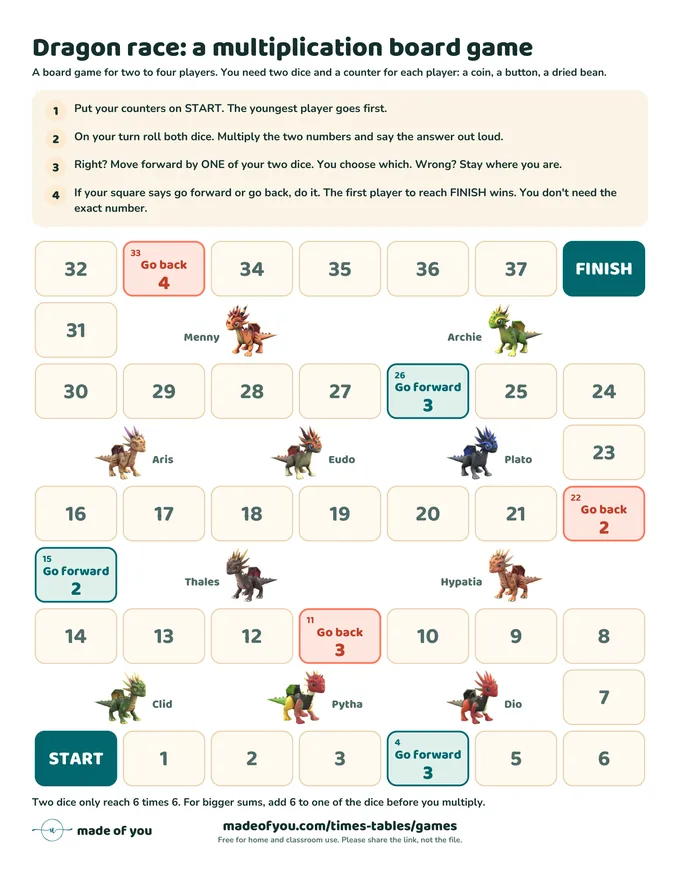 Multiplication gamesBingo, a board game, cards, dice and ten dragons
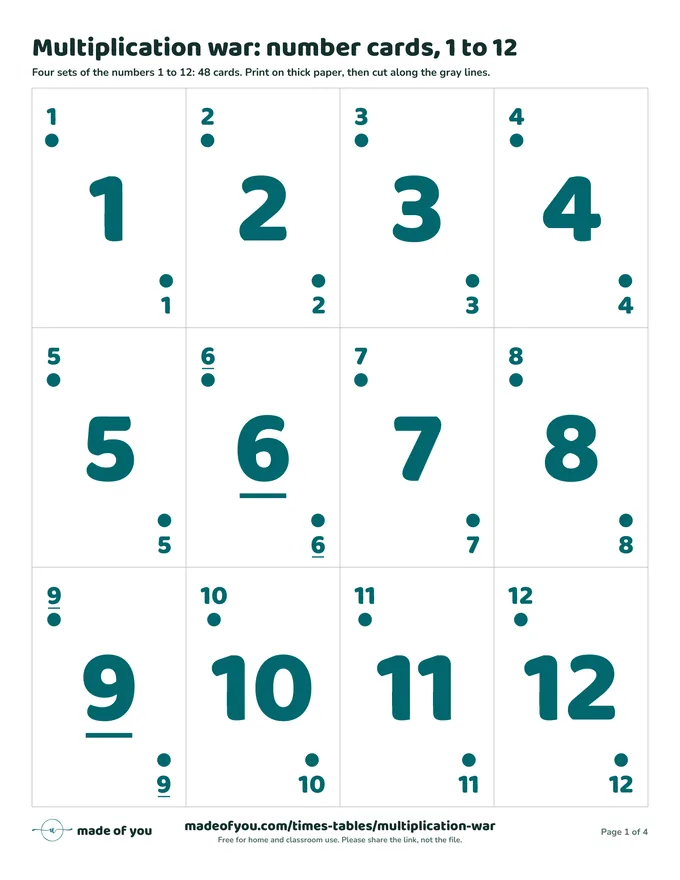 Multiplication warThe card game in six steps, with cards to print
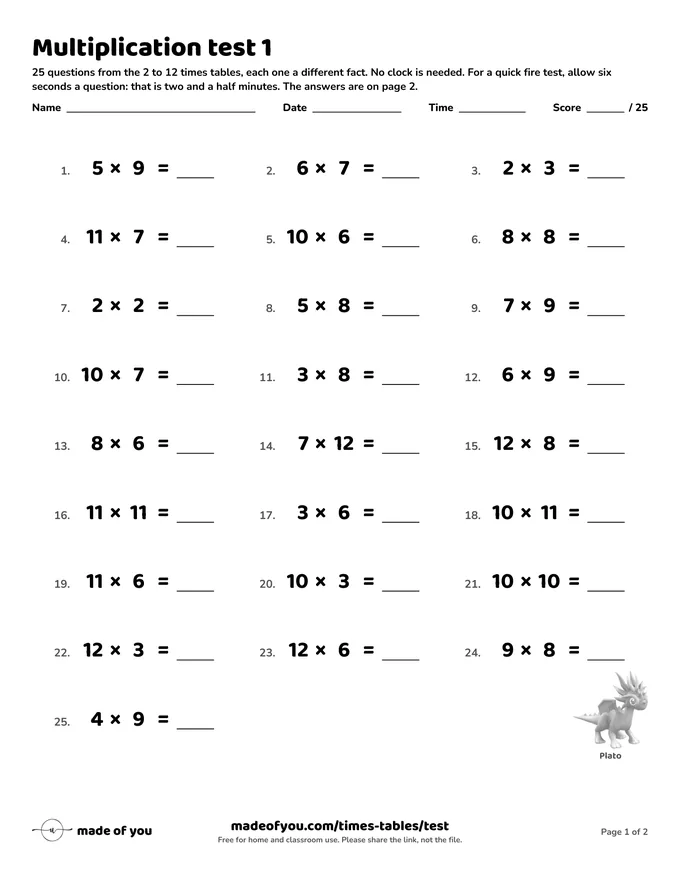 Times tables testTake your time or quick fire, then a chart of your own
 Multiplication tables checkA practice for the Year 4 check in England
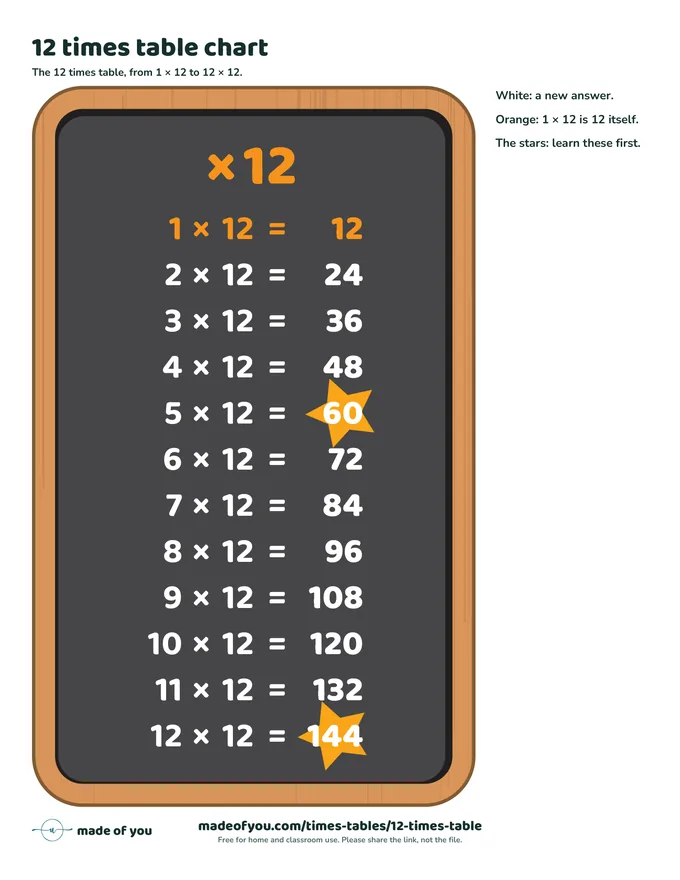 The 12 times tableTwelve rows, a tip, and sheets to print