Times tables · Year 4 · free · no sign-up
Multiplication tables check practice
25 questions, six seconds each, on a number pad: the shape of the Year 4 check.
This is our own practice in the same shape as the check. It is not the official check, which your child takes at school.
- 25 questionsfrom the 2 to 12 times tables, after 3 practice ones that do not count.
- Six seconds eachthen a three second pause, and the next one comes by itself.
- Type and press Enteror just wait. When the six seconds are over, what you typed is taken.
No account. The answers stay in this browser and are never sent to us.
In the government's own words
What is the multiplication tables check?
GOV.UK shortens it to MTC. Everything in quote marks below is copied word for word from GOV.UK. We read those pages on 2 October 2026 and we have added nothing from anywhere else. Where the pages say nothing, we say that they say nothing.
Who takes it
“The multiplication tables check (MTC) is statutory for all year 4 pupils registered at state-funded maintained schools, special schools or academies, including free schools, in England.”
In short, that is children in Year 4 at state schools in England. And the reason, from the leaflet for parents:
“The purpose of the check is to determine whether your child can fluently recall their times tables up to 12, which is essential for future success in mathematics.”
When it is
“Schools must administer the multiplication tables check within the 2-week period from Monday 7 June 2027.”
That is a window of two weeks, not one day. One thing to know: the government is looking again at its assessments. Its page for the check says future assessment arrangements are under review in line with the relevant recommendations
(GOV.UK), and then: Assessment arrangements for the academic year 2026 to 2027 will remain unchanged.
(GOV.UK) So for June 2027 nothing changes. The year after is on the list too, though the review could still change it: Schools must administer the multiplication tables check within the 2-week period from Monday 5 June 2028.
(GOV.UK)
What a child is asked
“It is an onscreen check consisting of 25 times table questions. Your child will be able to answer 3 practice questions before taking the actual check. They will then have 6 seconds to answer each question. On average, the check should take no longer than 5 minutes to complete.”
The guidance for schools has an example of what a teacher could say before the check. Three of its lines: There will be a 3-second pause between each question.
(GOV.UK) The system will automatically accept your answer after 6 seconds.
(GOV.UK) You don’t need to select the ‘Enter’ button if you don’t want to, but you can bring up the next question sooner by selecting ‘Enter’.
(GOV.UK)
And there is no going back: You won’t be able to correct your answer after the 6 seconds have finished, or after you select ‘Enter’.
(GOV.UK)
How the answers are typed
“Pupils can input their answers using a keyboard, touchscreen or mouse.”
The same guidance lists the devices a school may use: a PC, a Mac, a laptop or a tablet. On which is best it says this: Research suggests that, in this type of timed assessment, year 4 pupils may find a small benefit from using a keyboard or touchscreen rather than a mouse.
(GOV.UK)
What happens with the result
“Your child’s teacher will share your child’s score with you. There is no pass mark for the check.”
Your child does not see a score on the day: Pupils will not have access to their individual results when they complete the check.
(GOV.UK) What it is for: Schools will have access to all their pupils’ results, to allow them to identify pupils who need additional support.
(GOV.UK) And on publishing, the guidance for schools says: DfE will not publish school-level results for the MTC, but there will be a statistical publication at national and local authority level.
(GOV.UK)
Which tables come up most
The leaflet for parents does not say, so neither do we. It says the check is about "times tables up to 12" and stops there.
How the questions are chosen is set out in a separate document, the assessment framework. GOV.UK describes it like this: This assessment framework specifies the purpose, format, content and cognitive demand of the MTC.
(GOV.UK) It also says who it is for: The framework is primarily for those who write assessment materials
(GOV.UK). We quote only what we have read in full, and of the framework we read the page it sits on, not the document itself.
Where this comes from
Every line in quote marks is from one of these GOV.UK pages, word for word. We read them on 2 October 2026.
- Multiplication tables check: information for parents (Standards and Testing Agency, updated 15 September 2025). The leaflet schools give to parents.
- Multiplication tables check (Standards and Testing Agency, updated 1 September 2026). The government's front page for the check.
- Primary assessments: future dates (Standards and Testing Agency and Department for Education, updated 1 September 2026). The dates schools must keep free.
- Multiplication tables check: administration guidance (Standards and Testing Agency, updated 27 April 2026). The instructions for schools, written for the June 2026 check.
- Multiplication tables check assessment framework (Standards and Testing Agency, updated 21 March 2022). The page of the framework for the people who write the questions. Only this page was read, not the PDF on it.
The guidance for schools was written for the June 2026 check. GOV.UK brings it up to date each spring, so we will read these pages again in January and in May 2027.
Side by side
How our practice compares with the real check
We built the practice at the top of this page from the government's own description, so the shape is the same. It is still ours, and a few things are different on purpose.
The same
- Three practice questions that do not count, then 25 questions.
- Six seconds for each question, and a three second pause before the next.
- A number pad on the screen. A keyboard works too.
- Enter brings the next question sooner. If the six seconds run out first, whatever is in the box is taken as the answer.
- An answer cannot be changed once it is in.
Different
- Ours shows the score at once, and a chart of which facts were right, slow or wrong. In the real check a child does not see a score on the day.
- Ours can be stopped, and done again as often as you like. Each go is a new set of questions.
- Ours asks 25 different facts, picked by chance from 2 × 2 up to 12 × 12. We do not know how the real questions are picked, because the pages we read do not say.
- No password and no PIN. Nothing is sent to a school, to the government or to us: the answers stay in your browser.
Our own plan · ten minutes a day
Ten weeks to the check
First, the government's own leaflet says you don't have to do any of this:
“No, you do not need to do anything additional to prepare your child for the check. As part of usual practice, teachers may ask you to practise times tables with your child.”
So this is a plan for LEARNING the tables, which is worth doing for its own sake. It is the order our book teaches them in, stretched over ten weeks. It is our plan and no study is behind it. Count back ten weeks from Monday 7 June 2027 and you land on Monday 29 March.
Week 1
The 10s, the 5s and the 2s
You can SEE these three working: zeros, fives and doubles.
Week 2
The 4s and the 8s
Doubles. The 4s are the 2s doubled, and the 8s are the 4s doubled.
Week 3
The 7s and the 3s
By now most of both tables has turned up in the earlier ones. Four answers of the 7s are new, and three of the 3s.
Week 4
The 6s, the 9s and the 11s
The 6s are the 3s doubled. The 9s arrive with ONE new answer, 9 × 9.
Week 5
The 12s
The check goes up to 12. Our dragons stop at 11, so the 12s have a plain page of their own.
Week 6
The first practice check
Do the practice at the top of this page once, and look at My chart together. Print a second tracker.
Weeks 6 to 9
The same four groups again
One group a week, as in weeks 1 to 4. This time only the red and orange squares of that group, and one practice check a week.
Week 10
Nothing new
Three practice checks in the week, on the same kind of device school will use. Then leave it alone.
After the practice
My chart: what to do with the red squares
When the 25 questions are done you see a score and, under it, a chart of your own. Green means right and inside three seconds. Orange means right but slower. Red means wrong, or out of time. The chart is kept in your browser and grows each time you practise.
The red squares are the useful part. Three ways to work on them:
As flash cards
The cards remember which answers were hard, and deal those first.
On paper
A sheet of 20 questions made from your own red squares, with the answers on a second page.
Without the clock
Six seconds is not for everyone, and not for every day. The same test runs with no clock at all, on the tables you choose.
My chart also shows on the multiplication chart page, where you can tap any square to hear it. Safari forgets the chart after seven days without a visit.
Questions
Grown-ups ask
- Is there a pass mark for the multiplication tables check?
- No. The government's leaflet for parents says:
There is no pass mark for the check.
(GOV.UK) Its guidance for schools says the same in more words:There is no expected pass mark for pupils taking the MTC, but higher scores indicate greater proficiency in fluently recalling multiplication tables.
(GOV.UK) - When is the multiplication tables check in 2027?
- In June. GOV.UK's page of future dates says:
Schools must administer the multiplication tables check within the 2-week period from Monday 7 June 2027.
(GOV.UK) The government's page for the check says that future arrangements are under review, and adds:Assessment arrangements for the academic year 2026 to 2027 will remain unchanged.
(GOV.UK) - How many questions are in the check, and how long does a child get?
- 25 questions, with 6 seconds for each. In the words of the leaflet for parents:
It is an onscreen check consisting of 25 times table questions. Your child will be able to answer 3 practice questions before taking the actual check. They will then have 6 seconds to answer each question. On average, the check should take no longer than 5 minutes to complete.
(GOV.UK) - What if my child is slow at typing?
- The guidance for schools says:
Pupils can input their answers using a keyboard, touchscreen or mouse.
(GOV.UK) andResearch suggests that, in this type of timed assessment, year 4 pupils may find a small benefit from using a keyboard or touchscreen rather than a mouse.
(GOV.UK) It leaves the choice to the school:Schools should decide which devices and input methods are best suited to their pupils. This decision should be based on normal classroom practice.
(GOV.UK) For a child who really cannot type fast enough there is an access arrangement:An input assistant is a person who enters answers dictated by the pupil.
(GOV.UK) One of the cases it lists is a pupil who isable to input, but only very slowly
(GOV.UK). Extra time is not possible:pupils cannot be given additional time to complete the MTC questions, as this would remove the fluent recall element of the check
(GOV.UK). The leaflet's advice to parents is:If you have any concerns about your child accessing the check, you should discuss this with your child’s school.
(GOV.UK) - Can we practise on a tablet?
- Yes. The practice on this page runs in the browser of a phone or tablet, or of a laptop. For the check itself, the guidance for schools lists a PC, a Mac, a laptop or a tablet, and says:
Schools should decide which devices and input methods are best suited to their pupils. This decision should be based on normal classroom practice.
(GOV.UK) So it is worth asking the teacher what your child will use, and practising on the same kind of thing. That last sentence is our advice, not the government's. - Will I be told my child's score?
- Yes, by the teacher. The leaflet says:
Your child’s teacher will share your child’s score with you.
(GOV.UK) Your child does not see it on the day:Pupils will not have access to their individual results when they complete the check.
(GOV.UK) Schools get the results later in the month:Schools must administer the MTC during a scheduled 2-week period in June and can access their pupils’ results later on in June.
(GOV.UK) - Do we need to prepare for the check at home?
- The government says no. From the leaflet for parents:
No, you do not need to do anything additional to prepare your child for the check. As part of usual practice, teachers may ask you to practise times tables with your child.
(GOV.UK) We agree with the second sentence. The reason to practise is that the times tables are worth knowing, and the check is one day in June. - Which times tables come up most in the check?
- The leaflet for parents does not say, so neither do we. It says only that the check is about "times tables up to 12". How the questions are chosen is set out in a separate document, the assessment framework, which GOV.UK says
The framework is primarily for those who write assessment materials
(GOV.UK). Our practice draws its 25 questions by chance from every fact between 2 × 2 and 12 × 12. - Is this the official multiplication tables check?
- No. The official check is taken at school, on the government's own system, with a password and a PIN from the teacher. This page is our own practice in the same shape: three practice questions, then 25 questions with six seconds each. Nothing your child does here is sent to a school, to the government or to us.
Our own book
The book behind the practice
For grown-ups · it comes out in November 2026
Our times tables book takes the tables from 2 to 11 one at a time. Each has its own blackboard, with the answers you already know in orange, a star on the two answers to learn first, and the book's tricks for the hard ones. It is the slow, friendly part that comes before any clock.
The check goes up to 12 and the book stops at 11, so the 12s have a plain page of their own here.
More times tables
 Times tables with dragonsTen tables, ten dragons, one free cube game.
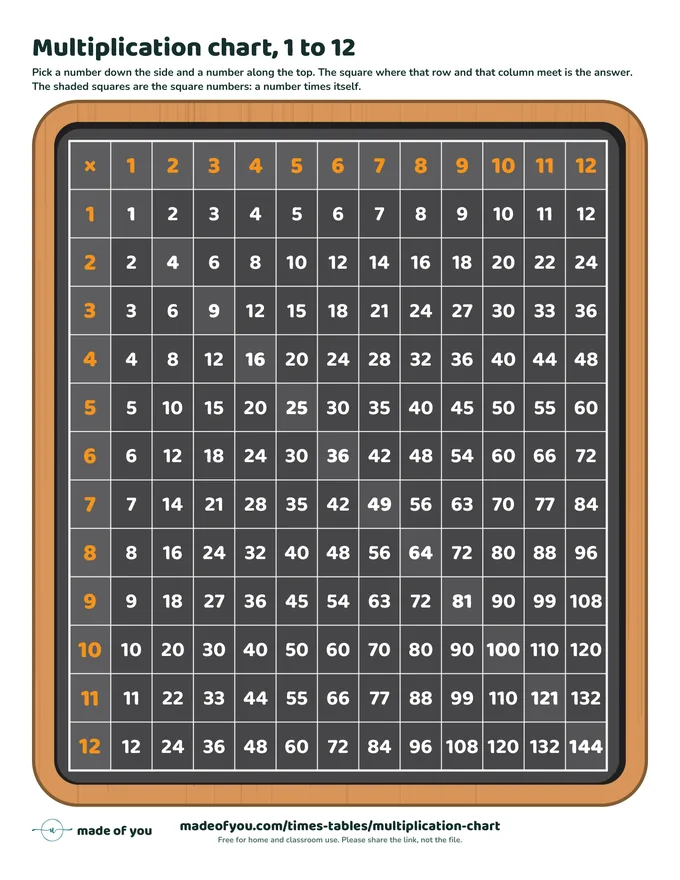 Multiplication chartTap a square to hear it, or print it
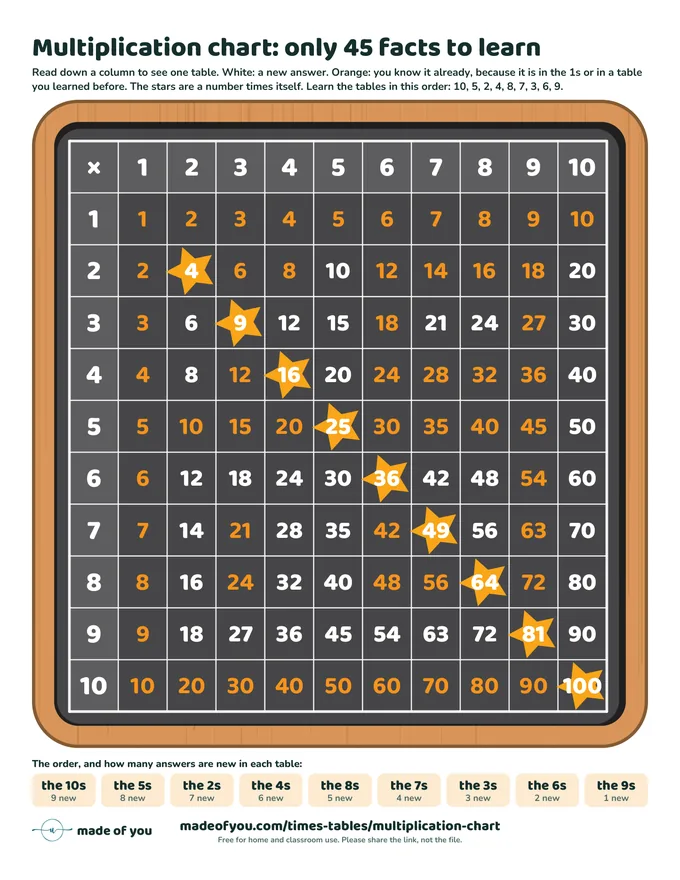 How to learn the times tablesOnly 45 facts, and the order to learn them in
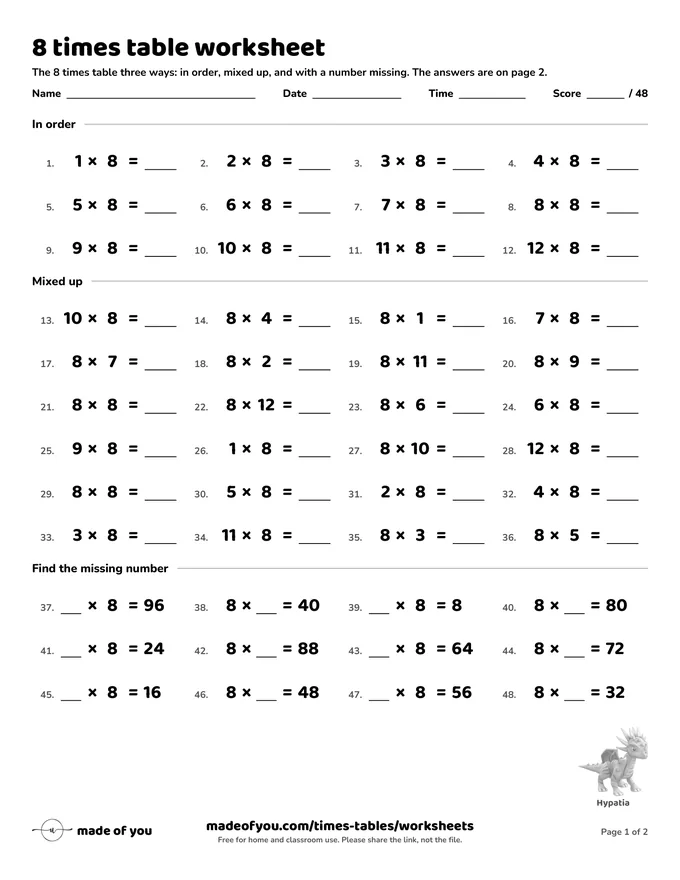 Times tables worksheetsMake a fresh sheet, or print a ready one
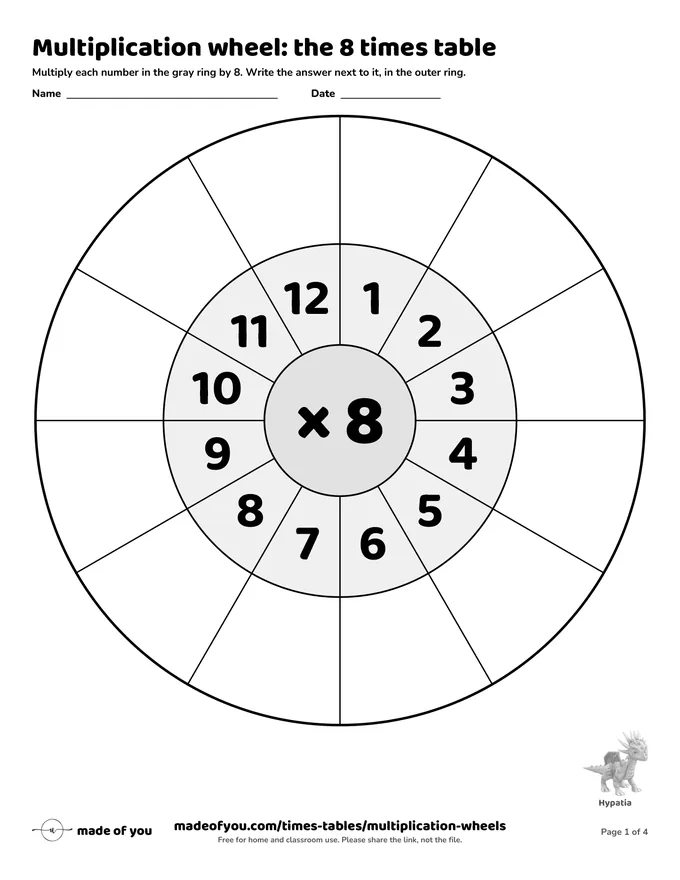 Multiplication wheelsFill one in on the page, or print the twelve
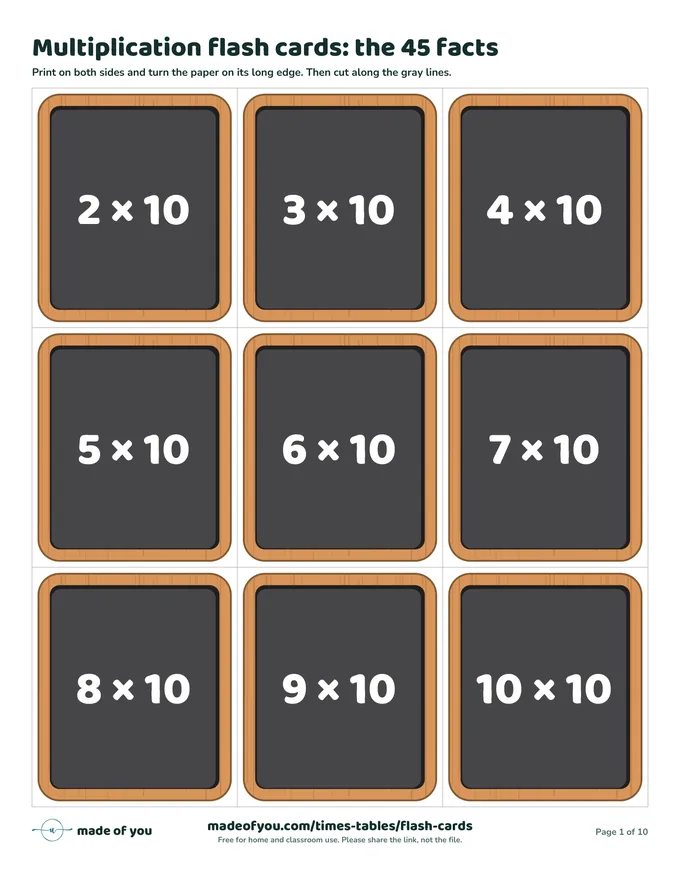 Multiplication flash cardsCards that remember the hard ones, and decks to print
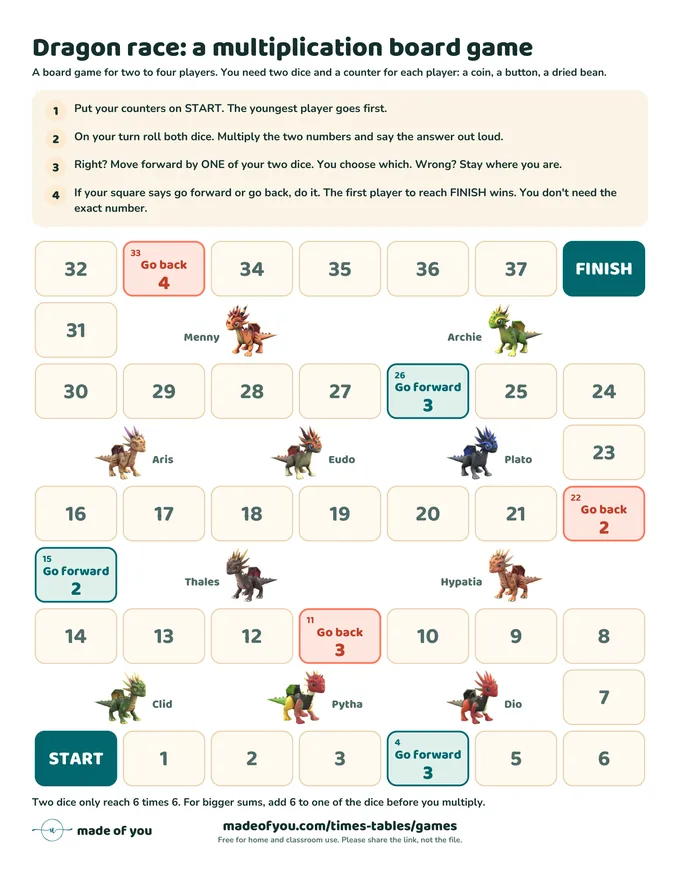 Multiplication gamesBingo, a board game, cards, dice and ten dragons
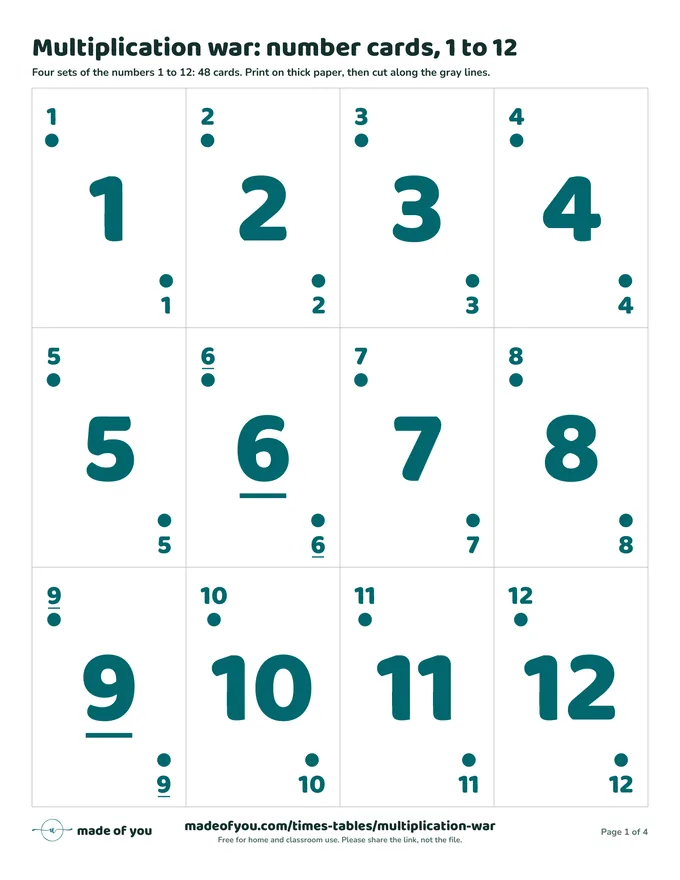 Multiplication warThe card game in six steps, with cards to print
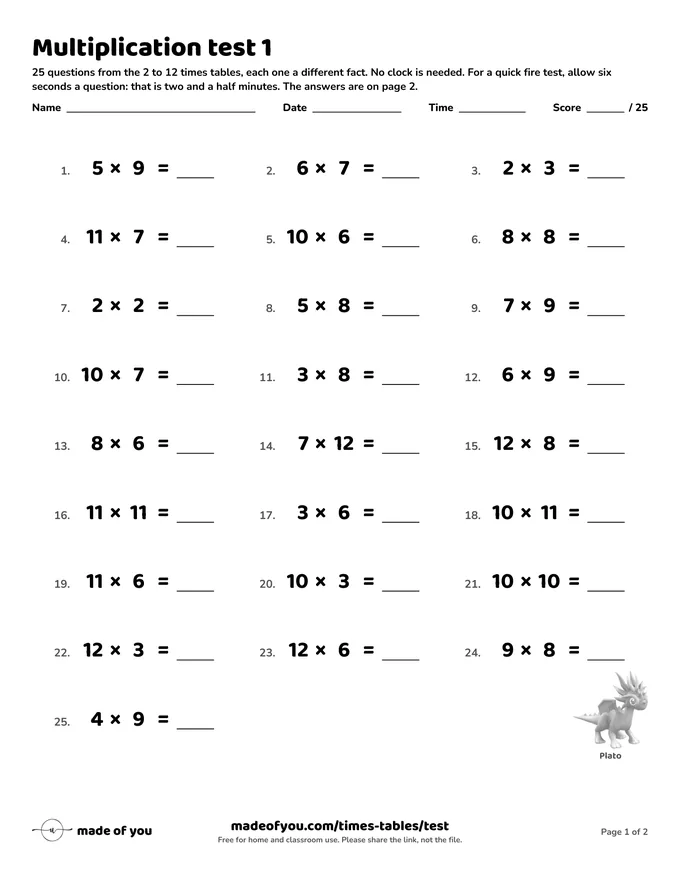 Times tables testTake your time or quick fire, then a chart of your own
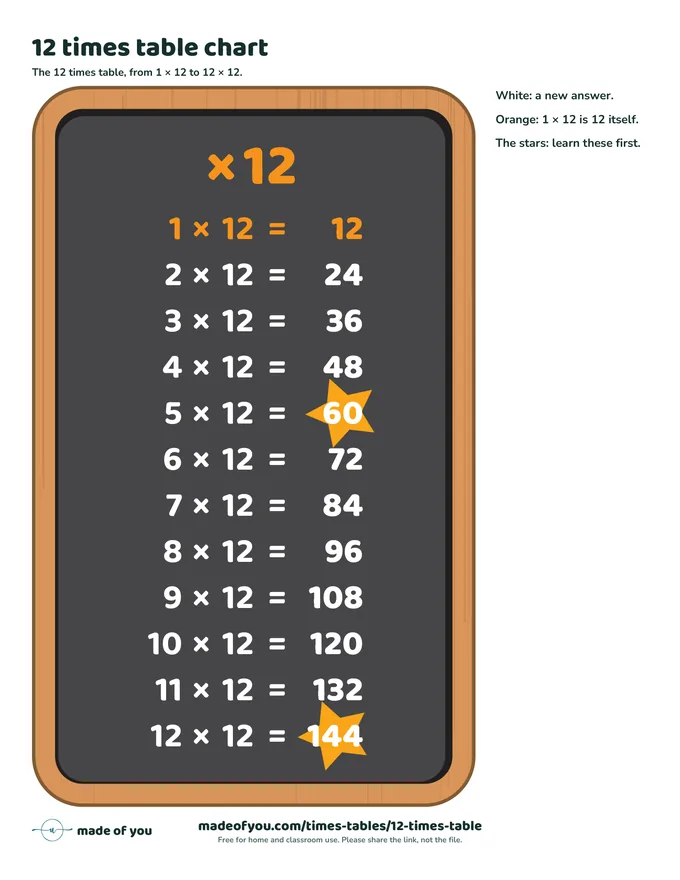 The 12 times tableTwelve rows, a tip, and sheets to print