Times tables · a card game · free
Multiplication war
A deck of cards, two players, and the bigger answer takes all four.
Multiplication war is the old card game War with one change. You turn over two cards, multiply them, and the bigger answer wins. Nobody owns this game and families play it a little differently from house to house. These are the rules as we play them.
You need
An ordinary deck of 52 playing cards and two players. There is no need to buy a special boxed game: an ordinary deck does the same job, and so do the free number cards further down this page.
For two players
How to play multiplication war, in six steps
1
Get the deck ready
Take out the jokers and the four Kings. That leaves 48 cards. An Ace counts as 1, a Jack as 11 and a Queen as 12.
2
Deal
Shuffle, then deal all the cards face down into two piles of 24. Nobody looks.
3
Turn two cards
Both players turn over the top two cards of their own pile and lay them side by side.
4
Multiply
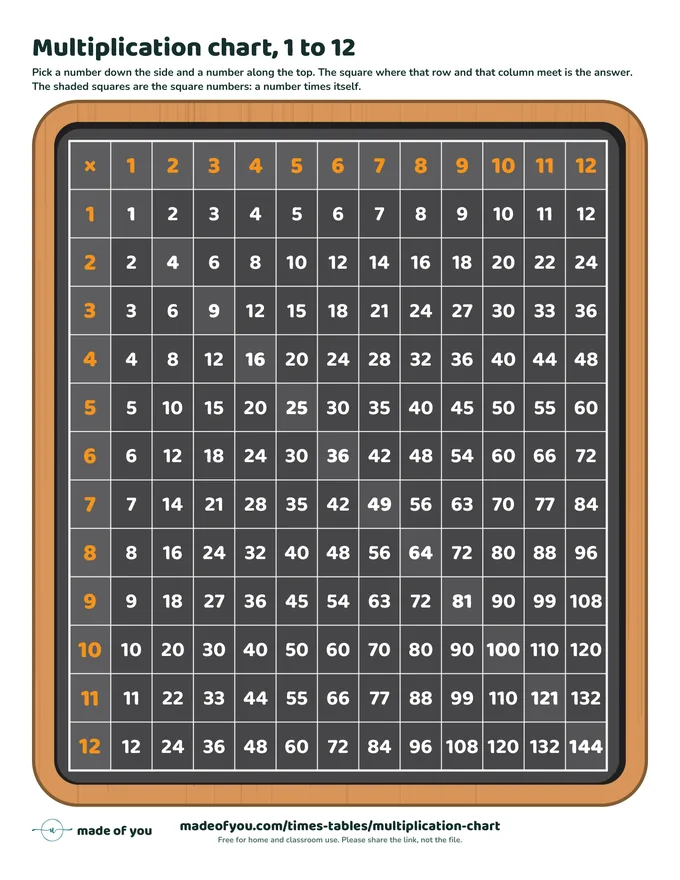
Each player multiplies their own two cards and says it out loud: "7 times 8 is 56." The other player checks. A multiplication chart on the table settles any argument.
5
The bigger answer wins
Whoever has the bigger answer takes all four cards and puts them on a winnings pile. If your answer was wrong and the other player caught it, the cards are theirs.
6
Count the cards
When the piles are gone, count your winnings. More cards wins. That is twelve turns, or fewer if there was a war.
The same answer? That is a WAR.
Leave the four cards on the table. Both players turn over two more and multiply again, and the bigger answer takes all eight. If there are no cards left to turn, each player keeps their own two.
It happens more often than you would think: 3 × 8 and 4 × 6 both make 24.
Settle it before you deal
What the picture cards count as
This is the part families argue about, because there are three or four ways to do it. We play it ONE way: an Ace is 1, a Jack is 11, a Queen is 12, and the Kings sit the game out.
With the Kings gone, the deck is the numbers 1 to 12, four of each. That matches a multiplication chart that goes to 12, and it matches our number cards. The biggest answer in the game is Queen times Queen, which is 144.
If your child is still on the tables up to 10, take the Jacks and Queens out as well.
| Card | Counts as |
|---|---|
| Ace | 1 |
| 2 to 10 | the number on the card |
| Jack | 11 |
| Queen | 12 |
| King | out of the deck |
Same deck, other games
Easier and harder ways to play
The cards you leave in the deck decide how hard the game is. So does the number of cards you turn over.
Easier
Only the small cards
Keep the Aces to the 5s and put the rest away. That is 20 cards and five turns, and no answer is bigger than 25. A good first game.
Up to 10 × 10
Take out the Jacks and Queens along with the Kings. Forty cards are left, and nothing goes past 100.
Harder, or just different
Table of the day
Say you are learning the 7s this week. Each player turns over ONE card and multiplies it by 7. The bigger answer still wins, which means the bigger card wins, and yes, that is the same thing. But your child has now said a fact of the 7s out loud 24 times in one game.
Speed war
One card each, turned over at the same moment. The first to say the answer takes both. It is fast and loud, and it is hard on the slower child, so keep it for two players who are evenly matched.
Three cards each
For older children. Turn over three cards and multiply all three: 3 × 4 × 5 makes 60. The answers climb quickly. Three Queens make 1,728.
For bingo, a board game and games with two dice, see multiplication games.
To print · free, no sign-up
Multiplication war cards to print
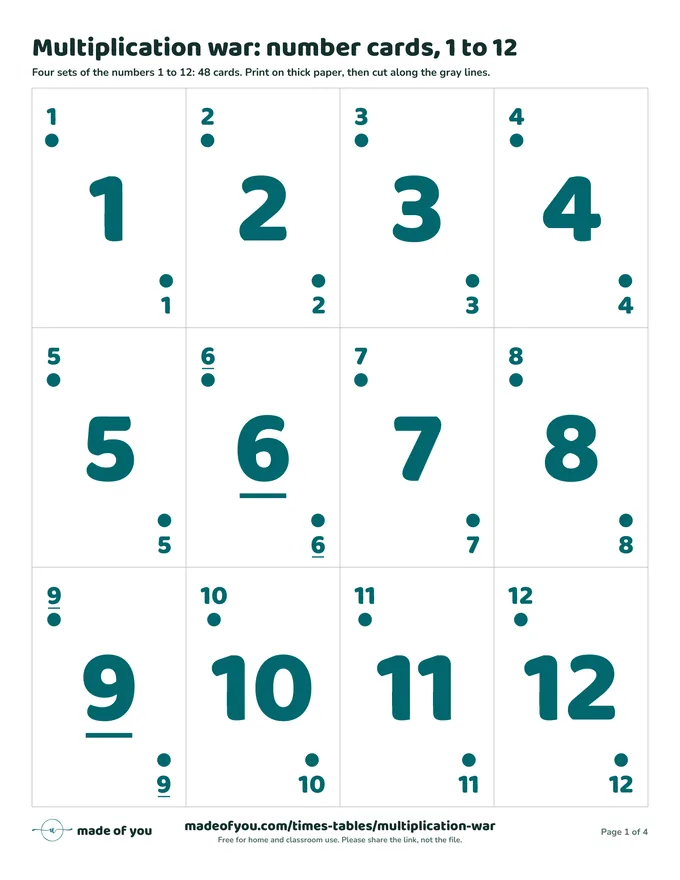
No deck in the house, or yours is three cards short? Print ours. It is four sets of the numbers 1 to 12: 48 cards on four pages, which is an ordinary deck without its Kings. Each set has a small mark of its own (a dot, a square, a triangle, a star), and the 6 and the 9 are underlined so nobody plays one upside down.
Use thick paper or thin card if you have it. On ordinary paper the numbers show through from the back, and a child WILL notice.
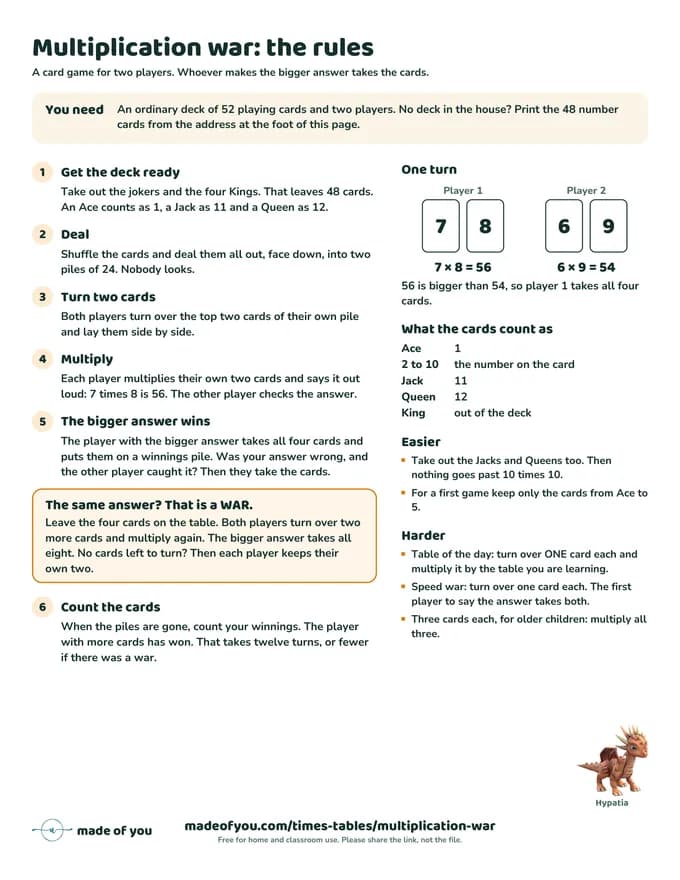
The rules sheet is this page on one sheet of paper: the six steps, the war, what each card counts as. Keep it in the box with the cards.
Number cards, 1 to 12
Four sets of the numbers 1 to 12: 48 cards on four pages, the same as a deck of playing cards without its Kings. A number and a small mark on white, so they go easy on the ink.
4 pages · PDF
Multiplication war rules, on one page
The six steps, the war, what the Jack and the Queen count as, and easier and harder ways to play. One sheet to keep with the cards.
1 page · PDF
Free for home and classroom use. To pass them on, please share the link to this page and not the file.
Questions
Grown-ups ask
- How do you play multiplication war?
- Deal an ordinary deck of cards face down into two piles. Both players turn over two cards, multiply them and say the answer. The bigger answer takes all four cards. If the two answers are the same, that is a war: both turn over two more cards, and the bigger answer takes all eight. When the piles are gone, the player with more cards wins. The six steps are written out above.
- What do the Jack, Queen and King count as in multiplication war?
- We count a Jack as 11 and a Queen as 12, and we take the Kings out, so the deck runs from 1 (the Ace) to 12. Other families count every picture card as 10, or leave them all out. Any of these works. Agree on one before the first card is turned.
- How many cards do you need for multiplication war?
- 48: an ordinary deck of 52 without its four Kings. That makes 24 cards each and twelve turns. Our printed number cards are the same 48.
- Can three or four people play multiplication war?
- Yes. Deal the 48 cards out evenly: 16 each for three players, 12 each for four. Everyone turns over two cards and the biggest answer takes them all. If the two biggest answers are the same, only those players go to war.
- What if one child is much faster than the other?
- Then play it the way this page describes, where each player works out their OWN two cards and nobody races. The quick one has to wait and check the other's answer, which is practice too. Speed war, where the first shout wins, is for children who are evenly matched.
- Can you play multiplication war alone?
- Yes. Turn over two cards, say the answer and check it on a multiplication chart. A right answer goes on one pile and a wrong one on another. When the deck is finished, shuffle the wrong pile and go through it again.
- Which times tables does multiplication war practice?
- All of them from 1 to 12, mixed up, in whatever order the cards fall. So it suits a child who has met most of the tables already. For ONE table at a time, play table of the day, or keep only the small cards. The order we would learn the tables in is on the how to learn the times tables page.
Our own book
The book for the cards that keep losing
For grown-ups · it comes out in November 2026
In a game of war the cards decide what comes up, and sooner or later they deal a 7 and an 8. If that pair costs your child the round every time, the game has told you something useful: which answer to go and learn.
Our times tables book takes the tables one at a time, the 10s first, and shows which answers of each table you already know from an earlier one. By the 8s only five are new. The reason is on the how to learn the times tables page.
More times tables
 Times tables with dragonsTen tables, ten dragons, one free cube game.
 Multiplication chartTap a square to hear it, or print it
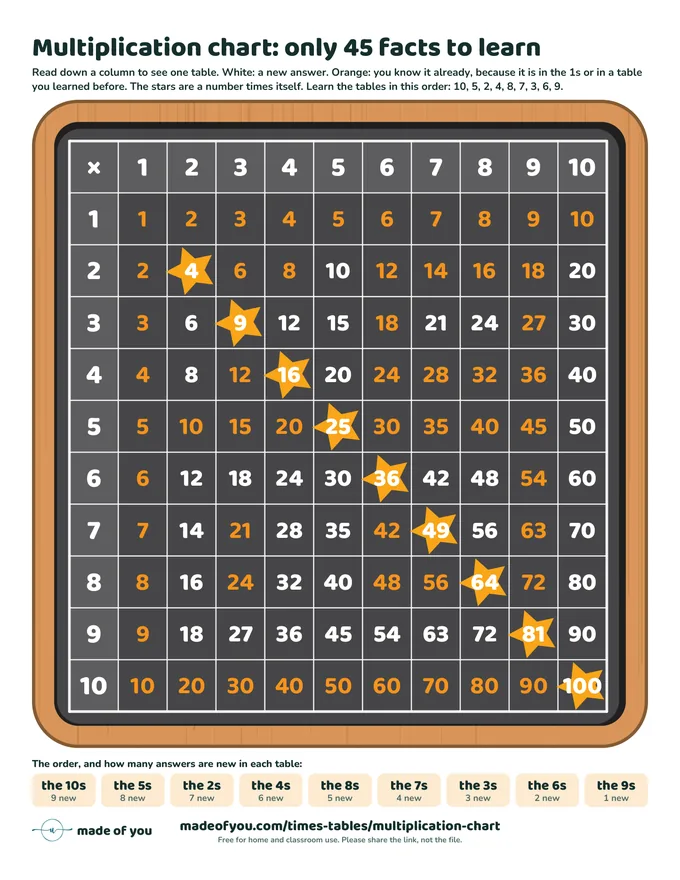 How to learn the times tablesOnly 45 facts, and the order to learn them in
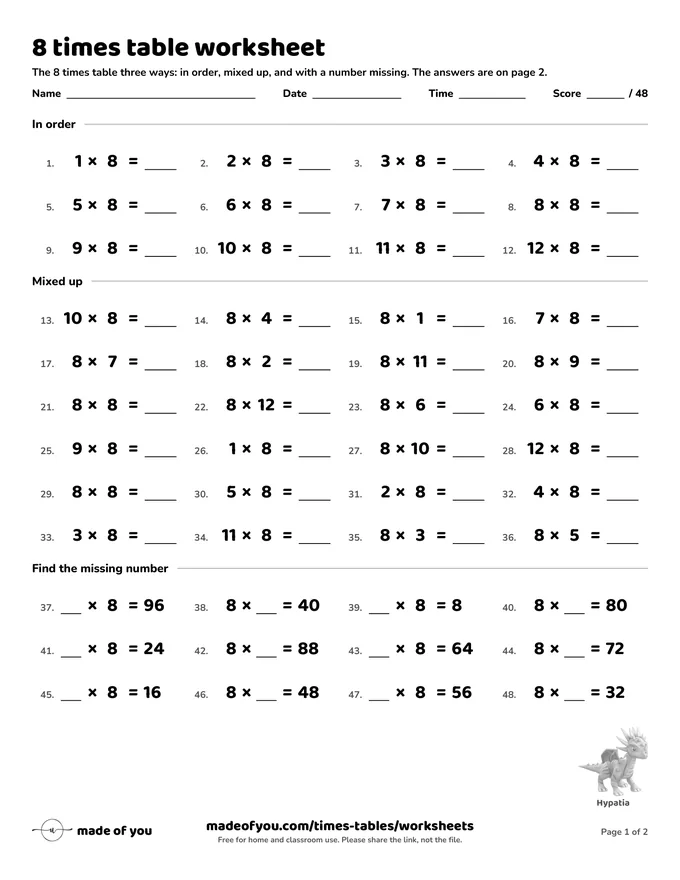 Times tables worksheetsMake a fresh sheet, or print a ready one
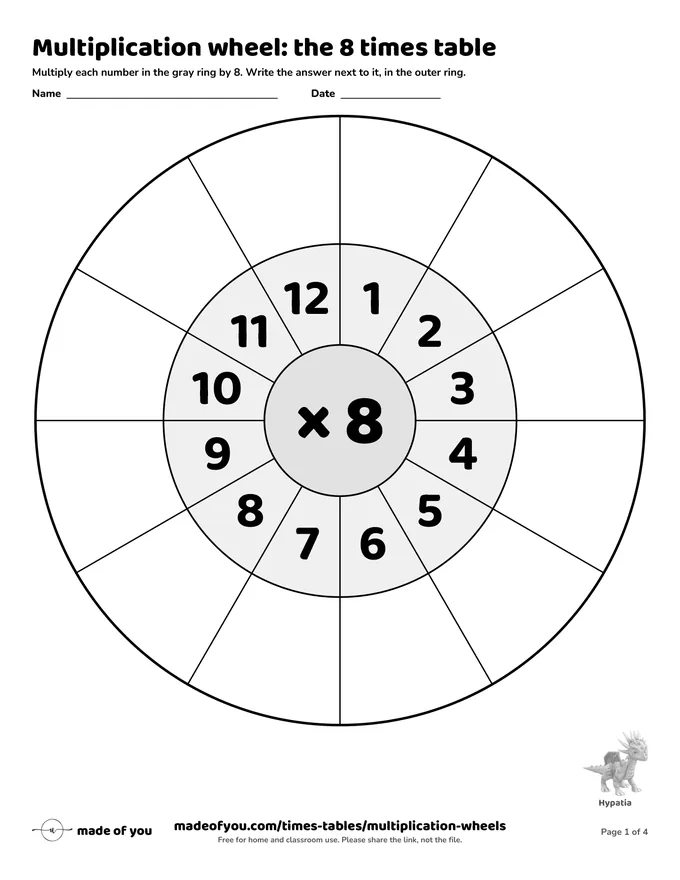 Multiplication wheelsFill one in on the page, or print the twelve
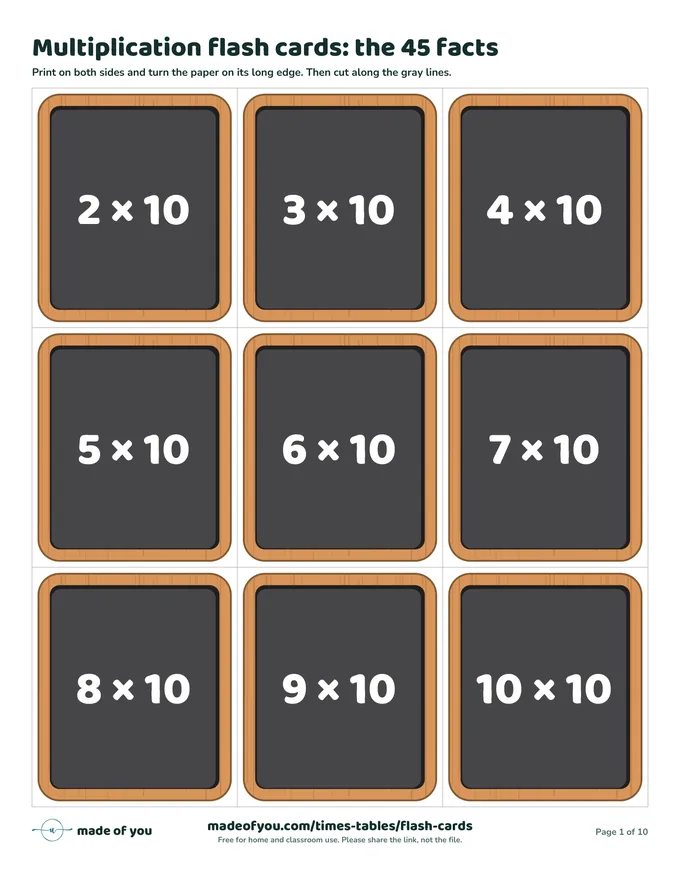 Multiplication flash cardsCards that remember the hard ones, and decks to print
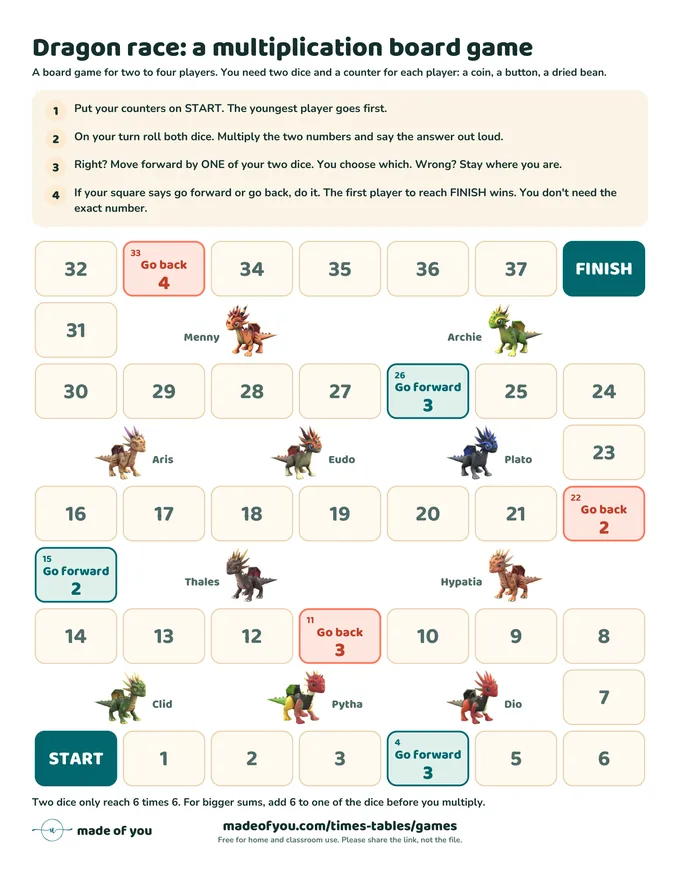 Multiplication gamesBingo, a board game, cards, dice and ten dragons
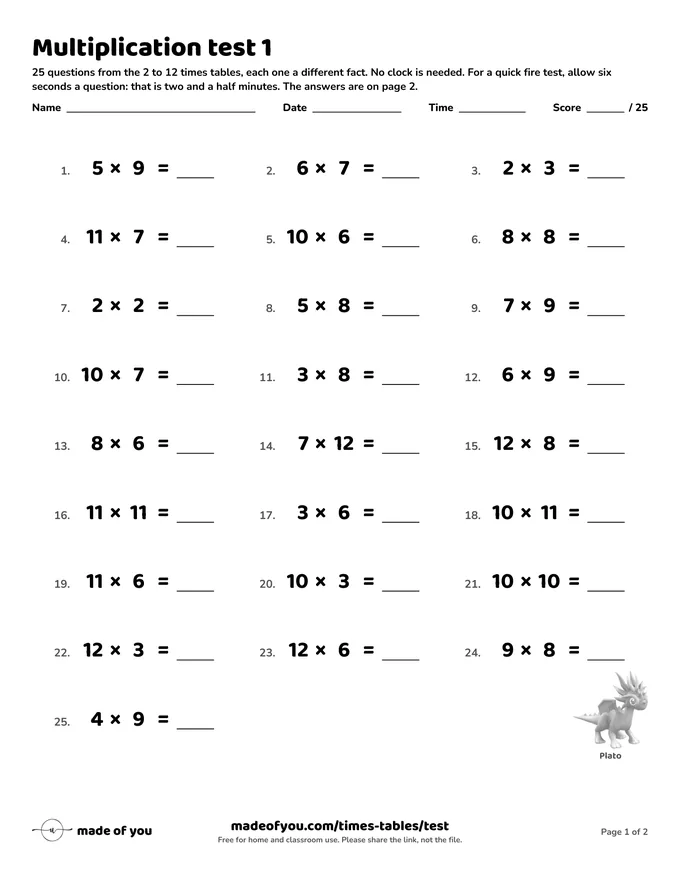 Times tables testTake your time or quick fire, then a chart of your own
 Multiplication tables checkA practice for the Year 4 check in England
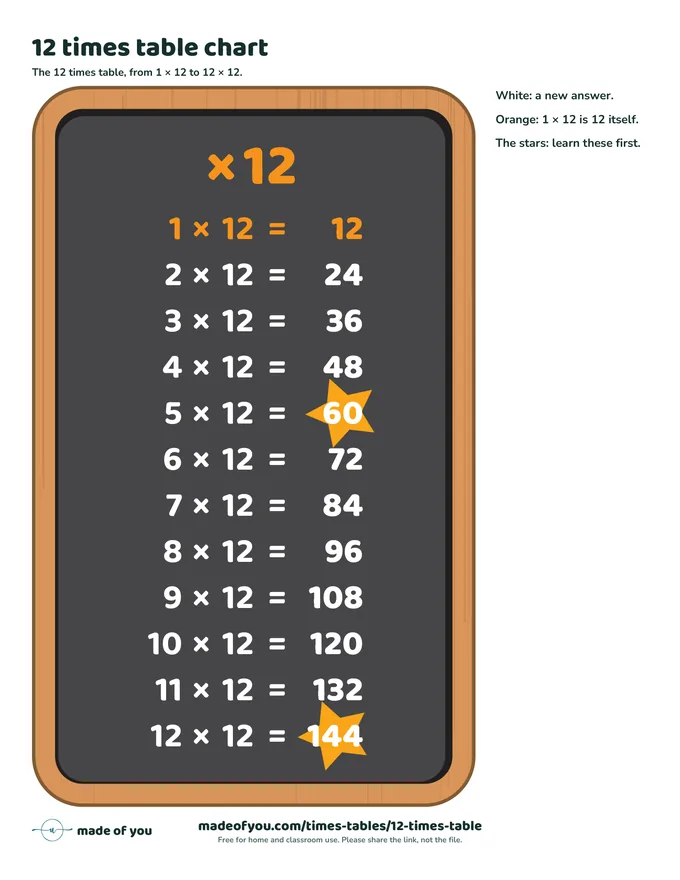 The 12 times tableTwelve rows, a tip, and sheets to print