Ages 3 to 6 · checked October 7, 2026
Alphabet books for preschool and kindergarten
Alphabet books do different jobs. A 3 year old meeting letters wants one clear letter at a time. Around 4, children start to hear that ball begins with b, and by 5, a child who has known the song for years wants a book that plays tricks with it. At bedtime you want one that winds down, and most of the famous ones don't. We picked 16 books from other publishers and grouped them by what each one is good for. Every card says which letters the book shows and how lively it is to read.

Before you scroll
- The groups are about what a book is good for. Nothing is ranked, and one calm book plus one loud one make a good pair.
- The meter says how lively each one is to read, from calm enough for lights-out to loud and silly. The best known ones are at the loud end.
- We say which letters each book shows. Half of them show only capitals, as far as we could see, though almost every letter your child will read is a small one.
- Ages are the publishers' own unless a card says otherwise. Each title links to its publisher, and none of the links earn us anything. Our own book sits in a separate box after the list.
At a glance
Which one for which child?
| If your child | Try |
|---|---|
| Is 3 and just starting to notice letters | Alphabet Under Construction, Eating the Alphabet: Fruits & Vegetables from A to Z or I Spy Letters |
| Wants the same loud book every single day | Chicka Chicka Boom Boom or Dr. Seuss's ABC |
| Needs a calm last book at lights-out | ABZZZZ...: A Bedtime Alphabet or Sleepy ABC |
| Loves a bedtime story and is starting on letters | Alphabedtime or Catch the Letters! (ours) |
| Would rather search the pictures than listen | I Spy Letters, Alphabot Adventures or LMNO Peas |
| Knows the alphabet song and finds alphabet books babyish | Z Is for Moose or AlphaOops! The Day Z Went First |
| Is 5 or 6 and loves a puzzle | Tomorrow's Alphabet or Alphabet City |
| Is starting to write letters | Wipe-Clean Alphabet, My First Wipe Clean: ABC or Catch the Letters! (ours) |
One clear letter at a time
First alphabets for a 3 year old
Each of these has one big letter a page, in capital and small, and something to name. That suits a child who is just starting to notice letters, and neither book needs the alphabet song to make sense.
Alphabet Under Construction
Denise Fleming
- Ages
- 2 to 5
- Kind
- Picture book
- Read aloud
- 2 to 3 minutes
- Letters
- Capital and small
- How lively
- Gentle
A mouse builds the alphabet. He dyes the D, nails the N and trims a hedge into a P, and by the end he is worn out and all 26 are done. Each page is one giant capital being worked on and a three word line, with the small letter at the start of the verb. A few verbs are new words for a 3 year old (weld, quilt, X-ray), and reviewers found one or two a stretch, but the pictures make most of them clear.
How lively: Each page is quiet, with one short line, and the book ends with a tired mouse and the whole alphabet finished.
Best for: Three year olds who love tools and building, or anyone who wants the shortest read on this page.
Henry Holt (Macmillan), 2002. 32 pages. Paperback from Square Fish; the hardcover is still sold too. Age range from the publisher. Publisher's page
Eating the Alphabet: Fruits & Vegetables from A to Z
Lois Ehlert
- Ages
- 3 to 5
- Kind
- Picture book of fruits and vegetables
- Read aloud
- 3 to 5 minutes, without the notes at the back
- Letters
- Capital and small
- How lively
- Calm
Lois Ehlert painted 75 fruits and vegetables, by Kirkus's count, in bright collage on white, each one named in big type in capitals and small letters. It's a picture dictionary of food with no story, so a child who wants a plot may drift. Some names will be new to grown-ups too (kohlrabi, jicama, and xigua, the Chinese word for watermelon), and the notes at the back say how to say them.
How lively: There's no story and no chant. You point and your child names, which is calm at any time of day, though it's more a mealtime book than a bedtime one.
Best for: Supermarket pointers, and picky eaters you'd like to tempt.
Clarion Books (HarperCollins), 1989. 40 pages. First published by Harcourt. There is a board book too, which its cover pitches at 6 months to 3 years. Age range from Publishers Weekly's review (HarperCollins' site wouldn't open for us). Publisher's page
Say it together
Classics to chant along to
Children learn the order by chanting it with you, again and again, and three of the best known alphabet books are made for exactly that. All three are lively, so they work better before the bath than at lights-out.
Chicka Chicka Boom Boom
Bill Martin Jr. and John Archambault, illustrated by Lois Ehlert
- Ages
- 4 to 8
- Kind
- Picture book chant
- Read aloud
- 3 to 4 minutes
- Letters
- Capital and small
- How lively
- Loud and silly
The small letters race each other up a coconut tree in alphabet order until it tips over, and the capitals, the mamas and papas and uncles and aunts, come running to patch them up. The whole alphabet is said in order twice, to a rhythm most children know by heart after a few reads. Lois Ehlert's bold, flat shapes are a little abstract: Common Sense Media found some small children don't see the tree until you point it out.
How lively: Your child will shout the chant, and there's a big pile-up when the tree tips over: a stubbed toe, a black eye, a loose tooth, all played for laughs. The moon comes up at the end, and then A jumps out of bed to climb again.
Best for: Kids who love to join in, and grown-ups who want the order learned by heart.
Simon & Schuster, 1989. 40 pages. Also a paperback, and a board book with the whole story (an older board book had only half). Age range from the publisher (reviewers start it at 2). Publisher's page
Dr. Seuss's ABC
Dr. Seuss · Beginner Books
- Ages
- 3 to 7
- Kind
- Picture book, an early reader
- Read aloud
- 5 to 7 minutes
- Letters
- Capital and small
- How lively
- Loud and silly
Every letter starts the same way, “BIG A, little a, what begins with A?”, and then comes a silly scene: Aunt Annie's alligator, a lazy lion licking a lollipop, all the way to the made-up Zizzer-Zazzer-Zuzz. It shows both forms of every letter and the sound at the start of each word. It's a Beginner Book, so a 5 or 6 year old can start reading it alone. A few words are nonsense on purpose.
How lively: The tongue twisters and made-up creatures make children giggle, so it winds a child up rather than down, and it's long for a bedtime book.
Best for: Fans of silly words, and a 5 or 6 year old who will soon read it to you.
Random House, 1963. 72 pages. The board books are shortened, the publisher says, so get the full hardcover for this age. Age range from the publisher. Publisher's page
LMNO Peas
Keith Baker · The Peas Series
- Ages
- 4 to 8
- Kind
- Picture book in rhyme
- Read aloud
- 4 to 5 minutes, much longer if your child studies the pictures
- Letters
- Capitals
- How lively
- Lively
Tiny peas climb over and around a giant capital for each letter, doing jobs and hobbies that start with it: acrobats, artists and astronauts for A, all the way to zoologists. L, M, N and O share one page, the way they run together in the alphabet song. It got three starred reviews, and reviewers said the pages are so packed it works best on a lap, one child at a time.
How lively: Brisk, bouncy rhymes and busy pages. It ends on a question to your child, who are you?, which can start a chat rather than end the day.
Best for: A child who studies pictures, and one who asks what grown-ups do all day.
Beach Lane Books (Simon & Schuster), 2010. 40 pages. Also a board book. Age range from the publisher. Publisher's page
For lights-out
Bedtime alphabets
A calm bedtime alphabet is harder to find than you'd think. The best reviewed one of recent years is no longer sold by its publisher, and Goodnight ABCs, a popular one, is a board book its publisher pitches at 0 to 3. These three are in print and made for bedtime, but they aren't all calm: the meter says which.
ABZZZZ...: A Bedtime Alphabet
Isabel Minhós Martins, illustrated by Yara Kono
- Ages
- 4 to 8
- Kind
- Picture book, a bedtime routine
- Read aloud
- 5 to 8 minutes, if your child is still awake
- Letters
- Capitals
- How lively
- Calm
It's made to be read in bed to a child who isn't meant to reach the end. The publisher says some children yawn by B and most are asleep by S. Each page has one capital letter, one word and a few gentle lines, often with something to do. It was translated from Portuguese, and a few pages feel European, like a child asking to squeeze into the grown-ups' bed. The catch: when we checked, it was out of stock in the US and the UK, so you may need a library copy or a wait.
How lively: This is the calmest book on the page. Each letter asks your child to do something sleepy: curl up like a cat, say goodbye to the day, breathe in slowly and yawn. The pictures are bright, though, not dim and sleepy.
Best for: Children who fight sleep, and grown-ups who want the alphabet to do the winding down.
Thames & Hudson, 2016. 28 pages. First published in Portugal. Hardcover only. Out of stock at its US distributor and at its UK publisher when we checked. Age range from W. W. Norton, its US distributor (Thames & Hudson's own pages give no age). Publisher's page
Sleepy ABC
Margaret Wise Brown, illustrated by Karen Katz
- Ages
- 4 to 8
- Kind
- Picture book in rhyme
- Read aloud
- 2 to 4 minutes
- Letters
- We couldn't see inside
- How lively
- Calm
The author of Goodnight Moon wrote it in 1953, and Karen Katz drew it new in 2010: babies and toddlers with different skin colors getting ready for bed while the animals fall asleep too. Each letter gets about three short lines, and the words aren't the usual ones: A is the sigh of a sleepy kitten, B the baa of lambs. Reviewers split. Kirkus liked it, School Library Journal didn't, and a few letters, like X, don't teach their sound at all.
How lively: The sounds are soft, the animals are falling asleep, and the last page sends your child to bed. The pictures are bright and cheerful rather than dark.
Best for: The last book of the night, once the lights are low.
HarperCollins, 1953. 40 pages. This edition 2010, with Karen Katz's pictures. A board book since 2016, the easier one to find. Age range from the 2010 jacket, as copied in the Library of Congress record (HarperCollins' site wouldn't open for us). Publisher's page
Alphabedtime
Susanna Leonard Hill, illustrated by Betsy Snyder
- Ages
- 3 to 6
- Kind
- Picture book in rhyme
- Read aloud
- 3 to 5 minutes
- Letters
- Capitals
- How lively
- Lively
Twenty-six Alphababies, each in pajamas printed with their own capital letter, go from supper through baths, teeth and a story to bed, herded by Alpha Mom and Dad. It's a real bedtime routine in rhyme, with good words in it (impish, jazzy, scramble), and a family with a range of skin tones. Kirkus compares its romp to Chicka Chicka Boom Boom, and the pages are busy.
How lively: The rhymes bounce, 26 children fill every page, and after lights out there's an alphabet pillow fight before the parents tuck everyone in for good.
Best for: Brothers and sisters, who will know that bedtime chaos well.
Nancy Paulsen Books (Penguin Random House), 2022. 32 pages. A board book since 2025, for ages 0 to 3. Age range from the publisher. Publisher's page
Look closely
Letters to find in the pictures
Some children would rather search than listen. In these books every page hides things to find, or hides the letter itself, and your child does the looking. They work at any time of day, and a child can go back to them alone.
I Spy Letters
Jean Marzollo, photographs by Walter Wick · I Spy
- Ages
- 3 to 5
- Kind
- Search-and-find photo book
- Read aloud
- About 5 minutes, or 10 to 15 if your child searches every photo
- Letters
- Capitals
- How lively
- Gentle
Each spread has a short rhyming riddle with little picture clues, so a child who can't read yet can still play, and a photo crowded with letters and toys to find. The paperback is thin, with 14 spreads, so not every letter gets a page of its own. The letters we saw inside were capitals.
How lively: Your child sets the pace by looking, and nothing in it is loud.
Best for: A searcher, and a child who would rather play than be read to.
Cartwheel Books (Scholastic), 2000. 32 pages. First a board book, I Spy Little Letters (ages 0 to 3, still sold); this paperback edition 2012. Age range from the publisher. Publisher's page
Alphabot Adventures
Lauren Briére
- Ages
- 3 to 5
- Kind
- Picture book with things to find
- Read aloud
- 4 to 5 minutes, longer with the hunting
- Letters
- Capitals
- How lively
- Gentle
Every letter gets a robot, from A Bot, an archer with terrible aim, to Y Bot and its yo-yo. Each spread pairs a one sentence tongue twister with a painting that hides more things starting with that letter. Some words are far beyond a preschooler (abysmal, on the A page), which is part of the joke.
How lively: The oil paintings are soft and each page has one calm sentence, so the fun comes from the tongue twisters rather than from noise.
Best for: Robot fans, and children who like to go back and hunt.
Blue Star Press, 2025. 56 pages. A new book from a small press: no review journal has reviewed it yet. Age range from the publisher. Publisher's page
Alphabet City
Stephen T. Johnson
- Ages
- 3 to 7
- Kind
- Wordless paintings
- Read aloud
- No words: 5 to 10 minutes of looking
- Letters
- Capitals
- How lively
- Calm
There are no words, only paintings of New York so real they look like photos, and in each one a capital letter hides in the city: a sawhorse is an A, a fire escape a Z. It's the most beautiful book on this page and the hardest. Booklist said it is hardly a preschool book, and some letters stump grown-ups. A child who doesn't yet know every capital will get little from it.
How lively: It has no story and no words, only still paintings of streets and buildings. It's calm, but hard work.
Best for: A 5 or 6 year old who knows every capital and loves a challenge, or a city child.
Viking (Penguin Random House), 1995. 32 pages. Paperback from Puffin. A Caldecott Honor book. Age range from the publisher (reviewers put it older: Booklist says grades 4 to 7). Publisher's page
Once they know the song
Funny ones for kids who know their ABCs
Each of these breaks the alphabet on purpose, whether the letters go in the wrong order, a moose barges in or every letter is a riddle. They only work once your child knows what should come next, so they're best at 4 to 6, for a child who finds alphabet books babyish.
Z Is for Moose
Kelly Bingham, illustrated by Paul O. Zelinsky
- Ages
- 4 to 8
- Kind
- Picture book
- Read aloud
- About 5 minutes
- Letters
- We couldn't see inside
- How lively
- Loud and silly
Zebra runs a tidy alphabet show, A is for Apple, B is for Ball, and Moose can't wait for his turn at M. When M goes to Mouse, he wrecks the rest of the book until Zebra finds him a place. Six review journals gave it a starred review. The joke only works if your child knows M comes next, so it's best for a 4 to 6 year old who is past learning the order.
How lively: Moose barges in, stomps, throws a tantrum and cries, all very funny with voices. It winds children up, then ends kindly.
Best for: A child who knows the alphabet and hates waiting for a turn.
Greenwillow Books (HarperCollins), 2012. 32 pages. A cheaper hardcover since 2025. In the UK its publisher now sells only the ebook. Age range from the publisher, on a saved copy of its page (its site wouldn't open for us). Publisher's page
AlphaOops! The Day Z Went First
Alethea Kontis, illustrated by Bob Kolar
- Ages
- 4 to 8
- Kind
- Picture book
- Read aloud
- 7 to 10 minutes
- Letters
- Capitals
- How lively
- Loud and silly
Z is tired of always being last, so this time the alphabet starts at the end, and chaos follows. The letters are capitals with eyes, arms and legs, and a strip along the bottom of every spread shows who has had a turn and who is missing. Kirkus called it hysterical. The jokes need the usual order, so a child still learning it may just be confused.
How lively: Shouting letters, pushing in, a bathroom break and a Z with a megaphone. Loud, and long for a 3 year old. One line, “V is for violence”, is worth knowing about before you read it.
Best for: A youngest child, or anyone whose name always comes last on the list.
Candlewick Press, 2006. 48 pages. Paperback. There is a Halloween sequel too. Age range from the publisher. Publisher's page
Tomorrow's Alphabet
George Shannon, illustrated by Donald Crews
- Ages
- 4 to 8
- Kind
- Riddle picture book
- Read aloud
- 3 to 5 minutes, or 10 if your child guesses each one
- Letters
- Capitals
- How lively
- Gentle
“A is for seed, tomorrow's APPLE.” Each letter is a riddle: something today that becomes a word starting with that letter tomorrow. The answer is on the facing page, so cover it if you want a real guessing game. A few leaps are too far for young children (X is for foot, tomorrow's X-RAY), and it's for children who already know their letter sounds.
How lively: Big, calm watercolors make it a thinking game rather than a romp. The liveliest moment is the rocket countdown at the very end.
Best for: Riddle lovers of 5 or 6 who know their letter sounds.
Greenwillow Books (HarperCollins), 1996. 56 pages. Paperback. Facts from a saved copy of the publisher's page (its site wouldn't open for us). Age range from the publisher (reviewers say 5 and up). Publisher's page
Pen in hand
For a child starting to write letters
You need a table and a pen for these two, not a bed. Both show where each letter starts and which way it goes, capital and small, and both wipe clean, so a child can go again without using up paper. Letter styles differ from school to school, so check what your child's school uses.
Wipe-Clean Alphabet
Jessica Greenwell, illustrated by Stacey Lamb · Usborne Wipe-Clean
- Ages
- 3 and up
- Kind
- Wipe-clean activity book
- Read aloud
- 5 to 10 minutes of tracing at a time
- Letters
- Capital and small
- How lively
- Gentle
Each page has a big dotted capital and small letter to trace, with start dots and numbered arrows, and under it a busy scene of things that start with that letter (car, cap, cat, cow and cactus for C). The outlines of the pictures are dotted too, so your child traces pictures as well as letters, then wipes it and goes again. The scenes make it more fun than a plain workbook, and more cluttered.
How lively: It's quiet work at a table with a dry-wipe pen, not a bedtime read.
Best for: A 4 or 5 year old who wants to write but gets bored by rows of letters.
Usborne, 2011. 24 pages. UK edition 2011, US edition 2023. Usborne doesn't say whether a pen comes with it. Age range from the publisher. Publisher's page
My First Wipe Clean: ABC
Roger Priddy · My First Wipe Clean
- Ages
- 3 to 6
- Kind
- Wipe-clean board book
- Read aloud
- 5 to 10 minutes of tracing at a time
- Letters
- Capital and small
- How lively
- Gentle
Two letters a page, each a big capital and small letter with dashed lines, start dots and arrows, next to a photo and a word. It's plainer than the Usborne book, with no scenes, but the board pages are tough and the pen stays with the book, so it travels well. With 26 letters on 14 pages, each letter gets less room.
How lively: Like the Usborne book, it belongs at a table rather than in bed. The pen lives in a slot in the book.
Best for: A first go with a pen, or a book for the car.
Priddy Books (Macmillan), 2019. 14 pages. US board book 2019; the UK edition (2023) says ages 3 to 5. Age range from the publisher (US). Publisher's page
Our own book
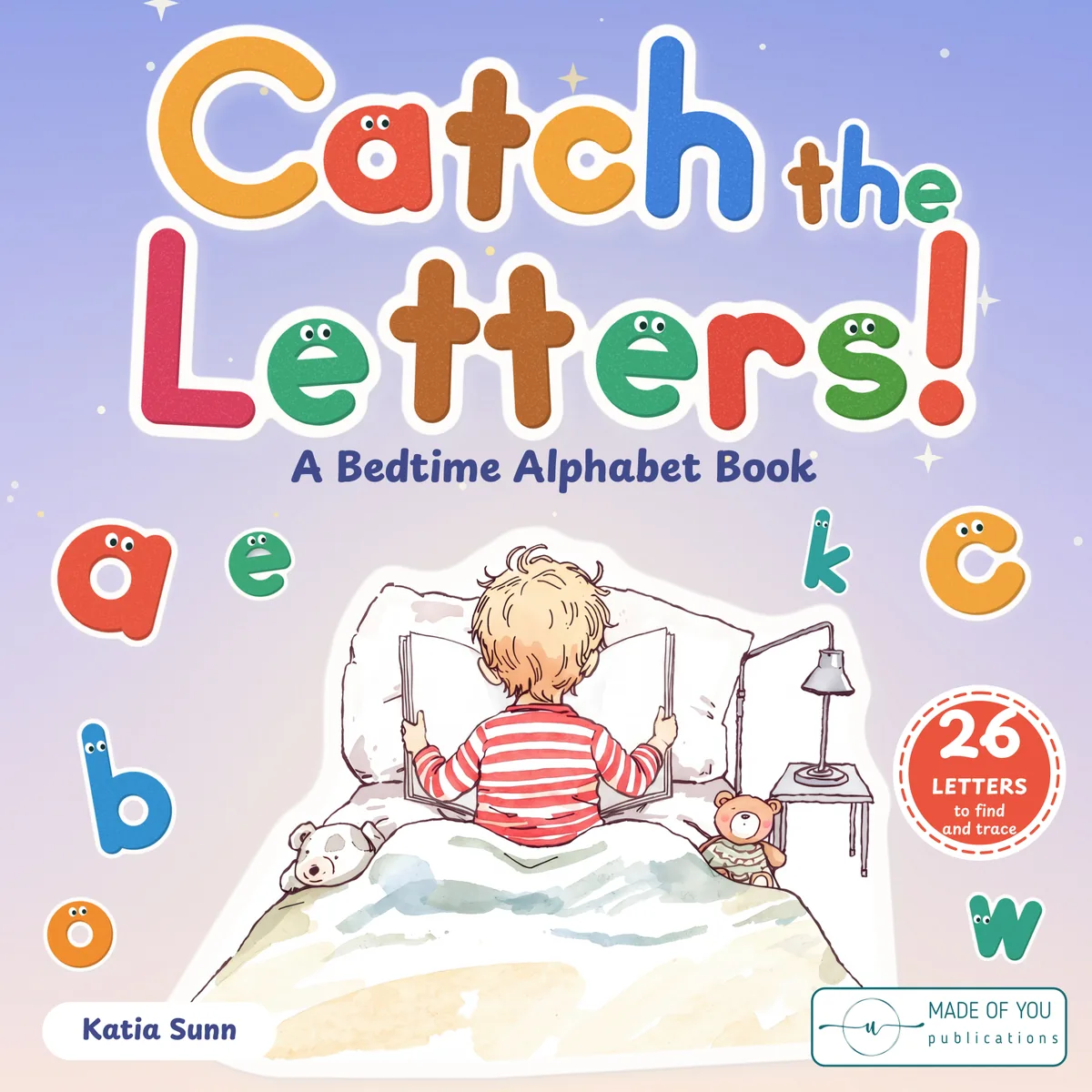
Catch the Letters! A Bedtime Alphabet Book
by Katia Sunn · Made Of You, 2026
- Ages
- 3 to 6
- Kind
- Bedtime picture book with letters to trace
- Read aloud
- About 15 minutes for all 26, or a few letters a night
- Letters
- Small and capital, small first
- How lively
- Lively
At bedtime a child opens a favorite book and finds the pages empty: twenty-six little letters have tiptoed off the bed to play hide-and-seek all over the house. They still keep their order, so the search goes from a to z, and each letter hides in something that starts with its sound. a tumbles out of the apple bowl, b bounces on a bubble in the bath. Nobody in the story has a name, and the child in the pictures is only ever seen from behind, so your child is the one in the bed. It ends with a line for your child to write their own name.
Every letter page has the small letter and its capital to trace with a finger: a green dot where to start, numbers for which line comes first and arrows for the way, in the plain upright print most US schools teach first. There's a QR code on every letter page too. Scan it with a phone or tablet and the letter writes itself in 3D, slowly, the way your child traced it, then steps into your room. There's no app and no account, and the book works without any of it.
At 48 pages, all 26 letters in one go make a long bedtime, so you may want to catch a few letters a night. The tracing is with a finger on the printed page, not pencil practice: for a pencil, there are free sheets for every letter on our site. A few hiding places bend the rule, like x, which hides in a box, at the end of the word. It came out in October 2026, so it has no reviews or track record yet, and it's a paperback printed by Amazon.
How lively: The story is hushed: letters tiptoe off the bed and the house is dark and quiet. But your child shouts “Got you!” every time a letter is caught. If that's too much at lights-out, whisper it, the way the book does for the very last letter, and the book ends with good night.
Best for: A 3 to 5 year old who loves a bedtime story and is starting to notice letter shapes, with a grown-up who will slow down for the tracing.
Checked October 7, 2026
How we chose
We built this list around three things parents ask for: a calm bedtime book for a 4 year old who is starting on letters, the best alphabet books for preschoolers, and something more fun than a tracing workbook for a 4 or 5 year old learning to write. A bedtime alphabet, a loud chant and a wipe-clean book do different jobs, so we grouped them by job instead of ranking them against each other.
Each book's author, year, page count and age range come from its publisher's page or a library record, and each card names where its age came from. One publisher's site wouldn't open for us, so for its four books we used saved copies of its own pages, the jacket as copied into a library record, or a review, and we say which. Which letters a book shows comes from the publishers' look-inside pages or from reviews, and where we couldn't see inside, we say so. How lively each one is comes from the publishers' descriptions and the reviews. Reading times are our estimates.
We left out books you can't easily buy new today or that are pitched at another age: The Sleepy Little Alphabet, the best reviewed bedtime alphabet we found, which its publisher no longer sells; Goodnight ABCs, a board book for 0 to 3; and Q Is for Duck, a 1980 guessing alphabet we couldn't check well enough. Catch the Letters! is our own book (Katia wrote it). It has a box to itself after the list rather than a place in a group, and the box says what the book can't do. Nobody paid to be on this page, and no publisher asked. If a book we left out we left out is the one your child asks for every night, write to us at info@madeofyou.com.
Questions
What parents ask
- My 4 year old loves bedtime stories and is just starting to learn letters. Is there a calm bedtime book that also teaches the alphabet?
- Only a few that are still in print. The best reviewed bedtime alphabet of recent years, The Sleepy Little Alphabet, is no longer sold by its publisher, and the most famous alphabet books are loud: Chicka Chicka Boom Boom and Dr. Seuss's ABC are for before the bath. The calmest we found is ABZZZZ...: A Bedtime Alphabet, which turns the alphabet into a wind-down with stretching, breathing and yawning, though it was out of stock when we checked. Sleepy ABC is short and soft. Alphabedtime has a real bedtime story, with a pillow fight near the end. Ours, Catch the Letters!, is a hushed story with a shout for every letter, and you can whisper the shouts.
- What are the best alphabet books for preschoolers?
- For a 3 year old meeting letters, pick a short book with one clear letter a page, like Alphabet Under Construction or Eating the Alphabet. For a child who loves to join in, the chants: Chicka Chicka Boom Boom, Dr. Seuss's ABC and LMNO Peas. For a searcher, I Spy Letters. Once a child knows the order by heart, the funny ones that break it, Z Is for Moose and AlphaOops!, are the ones they ask for again.
- What are good alphabet books for a 4 or 5 year old who is learning to write letters, something more fun than a tracing workbook?
- Look for books that show where each letter starts and which way it goes. Usborne's Wipe-Clean Alphabet puts each letter, capital and small, above a busy scene with pictures to trace too, and Priddy's My First Wipe Clean: ABC keeps its pen in the book. Both have start dots and arrows. Alphabet Under Construction doesn't teach writing, but watching a mouse build each letter helps a child see how letters are made. In our own book a child traces each letter with a finger inside a bedtime story, with green start dots, numbered lines and arrows. Letter styles differ between schools, so ask which one yours uses.
- Should my child learn capital letters or small letters first?
- Schools and handwriting programs differ, so follow your child's school. For reading, the small letters matter more, because almost every letter in a book is a small one. Some writing programs start with capitals, which are mostly straight lines and easier to write. As far as we could see, half the books on this page show only capitals. Chicka Chicka Boom Boom, Dr. Seuss's ABC, Eating the Alphabet, Alphabet Under Construction and the two wipe-clean books show both.
- My child can sing the ABC song. Do they still need an alphabet book?
- The song teaches the order of the names, and that's all. It doesn't show what each letter looks like or the sound it makes, and plenty of children sing L, M, N, O, P as one long word. LMNO Peas makes a joke of exactly that. A book lets you point at each letter as you say it, so the name, the shape and the sound come together. And the funny ones, like Z Is for Moose, only work once the song is known.
- Is the board book the same as the picture book?
- Not always. Random House says the board book editions of Dr. Seuss's ABC are shortened. An older board book of Chicka Chicka Boom Boom had only half the story, though the one sold now has all of it. For a 3 to 6 year old the picture book edition is the one to get, unless pages still get chewed or torn.
Free on our site, no book needed
Alphabet tracing sheets and an ABC chart · a page for every letter, a to z · a name tracing maker · rhyming and guessing books for ages 3 to 5