Ages 7 to 10 · checked October 6, 2026
Books that help kids learn the times tables
Children get stuck on the times tables in different places. One hasn't seen what multiplying is for yet, another understands it and still loses 7 × 8 every week, and a third just needs ten minutes of practice most days. Here are 11 books from other publishers that each help with one of those, sorted by what kind of book they are, with which tables each one covers and how much practice it asks for.
Before you scroll
- Sorted by what kind of book it is, not ranked. Most children need two: one way in, and one for practice.
- Most of these stop at the 9s or 10s. We say which tables each covers, because England's Year 4 check goes up to 12 × 12.
- Ages are each publisher's own. US books often give a school grade instead: 3rd grade is about 8 to 9.
- Titles link to the publishers, with no affiliate links. One book is ours, in its own labelled box.
At a glance
Which one for which child?
| If your child | Try |
|---|---|
| Freezes on 6 × 7 or 7 × 8 after months of flash cards | Times Tales, Times Tables the Fun Way or Times Fables |
| Asks why, and won't just memorize | The Best of Times: Math Strategies that Multiply or Multiplication Facts That Stick |
| Hasn't quite got what multiplying is yet | One Hundred Hungry Ants or 2 x 2 = Boo! |
| Says math is boring | Math Curse, 2 x 2 = Boo! or Times Tables and DragonBuddies (ours) |
| Needs daily practice, and you want a plan | Multiplication Facts That Stick or Kumon Grade 3 Multiplication |
| Has England's Year 4 check coming up | Usborne Times Tables Activity Book or KS2 Year 4 Maths Times Tables 10-Minute Weekly Workouts |
| Loves dragons, or plays every game on the tablet | Times Tables and DragonBuddies (ours) |
A silly story for each hard fact
Memory methods
Each number turns into a character, and a short story ties two characters to the answer. A child who has forgotten 7 × 8 ten times in a row will often keep it once it's a story. These three cover mostly the hard middle facts, so your child needs the 2s, 5s and 10s first. Two of them even turn the 8 into a snowman, so nobody owns the idea.
Times Tales
Jennie Winters and her sister Marillee
- Ages
- Grades 3 to 5
- Kind
- Memory stories, as a workbook or a video course
- Tables
- 18 hard facts, 3 × 6 to 9 × 9
- How much practice
- Some
Your child learns the stories as plain stories first, and only later finds out they were times tables facts all along. It's the best known of the story methods: more people search for it by name than for any other book on this page. Two things to know before you buy. The stories cover 18 hard facts only; the easy tables, the 11s and the 12s come in two extra workbooks. And the main product is now an online video course, though the print workbook teaches the whole method without a screen.
How much practice: The workbook has quizzes and a test for each part, flash cards, games and crosswords. The publisher suggests a week of practice between the two halves of the stories.
Time it takes: 30 days or less, the publisher says
Best for: Kids who have done flash cards for months and still freeze on 6 × 7 or 7 × 8.
Trigger Memory Co. (US), 2003. 104 pages. Page count from the print workbook (2023 printing). Also sold as an online video course with a one year home licence. Ships to the UK from the US. Age range from the publisher's questions page. Publisher's page
Times Tables the Fun Way
Judy Liautaud and Dave Rodriguez · Book for Kids
- Ages
- 6 and up
- Kind
- Picture story memory book
- Tables
- 0 to 9
- How much practice
- A little
City Creek has sold this method since 1992, longer than anyone else on this list. Each story ends on a punchline that sounds like the answer, so two sixes lost in a desert become thirsty sixes, and 6 × 6 is 36. Stories cover the hard 3s, 4s, 6s, 7s and 8s, and quick tricks cover the 1s, 2s, 5s and 9s. The children's book stops at 9 × 9, with no 10s, 11s or 12s. There are films, songs and an app as well, and you don't need any of them.
How much practice: The book is mostly the stories. The quizzes and timed sheets are in a separate 60 page student workbook.
Time it takes: No plan given
Best for: A child who remembers songs and jokes better than numbers.
City Creek Press (US), 1992. 88 pages. This edition 2017. The workbook, clue cards and teacher's manual are sold separately. Kindle and Apple Books editions too. Age range from the publisher's About page (it prints no age range on the book's own page). Publisher's page
Times Fables
Jessie Wilson
- Ages
- 5 and up
- Kind
- Story memory book
- Tables
- The middle tables: 3, 4, 6, 7, 8, 9
- How much practice
- None, it's a read
The author came up with it because she always remembered 7 × 8: she lived at number 56. In this small UK paperback each number has a character, and the facts hang on short rhyming stories. The publisher says it's for children who already understand multiplication and know their 2s, 5s and 10s. Parents' reviews on the publisher's own site say it covers the 3s, 4s, 6s, 7s, 8s and 9s, and not the 11s or 12s, so for the Year 4 check you'll need those from somewhere else.
How much practice: We found no exercises. It's characters and short stories to read together.
Time it takes: As little as a week, the publisher says
Best for: UK families whose child knows the 2s, 5s and 10s and is stuck on the rest.
IOM Press (UK), 2017. 58 pages. Page count from a bookseller record; the publisher doesn't give one. Which tables: from parents' reviews on the publisher's site, which doesn't list them. Age range from the publisher (UK). Publisher's page
Work it out instead of remembering
Tricks and strategies
These suit a child who would rather understand than memorize. Forget 7 × 6 and you can still get there from 5 × 6 and 2 × 6. It's slower at first, but it doesn't vanish when a child panics.
Multiplication Facts That Stick
Kate Snow · Facts That Stick
- Ages
- Grades 2 to 7
- Kind
- A parent's guide, with games
- Tables
- 1 to 10
- How much practice
- Lots, most pages
Kate Snow wrote it for the parent, and every day is scripted, so you can open it and teach. Each table is laid out as a grid of dots with a card that slides across it, and your child uses facts they know to reach the ones they don't, before the tables get mixed up. Every day has a game, like Multiplication War or Four in a Row, and you'll need a pack of cards, two dice and 20 counters.
How much practice: A short lesson, a game and written practice every day, 100 practice pages in all, with answers. You teach it: it's a book for the grown-up, not one your child reads.
Time it takes: 15 minutes a day for 10 weeks, the publisher says
Best for: A parent who wants a plan to follow, and a child who likes games more than worksheets.
Well-Trained Mind Press (US), 2018. 425 pages. Paperback or PDF. The page count is the publisher's; most of it is game boards and practice pages to copy. Age range from the publisher's grade tags. Publisher's page
The Best of Times: Math Strategies that Multiply
Greg Tang, illustrated by Harry Briggs
- Ages
- 7 to 10
- Kind
- Picture book in rhyme
- Tables
- 0 to 10
- How much practice
- None, it's a read
Each table gets a short rhyming verse and a way in from an easier table. The 2s are doubling, the 4s are doubling twice, the 5s are half of ten, and the 7s are the 5s plus the 2s. The book says plainly that understanding beats memorizing. Kirkus liked the clear strategies but found some, like the one for the 7s, a lot to hold in your head.
How much practice: No exercises, only a verse and a picture for each table.
Time it takes: About 5 minutes to read
Best for: Children who ask why and won't learn something just because you said so.
Scholastic Press, 2002. 32 pages. Hardcover; an ebook since 2017. Age range from the back cover, in the Library of Congress record (Scholastic's teacher store says grades 2 to 5). Publisher's page
Before the tables
Picture books that show what multiplying is
These come before the tables. They show what multiplying is: that 4 × 25 is four equal rows, and quicker than counting to 100 one by one. Their publishers pitch them younger than 7, and they still read well aloud at 7 and 8.
2 x 2 = Boo!
Loreen Leedy · A Set of Spooky Multiplication Stories
- Ages
- 4 to 8
- Kind
- Comic strip picture book
- Tables
- 0 to 5
- How much practice
- None, it's a read
Loreen Leedy tells six short comic strip stories, one each for times 0, 1, 2, 3, 4 and 5. Multiply by zero and the vampires vanish; multiply by two and the bats double. It's the only picture book here that teaches actual tables, but only up to 5. Kirkus enjoyed it and found the pages busy, so a child who likes calm pictures may not.
How much practice: No exercises, only a multiplication table at the end. The Halloween witches, bats and skeletons are silly rather than scary.
Time it takes: About 8 minutes to read
Best for: A 6 or 7 year old meeting multiplication for the first time, especially in October.
Holiday House, 1995. 32 pages. Age range from the publisher. Publisher's page
One Hundred Hungry Ants
Elinor J. Pinczes, illustrated by Bonnie MacKain
- Ages
- 4 to 7
- Kind
- Picture book in rhyme
- Tables
- Equal rows, no tables
- How much practice
- None, it's a read
A hundred ants march to a picnic in one long line, and the smallest ant decides it's too slow. It keeps sorting them into new shapes: 2 lines of 50, 4 of 25, 5 of 20, 10 of 10. Every change takes time, and the ending is the joke. It shows what equal groups look like without saying the word multiply.
How much practice: No exercises. The only sad moment comes at the end, when the ants reach the picnic and the food is gone.
Time it takes: About 5 minutes to read
Best for: Younger children who still count everything one by one.
Clarion Books (HarperCollins), 1993. 32 pages. First published by Houghton Mifflin. Library records file it under division. Age range from the publisher (HarperCollins US). Publisher's page
Math Curse
Jon Scieszka, illustrated by Lane Smith
- Ages
- 3 to 7
- Kind
- Comic picture book
- Tables
- All kinds of math, no tables
- How much practice
- A little
A teacher says almost anything can be a math problem, and from then on a girl sees problems everywhere: getting dressed, the bus, lunch, bedtime. Multiplication is only one thread in it. We put it here for the child whose real trouble is how they feel about math, and the pages are busy collages with a lot of text.
How much practice: The problems on every page are real ones to try, with the answers on the back cover. A few are nonsense on purpose.
Time it takes: About 10 minutes to read
Best for: A child who says math is boring or scary, and a grown-up who secretly agrees.
Viking (Penguin Random House), 1995. 32 pages. The UK edition, Maths Curse, looks out of print; the US hardcover is still sold. Age range from the publisher (Kirkus and Publishers Weekly say 7 and up, which fits the jokes better). Publisher's page
Ten minutes, most days
Practice books
Every method on this page still needs practice to make the facts quick. These are the practice books, one from the US and two from the UK. They teach very little on their own, so pair one with a book from above.
Kumon Grade 3 Multiplication
Kumon (no author named) · Kumon Calculation Workbooks
- Ages
- 6 to 10
- Kind
- Workbook
- Tables
- 1 to 10
- How much practice
- Lots, most pages
Kumon's book starts from skip counting, works through the 2s to the 9s, then the 1s and 10s, and ends with mixed review. It explains very little on purpose. The child learns by doing the pages in order, and Kumon asks you not to skip any.
How much practice: About 43 two page sessions, one a day. Every table in order, then mixed up, then with a number missing.
Time it takes: 15 to 30 minutes a day, Kumon's guide says
Best for: Kids who like ticking things off, with a grown-up who will mark each day's pages.
Kumon Publishing North America, 2008. 96 pages. Year from a bookseller record. Kumon's product page says 80 pages, its 2024 catalogue 96. Age range from the publisher. Publisher's page
Usborne Times Tables Activity Book
Rosie Hore, illustrated by Luana Rinaldo
- Ages
- 6 and up
- Kind
- Activity book
- Tables
- 2 to 12
- How much practice
- Lots, most pages
Here the practice is dressed up as puzzles, with dot to dots, mazes and doodles grouped by table and tips along the way. It's the only book on this page with every table from 2 to 12 inside, which matters for England's Year 4 check. You write in it, so it's one child per copy.
How much practice: Puzzles on every page, a quiz after each section, and all the answers at the back.
Time it takes: No plan given
Best for: A child who hates worksheets but will happily do a maze.
Usborne, 2016. 64 pages. UK edition 2016, US edition 2023. Age range from the publisher. Publisher's page
KS2 Year 4 Maths Times Tables 10-Minute Weekly Workouts
CGP (no author named)
- Ages
- Year 4
- Kind
- Weekly practice book
- Tables
- Not listed by CGP
- How much practice
- Lots, most pages
CGP marks this one a bestseller on its own site, and builds it around England's times tables check: one ten minute workout a week, all year. It reads like a classroom book, with a chart for recording marks. CGP's page doesn't say which tables are inside, so look through it before you rely on it for the 12s.
How much practice: One short workout for each week of the school year. The answers and a chart for marks cut out of the back.
Time it takes: 10 minutes a week, the title says
Best for: A Year 4 child in England with the multiplication tables check coming in June.
CGP, 2017. 88 pages. A Year 3 version exists too. Age range from the publisher (Year 4 in England is ages 8 to 9). Publisher's page
Our own book
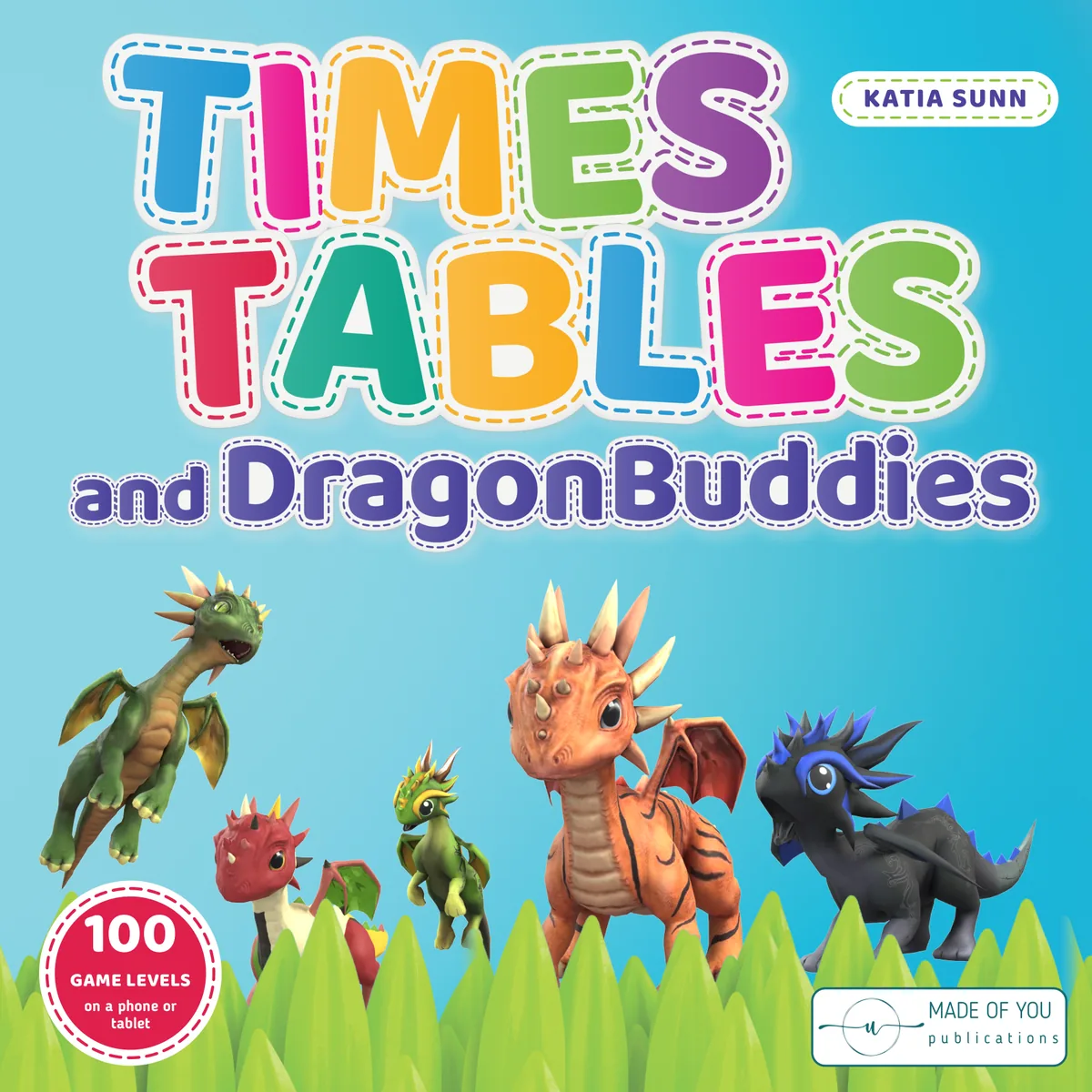
Times Tables and DragonBuddies
by Katia Sunn · Made Of You, 2026
- Ages
- 7 to 10
- Kind
- Picture book with tricks, and a game
- Tables
- 2 to 11, no 12
- How much practice
- A little
Renata the cat sets out to free ten dragons that Lazy Ladon, a grumpy old dragon who hates math, has locked in cages. Each cage opens with one table. The tables come in the order 10, 5, 2, 4, 8, 7, 3, 6, 9, 11, and every answer your child already knows from an earlier table is printed in orange, so by the 9s only 9 × 9 is new. Each table gets a double page: the whole table on a blackboard, with its tricks beside it.
Every table page has a QR code that opens that table's cube game in the browser of a phone, tablet or computer, with no app and no account. Each level is one fact, said out loud when it's solved. Five levels and a padlock open the cage, the other five give the dragon its fire back, and then it steps into your room. Levels 1 to 5 of every table are free on our site, so you can try the game before you buy the book.
Know its limits before you choose it. At 30 pages it's a way into the tables, not a year of practice. There is no 12 times table, which matters if your school wants 12 × 12, as England's Year 4 check does, and the practice needs a screen. It came out in October 2026, so it has no track record yet, and it's a paperback printed by Amazon.
How much practice: There's nothing to fill in on paper. The book holds the story, the tables and their tricks, and the practice is the game: ten short levels for each table, 100 in all, on a phone, tablet or computer.
Time it takes: About 10 minutes to read through, then a table at a time
Best for: A 7 or 8 year old starting the tables who likes dragons, with a grown-up who will sit in on the first few levels.
Checked October 6, 2026
How we chose
Three parent questions shaped this list: a fun book for an 8 year old who is struggling and says math is boring, the best book for a 7 or 8 year old, and something for England's Year 4 check. We sorted the answers by what each book does, because a memory method, a picture book and a workbook fix different problems, and one ranking of story books and drill pages together would compare things that do different jobs.
For every book we read the publisher's page or a library record for the author, the year, the page count and the age range, and we say where each age came from. Which tables a book covers comes from the publisher too; where only parents' reviews say it, we tell you. Time claims like “30 days” are the publishers' own, and we haven't tested them. Reading times for the picture books are our estimates.
We left out books we couldn't check: a popular new memory method book whose details are only on Amazon, a timed test workbook with no publisher page, and a much loved picture book that seems to be out of print. Times Tables and DragonBuddies is ours (Katia wrote it), which is why it has a box of its own below the list, with what it can't do written out. No publisher paid or asked to be on this page. If a book we left out worked for your child, write to us at info@madeofyou.com.
Questions
What parents ask
- My 8 year old is struggling with the times tables and says math is boring. Is there a book that helps?
- First find out what's boring. If it's chanting the same tables, a memory method like Times Tales or Times Tables the Fun Way turns the hardest facts into silly stories. If math itself feels like a curse, Math Curse is a funny book about exactly that. If your child can't see the point, The Best of Times shows how each table grows out of an easier one. A book gets them started. Five or ten minutes of practice most days does the rest.
- What are the best books to help a 7 or 8 year old learn multiplication?
- It depends on what's missing. If they don't yet see what multiplying is, try 2 x 2 = Boo! or One Hundred Hungry Ants. If they get it but can't hold on to the hard facts, try a memory method. If they need a plan with daily practice, Multiplication Facts That Stick is led by a parent, and Kumon Grade 3 Multiplication is one they can work through more on their own. Most children need two books: one way in, and one for practice.
- Do memory tricks and stories really work, or should my child just practice?
- They do different jobs. A story or a trick gets a hard fact into memory the first time. Practice makes it quick enough to use without thinking, which is what a timed test asks for. The story books here mostly cover the hard middle facts and expect practice alongside. Plain drill on its own works for some children, but it's the slow way for the ones who keep forgetting 7 × 8.
- Which times tables books cover the 12 times table?
- On this page, the Usborne Times Tables Activity Book covers every table from 2 to 12, and Times Tales reaches 12 with its extra workbook. Most US books stop at 9 or 10, and ours stops at 11. In the US the Common Core standards ask for the products of two one-digit numbers by the end of Grade 3, so up to 9 × 9. England's national curriculum asks for the tables up to 12 × 12 by the end of Year 4, and that's what the Year 4 check tests.
- Is a workbook enough on its own?
- For some children, yes: Kumon and CGP both work by steady daily pages. A workbook explains very little, though, so a child who is stuck on why, or who forgets the same facts every week, usually needs a way in first: a picture book, a book of tricks or a memory method. Then the workbook makes it stick.
Free on our site, no book needed
How to learn the times tables, in an order that halves the work · a page and a dragon game for every table · worksheets · flash cards · a times tables test · practice for the Year 4 check · the 12 times table