Four siblings, four seasons · ages 4 to 8
The four seasons for kids
Spring, Summer, Fall and Winter are siblings in our book. Here's what each one brings, and why we have seasons at all.
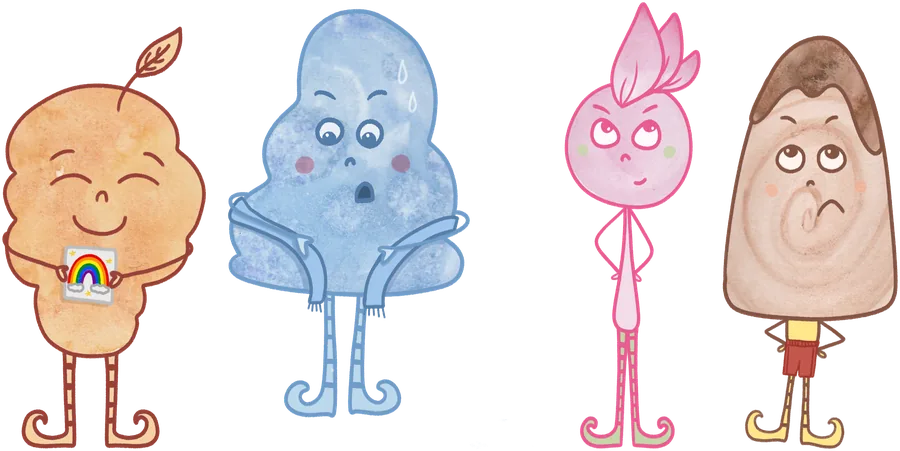
In our picture book Finding Gratitude, the four seasons meet for one snowy evening. Spring is a little sarcastic, Summer melts by the fire, Winter is always in a rush and Fall turns up late and happy. Meet them, find their months where you live, and print a chart, a wheel to spin and sorting cards.
Print · free, no sign-up
Free four seasons printables
A chart with the four siblings and their months, a wheel to cut out and spin with a paper fastener, sorting cards, a “my favorite season” sheet and a four seasons tree. US Letter and A4, color and black and white. No email, no account.
The siblings as coloring pages, one by one or all together, are with our gratitude coloring pages.
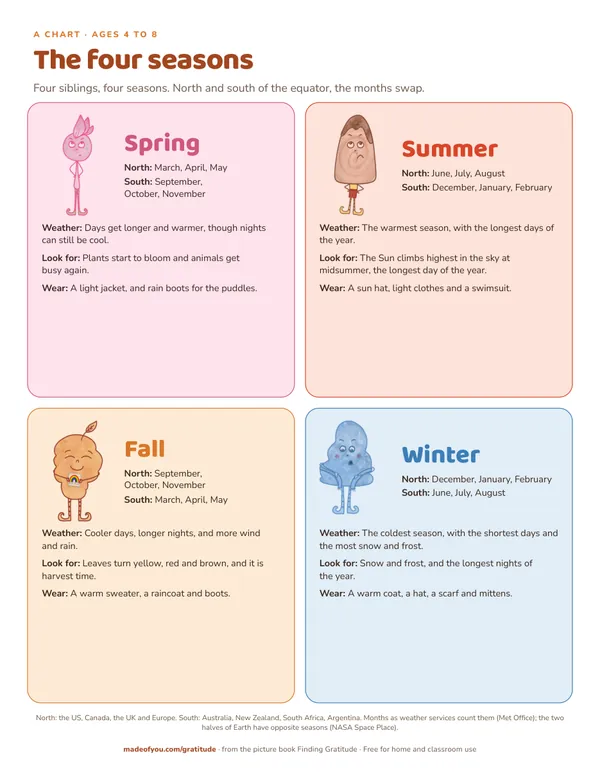
Four seasons chart
The four siblings, each with its months north and south of the equator, the weather, what to look for and what to wear.
Ages 4 to 8 · 1 page · PDF
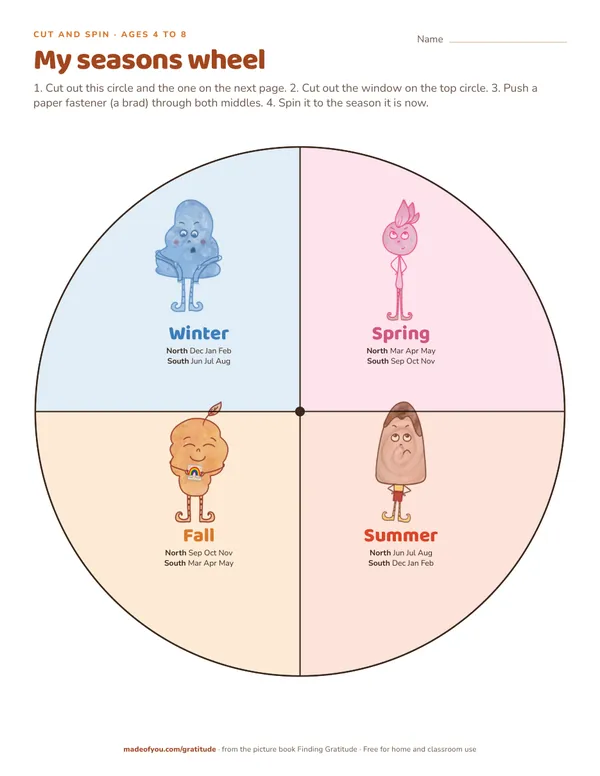
Seasons wheel to cut and spin
Two circles and a paper fastener: spin the top circle and the window shows one season at a time.
Ages 4 to 8 · 2 pages · PDF
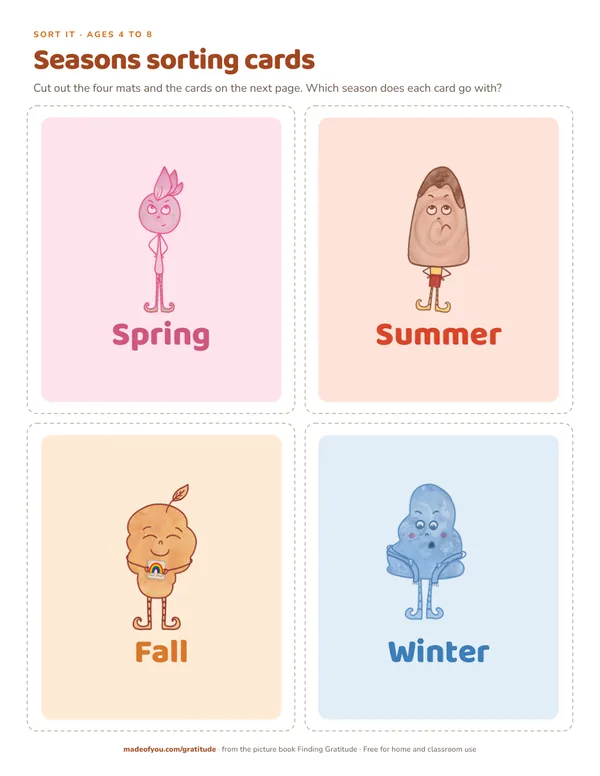
Seasons sorting cards
Four season mats with the siblings and 16 cards to sort, each with a box to draw it.
Ages 4 to 8 · 2 pages · PDF
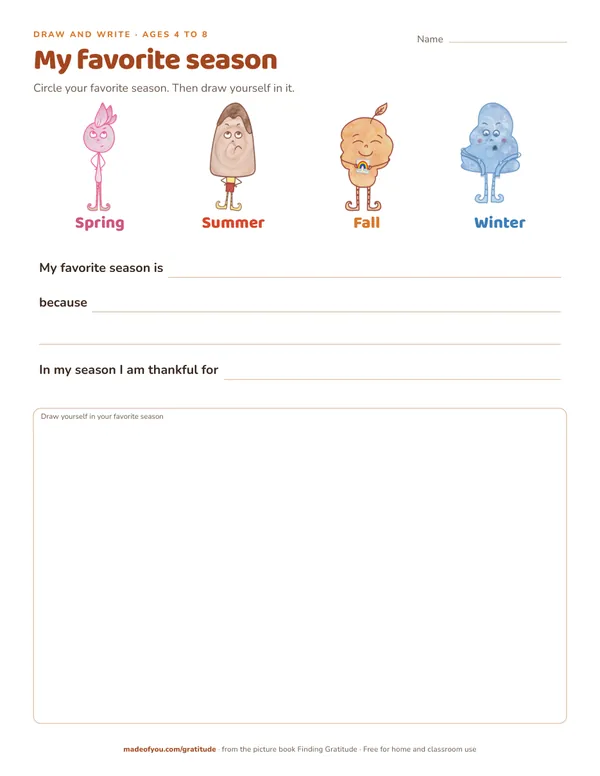
My favorite season
Circle a season, say why, and draw yourself in it.
Ages 4 to 8 · 1 page · PDF
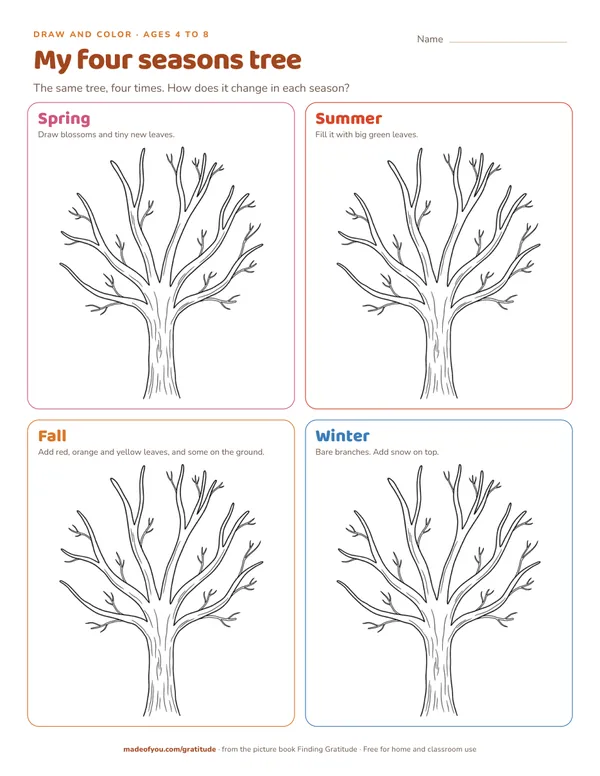
My four seasons tree
One tree drawn four times: add blossoms, green leaves, autumn leaves and snow.
Ages 4 to 8 · 1 page · PDF
Free for home and classroom use. To pass them on, please share the link to this page and not the file.
Four siblings
Meet the four seasons
Each season has its own weather, its own months and its own character. The characters come from the book; the facts come from weather scientists, linked under each one.
Spring
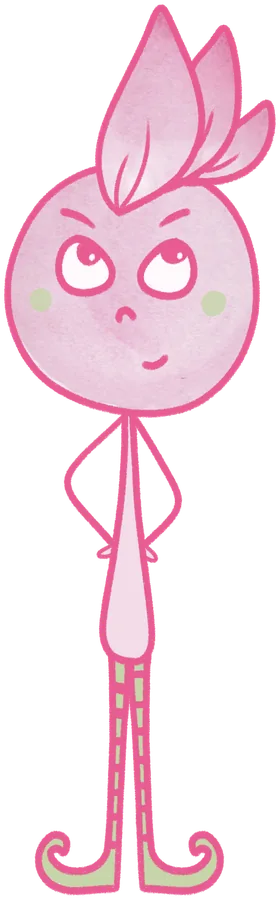
A bit annoyed and a little sarcastic. She gets bored when Fall is away, but she runs straight at him when he comes.
- North
- March, April, May
- South
- September, October, November
- Weather
- Days get longer and warmer, though nights can still be cool.
- Look for
- Plants start to bloom and animals get busy again.
- Wear
- A light jacket, and rain boots for the puddles.
- Try
- Plant a seed, look for the first flowers, splash in a puddle.
Did you know? Spring is also called the vernal season, from an old Latin word for bloom.
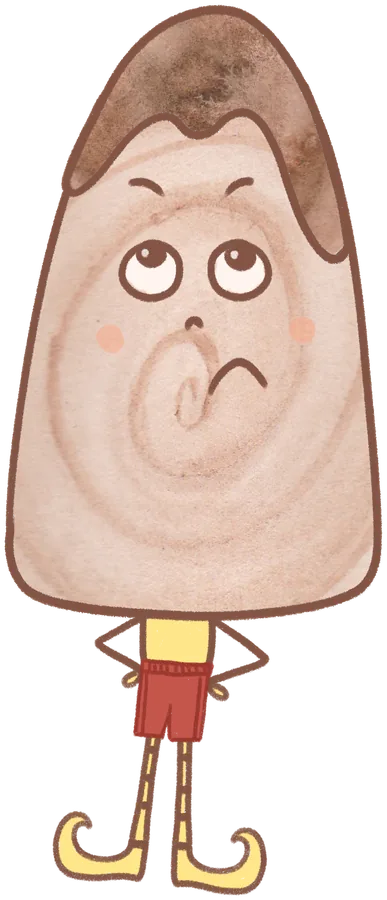
Summer
Loves the heat but melts by the fire, so she lives on the balcony. She needs Winter's snow to cool down.
- North
- June, July, August
- South
- December, January, February
- Weather
- The warmest season, with the longest days of the year.
- Look for
- The Sun climbs highest in the sky at midsummer, the longest day of the year.
- Wear
- A sun hat, light clothes and a swimsuit.
- Try
- Build a sandcastle, eat an ice pop, watch the clouds.
Did you know? Summer is warm because your half of Earth leans toward the Sun, not because Earth is closer to it.
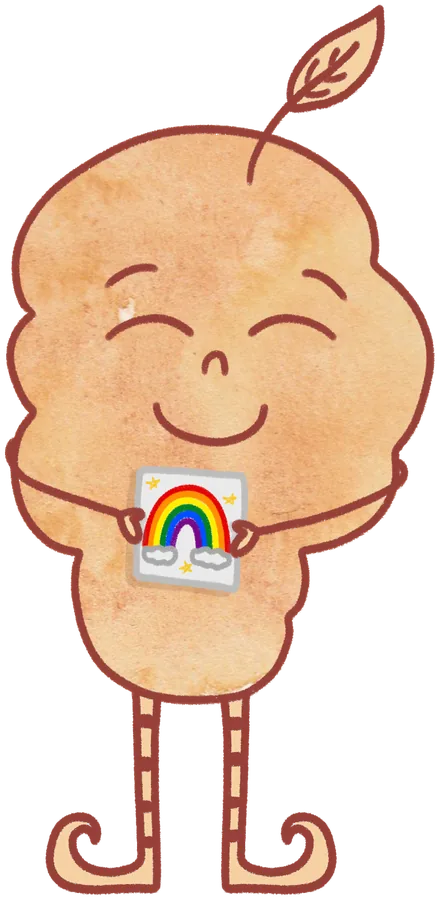
Fall
Arrives late and full of joy, in his coat with the big leaves. He keeps a notebook of the moments he felt grateful.
- North
- September, October, November
- South
- March, April, May
- Weather
- Cooler days, longer nights, and more wind and rain.
- Look for
- Leaves turn yellow, red and brown, and it is harvest time.
- Wear
- A warm sweater, a raincoat and boots.
- Try
- Jump in a pile of leaves, pick apples, collect the prettiest leaf.
Did you know? The name fall comes from an old way of saying it: the fall of the leaf. Its other name is autumn.
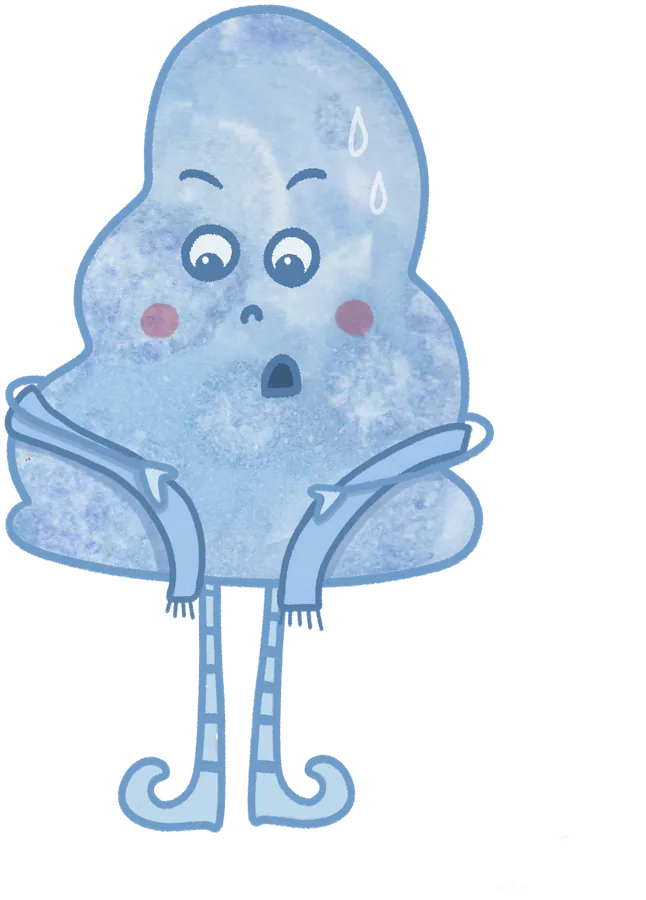
Winter
Always in a rush, with a honey-cake in the oven. He has only a moment with Fall before he takes over.
- North
- December, January, February
- South
- June, July, August
- Weather
- The coldest season, with the shortest days and the most snow and frost.
- Look for
- Snow and frost, and the longest nights of the year.
- Wear
- A warm coat, a hat, a scarf and mittens.
- Try
- Build a snowman, drink something warm, count the stars on a long night.
Did you know? Wet, sticky snow is best for snowmen and snowballs. Dry, powdery snow is best for skiing.
Seasons and months
The months of each season, north and south
Weather services count each season as three whole months, which makes it easy to remember. The two halves of the world have opposite seasons, so when it's summer in the US, Canada and the UK, it's winter in Australia, New Zealand, South Africa and Argentina.
| Season | North of the equatorUS, Canada, UK, Europe | South of the equatorAustralia, South Africa, Argentina |
|---|---|---|
| Spring | March, April, May | September, October, November |
| Summer | June, July, August | December, January, February |
| Fall | September, October, November | March, April, May |
| Winter | December, January, February | June, July, August |
Months as weather scientists count them: Met Office. Opposite seasons in the two halves: NASA Space Place. Astronomers start the seasons a few weeks later, on the equinoxes and solstices (around 20 March, 21 June, 22 September and 21 December in the north: Met Office).
For a 6 year old
Why do we have seasons?
Because Earth leans. Here it is in six small steps. Try it with an orange and a lamp: tip the orange a little and walk it around the lamp.
Earth spins around an invisible pole through its middle, from top to bottom. One turn takes a day: that's why we have day and night. (NASA Space Place)
That pole doesn't stand up straight. It leans over a little, about 23.5 degrees, like a spinning top that tips to one side. (Met Office)
Earth goes all the way around the Sun once a year, and the lean always points the same way in space. (National Weather Service)
Around June, the top half of Earth leans toward the Sun. The Sun's rays hit it more directly, so the north has summer and the south has winter. (NASA Space Place)
Around December, it's the bottom half's turn to lean toward the Sun. Now the south has summer and the north has winter. (NASA Space Place)
It isn't about being closer to the Sun. Earth is actually closest to the Sun in January, in the middle of the north's winter. (NASA Space Place)
On a phone or tablet
Spin the seasons wheel
Pick your half of the world, then spin, or ask the wheel which season it is today. The paper wheel to cut out is in the printables above.
Spring
North of the equator: March, April, May
Days get longer and warmer, though nights can still be cool.
Plants start to bloom and animals get busy again.
From the book
Something to be thankful for in every season
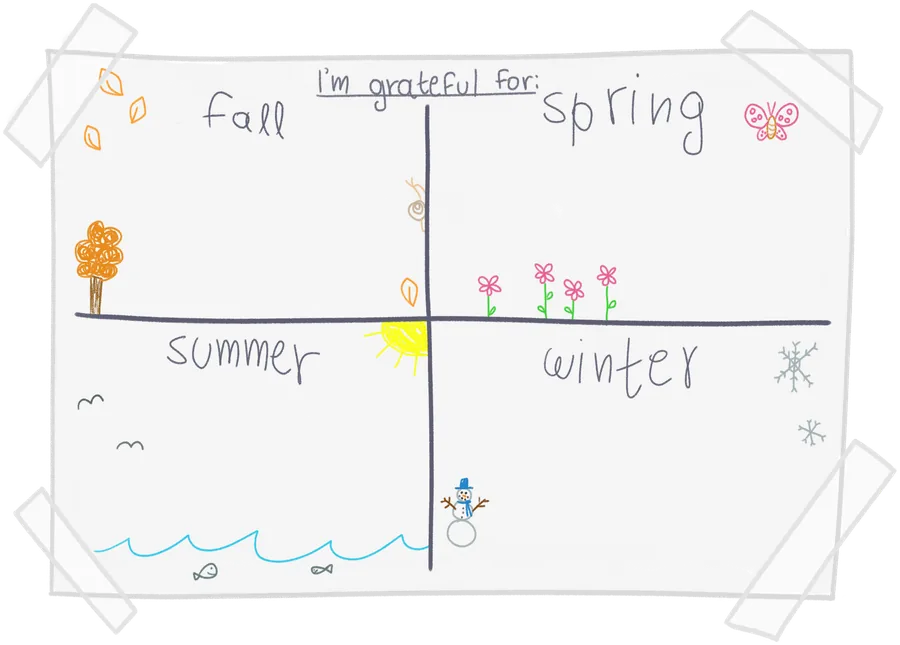
At the end of the book, Fall paints four large boxes and heads them with the four seasons. In each, he puts one thing he's grateful for. Try it with your child at the turn of each season: what was good about the season that's ending, and what are we looking forward to?
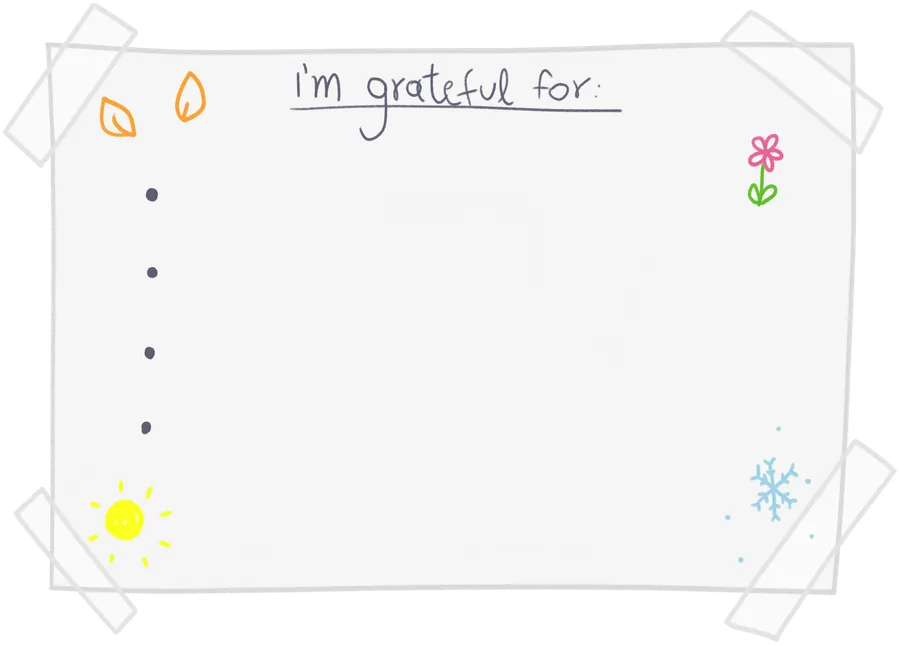
Fall's four boxes are there to print, with Fall, Spring, Summer and Winter at the top. And when “what are you thankful for?” gets a shrug, these questions help.
What do YOU think? What things are you grateful for today?
Where the facts come from
Every fact about the seasons on this page and its printables comes from one of these pages, read in October 2026:
- NASA Space Place: What causes the seasons?
- Met Office: What causes the seasons?
- Met Office: Spring, a season of change
- Met Office: Summer, the warmest season
- Met Office: Autumn, a burst of colour
- Met Office: Winter, the coldest season
- Met Office: Understanding equinoxes and solstices
- National Weather Service: The Seasons, the Equinox, and the Solstices
The siblings' characters are from the book. The clothes, the things to try and the sorting cards are our ideas.
Questions
Grown-ups ask
What are the four seasons in order?
Spring, summer, fall (also called autumn) and winter, and then spring again. North of the equator, spring starts in March. South of the equator, the same order starts in September.
What months are the seasons?
Weather services count each season as three whole months. North of the equator: spring is March, April and May; summer is June, July and August; fall is September, October and November; winter is December, January and February. South of the equator it's the other way round: summer is December to February and winter is June to August.
Why do we have seasons? (an answer for kids)
Because Earth leans. Earth spins around an invisible pole that tips over a little, and it always tips the same way as Earth goes around the Sun once a year. When your half of Earth leans toward the Sun, the Sun's rays hit it more directly and it's summer. When it leans away, it's winter. It isn't about being closer to the Sun: Earth is closest to the Sun in January.
Why is it summer in Australia at Christmas?
Because Australia is in the southern half of the world. Around December, the southern half leans toward the Sun, so it has summer while the northern half has winter. The two halves always have opposite seasons.
Is it fall or autumn?
Both are right. The name fall comes from an old way of saying it, the fall of the leaf. In the US people mostly say fall; in the UK, autumn. In our book, the leaf season is a happy character called Fall.
How do I teach the seasons to a preschooler?
Start with what they can see and feel today: is it warm or cold, what are the trees doing, what are we wearing? Then sort things into seasons (our sorting cards help), spin the wheel to today's season, and tie it to their own year: their birthday, a holiday, the first snow or the first flowers. The why can come later, around 6 or 7.
What is Finding Gratitude?
Our picture book for ages 4 to 8, coming this October. Four siblings, the four seasons, meet for one snowy evening, and Fall shows them the notebook where he colored the moments he felt grateful. The pictures on these pages come from it.
More gratitude
- Gratitude for kidsThe book's four activities, a short guide for grown-ups and every free sheet.
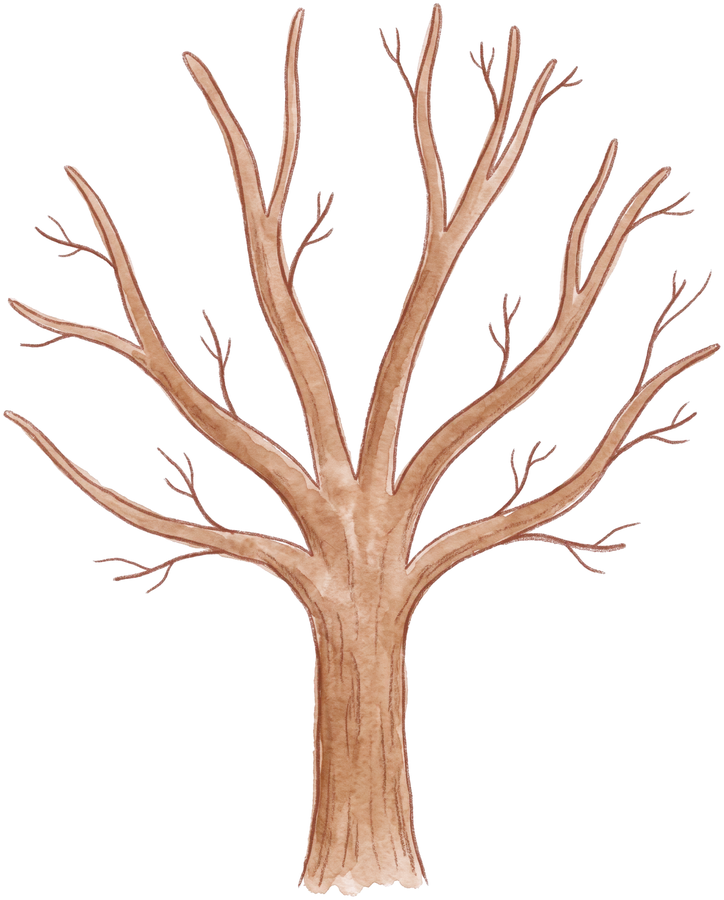 Thankful treeA printable tree and Fall's leaves, in words or pictures, and a leaf a day.
 "I am thankful for" sheetsFall's four boxes as sheets by age: draw, trace or write, with a "because".
 Things to be thankful for100 ideas and questions by age, for dinner, the car or bedtime.
 Gratitude jarThe book's family box of gratitude: prompts, slips to print and a jar label.
 Thank you notes for kidsCards to fill in or draw in, and the book's hide-a-note game.
 Gratitude journal for kidsDraw three things a day, like Fall's notebook: 7 days or 30.
- Gratitude coloring pagesThe book's own line drawings, with a thankful box to fill on every page.
Free tonight
Fall's 7 Thankful Nights
A short thankful moment at bedtime for 7 nights, with Fall and a gentle voice, on a phone or tablet. Night 1 is free and opens right away. If your child likes it, we can email you the other six, one a night.
Open night 1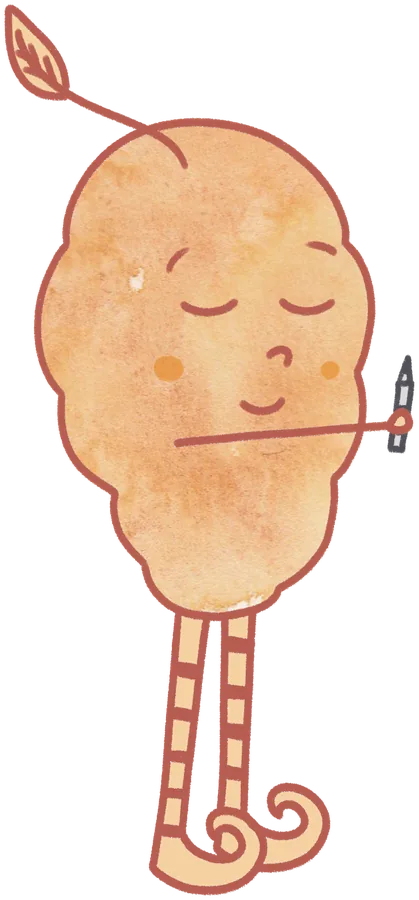
Meet the book
Finding Gratitude
Our picture book for ages 4 to 8 · coming this October
Four siblings, the four seasons, meet for one snowy evening: Fall full of joy, Spring a bit annoyed, Summer melting away and Winter in a rush.
A story about the love that siblings share, and how Fall found gratitude by changing the way he looks at his days.
Fall, his siblings and every picture on these pages come from it. The book isn't out yet.