Free printables · ages 3 to 8
Thank you notes for kids
Cards to fill in, cards to draw on, and a little note to hide.
Free thank you cards for every age: fill-in lines for little writers, big boxes for little drawers, a letter for early writers and a card that folds. Plus how to help at each age, and the hide-a-note game from our picture book Finding Gratitude.
Print · free, no sign-up
Free printable thank you cards for kids
Fill-in cards four to a page, cards to draw on for the youngest, a letter with more lines for 7 and 8 year olds, cards for helpers and for presents, and one page that folds into a card. Every sheet comes in US Letter and A4, in color and in black and white. No email, no account.
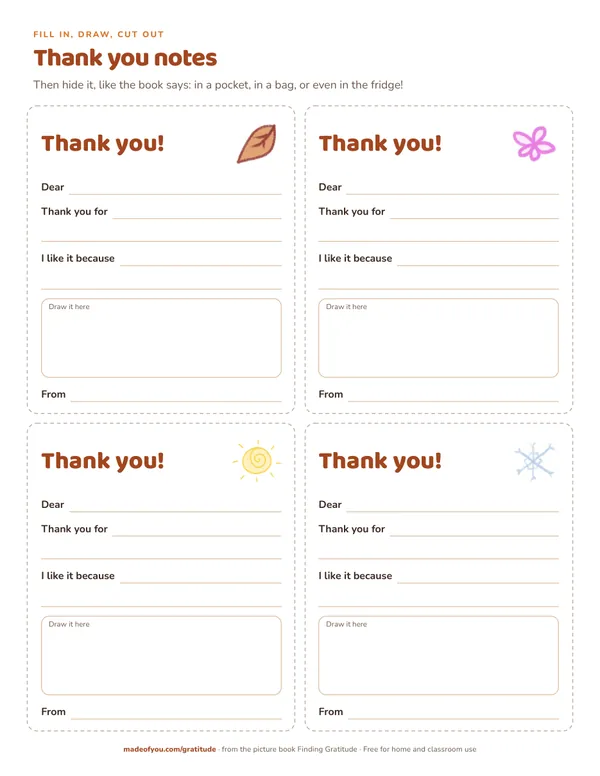
Thank you notes
Four notes to a page: who it's for, what for and why, a box to draw in and a line to sign. Then hide it, like the book says.
Ages 4 to 8 · 1 page · PDF
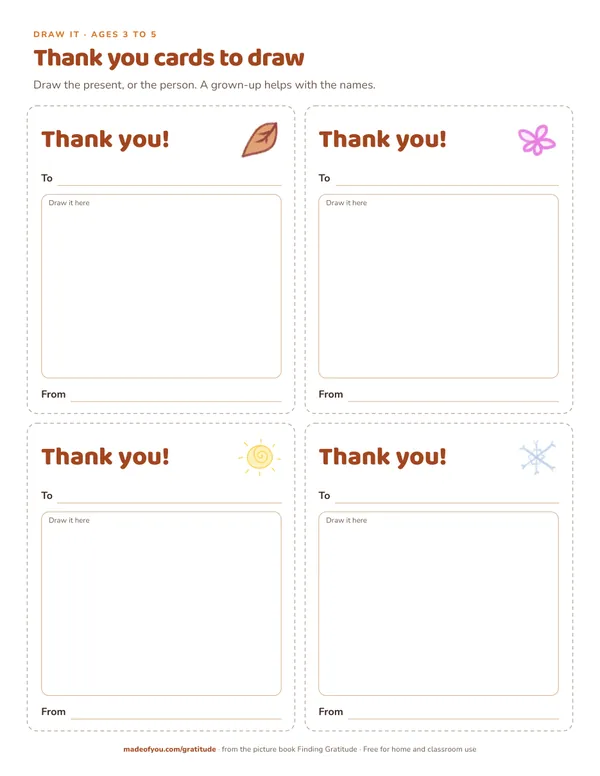
Thank you cards to draw
Four cards a page with a big box to draw the present or the person, and lines for To and From. For little ones.
Ages 3 to 5 · 1 page · PDF
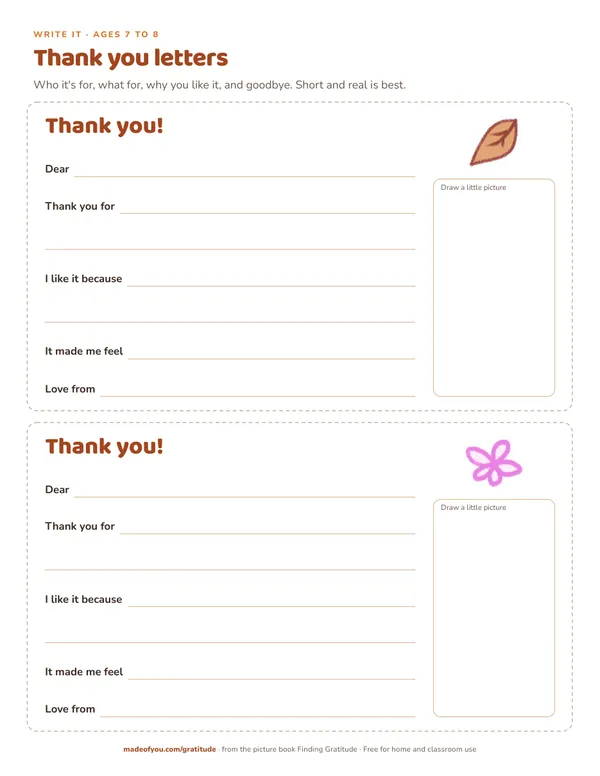
Thank you letters
Two to a page, with more lines for early writers: what for, because, how it made me feel, and a little box to draw.
Ages 7 to 8 · 1 page · PDF
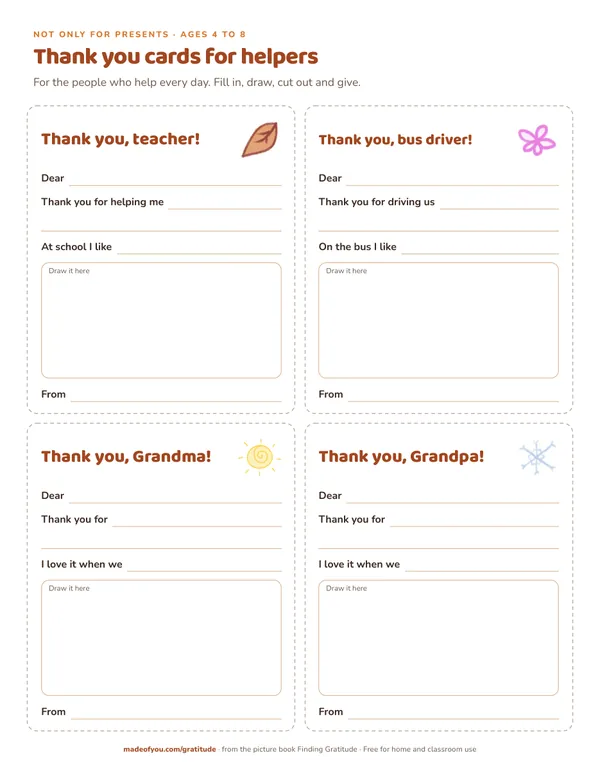
Thank you cards for helpers
Eight cards on two pages: a teacher, the bus driver, Grandma, Grandpa, a friend, a doctor or nurse, the mail carrier and the chef at home.
Ages 4 to 8 · 2 pages · PDF
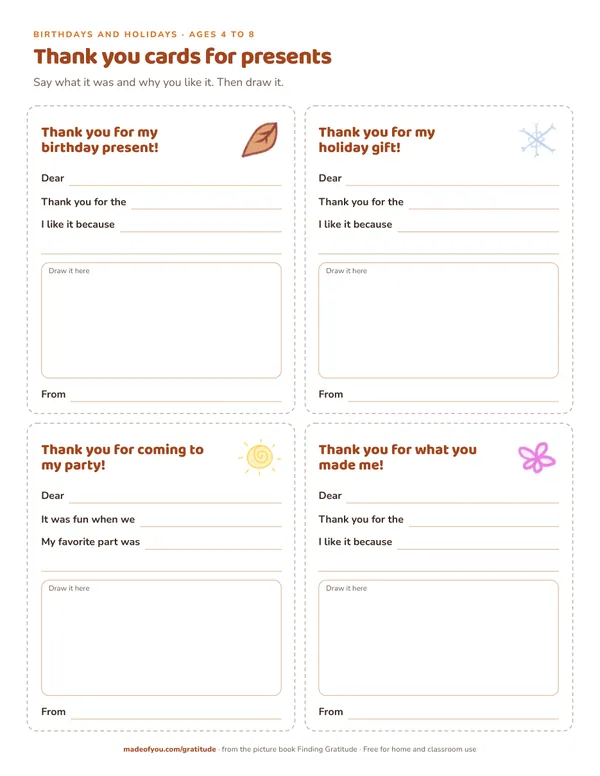
Thank you cards for presents
A birthday present, a holiday gift, coming to my party and something made for me: four cards to fill in and draw.
Ages 4 to 8 · 1 page · PDF
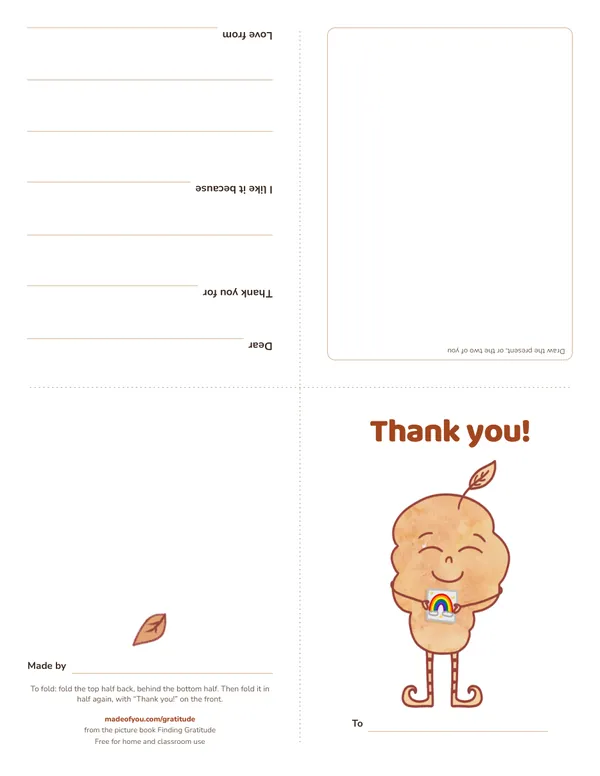
A thank you card to fold
One page folds into a real card: Fall on the front, a box to draw and the words inside. Fold it in half, then in half again.
Ages 4 to 8 · 1 page · PDF
Free for home and classroom use. To pass them on, please share the link to this page and not the file.
Made in your browser
Make a thank you card
Type who it's for, what for and who it's from, pick a sibling for the front and print. The card folds from one page. The “because” and the drawing inside are left for your child.
4. Who goes on the front?
To keep a PDF, choose “Save as PDF” in the print window. Then fold the top half back, and fold it in half again.
The words stay on your device. The card is drawn right here in your browser. Nothing you type is sent to us or anyone else, and it is not saved: close the page and it is gone.
The card, as it prints (the inside is upside down until you fold it)
From the back of the book
The hide-a-note game
At the back of our book, Katia asks children to write a thank you note and hide it somewhere unexpected. We turned it into a game.
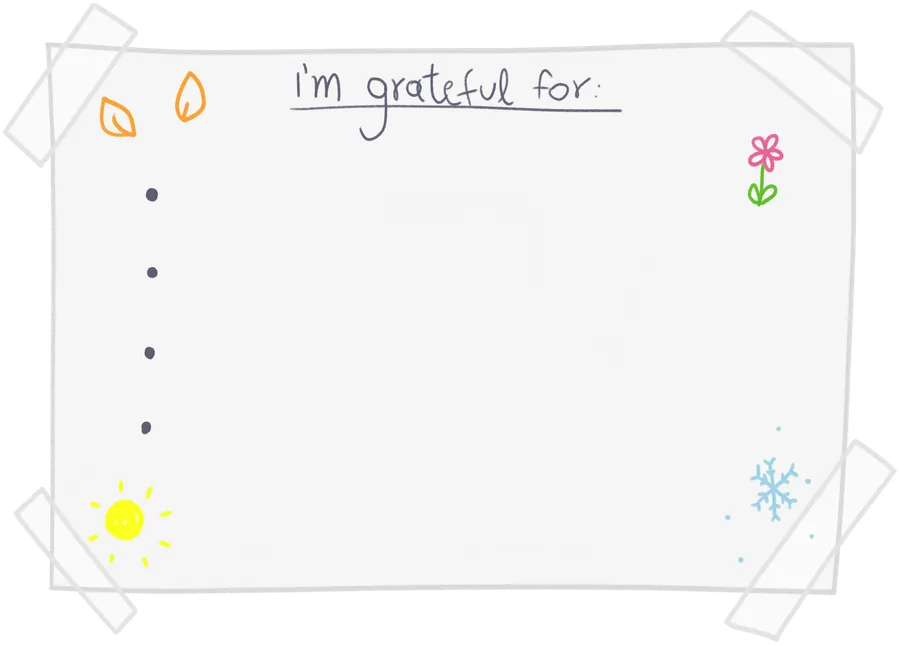
Write a “thank you” note
Katia's words, as printed in the book Take a piece of paper, color it and write “thank you” to someone you appreciate.Maybe you can draw something beautiful.Put the paper in an unexpected place, maybe in a pocket, in a bag, in the office, or even in the fridge!
How to play
Write or draw a tiny thank you
One line is plenty: "Thank you for reading to me." A drawing works for little ones who can't write yet.
Fold it small and hide it
Somewhere they'll find it later, when they don't expect it. The book's ideas: a pocket, a bag, the office or even the fridge.
Say nothing
The waiting is half the fun. Most kids can't keep the secret for long, and that's fine too.
Pass it on
Whoever finds a note hides the next one, for somebody else.
Grown-ups, go first: hide one for your child. Little ones love finding a note before they can read it, so a drawing and a heart are enough. Read it to them, then ask who they'd like to surprise.
Ten places to hide a note
- in a coat pocket (the book's idea)
- in a bag (the book's idea)
- in the office (the book's idea)
- in the fridge, next to the milk (the book's idea)
- in a lunchbox
- under a pillow
- in a shoe
- between the pages of a book
- taped to the bathroom mirror
- in the car, on the steering wheel
For grown-ups
How to help kids write thank you notes, by age
Each age adds a step to the one before. Little ones say thanks, then they draw it, then they tell it while you write, and by 7 or 8 most can write it themselves.
From age 2
Say it
Thank the giver together, face to face or on a video call. You say it first and they copy. A wave or a hug counts.
Ages 3 to 5
Draw it
They draw the present, or themselves playing with it. You write "Thank you" and the names, and they add their own squiggle of a signature.
Ages 4 to 6
Tell it while you write
Ask "What do you like about it?" and write their answer exactly as they say it. On a fill-in card they can copy one word, or write their name.
Ages 7 to 8
Write it
Three or four sentences: who it's for, what for, why they like it, and goodbye. Help with spelling only when they ask. A short note that sounds like them is better than a long, perfect one.
A note in six lines
What to write in a thank you note
Dear Grandma,
Who it's for.
Thank you for the dinosaur book.
Say what it is, so it doesn't sound like every other note.
I like it because the pictures are funny.
Why they like it. The real thanks is in the because.
I read it every night with Dad.
How they use it, or will. Givers love this part.
It was kind of you to pick it for me.
For older kids: the giver chose to do it. That's the Think step.
Love from Sam
Their name, however they write it. A scribble is a signature.
Why the because matters
Most thank yous stop at manners. The because is where a child starts to think about the giver: they chose it, it took them time, it's worth something to me. Researchers at the University of North Carolina call this the Think step of gratitude, and in parents' diaries it was the one they asked about least. Notice, think, feel and do has questions to ask.
In one school program, 8 to 11 year olds learned those three ideas about help. Two days later they wrote 80% more thank you notes than classes that hadn't. Younger children need more help with the why, so ask it out loud: “Why do you think Grandpa picked this one for you?”
From Andrea Hussong (UNC), Greater Good, 2017; Froh, Bono and colleagues, 2014: Nice Thinking!
Not only for presents
Thank you cards for teachers and helpers
The best thank you notes are often for help, not for things. A child who thanks the bus driver starts to notice the people behind an ordinary day. Our helper cards have eight: a teacher, the bus driver, Grandma, Grandpa, a friend, the doctor or nurse, the mail carrier, whoever made dinner.
The end of a school year, the last day before the holidays and a random Tuesday are all good days to give one. Let your child hand it over themselves.
In December, our free advent calendar by email, 24 Doors, has a day for a thank you card to a helper too.
After the holidays
January is thank you note season
The presents are open, the grandparents have gone home, and there's a pile of cards to write. Four habits keep it from turning into a chore.
- Make a list on the day. Who gave what, written down as the paper comes off. In January nobody remembers.
- Set up a thank you corner. Printed cards, crayons, envelopes and stamps in one box on the table.
- One card a day. Ten minutes after breakfast, then it's done. Within a week or two is plenty.
- Mix the ways. A drawing for the little one, the fill-in card for the middle one, the letter for the oldest. A photo of them using the present, tucked in the envelope, always goes down well.
Birthdays work the same way: the cards for presents have one for a birthday present and one for coming to the party.
Questions
Grown-ups ask
How do I help a 4 year old write a thank you note?
At 4, they talk and you hold the pencil. Read each line of a fill-in card out loud, write down their answer in their own words, then hand over the crayons for the drawing and the name. One card a day is plenty.
What should a child write in a thank you note?
Four things are enough: who it's for, what the present was, why they like it, and their name. "Dear Uncle Leo, thank you for the red ball. I like it because it bounces higher than the fence. Love from Mia." From about 7, a child can add how they use it.
Is a drawing enough as a thank you?
Yes, for little ones a drawing is a real thank you. Write the giver's name and a line of their words next to it, and let them sign it however they can. Grandparents tend to keep these.
How soon should kids send thank you notes after the holidays or a birthday?
There is no deadline a child has to meet. A week or two after the party or the holidays is fine, and a late note still beats no note. For family far away, a drawing held up on a video call counts too.
Should I make my child write thank you notes?
Invite, don't force. A note written under protest teaches that thanks is a chore. Write yours next to them, let them draw instead of write, or try again tomorrow. Asking why the giver chose it often does more than any rule.
Is anything I type in the card maker sent anywhere?
No. The card is drawn in your browser, on your computer, phone or tablet. The names and words are not sent to us or to anyone else, not put in the page's address and not saved: close the page and they are gone. When you press Print, we count that a card was printed and which sibling is on it, never the words.
What if my child is disappointed with a gift?
Let the feeling come first. Name it ("you hoped for something else"), let it pass, and talk about the giver's effort later. Gratitude sits next to hard feelings; it does not replace them.
More gratitude
 Gratitude for kidsThe book's four activities, a short guide for grown-ups and every free sheet.
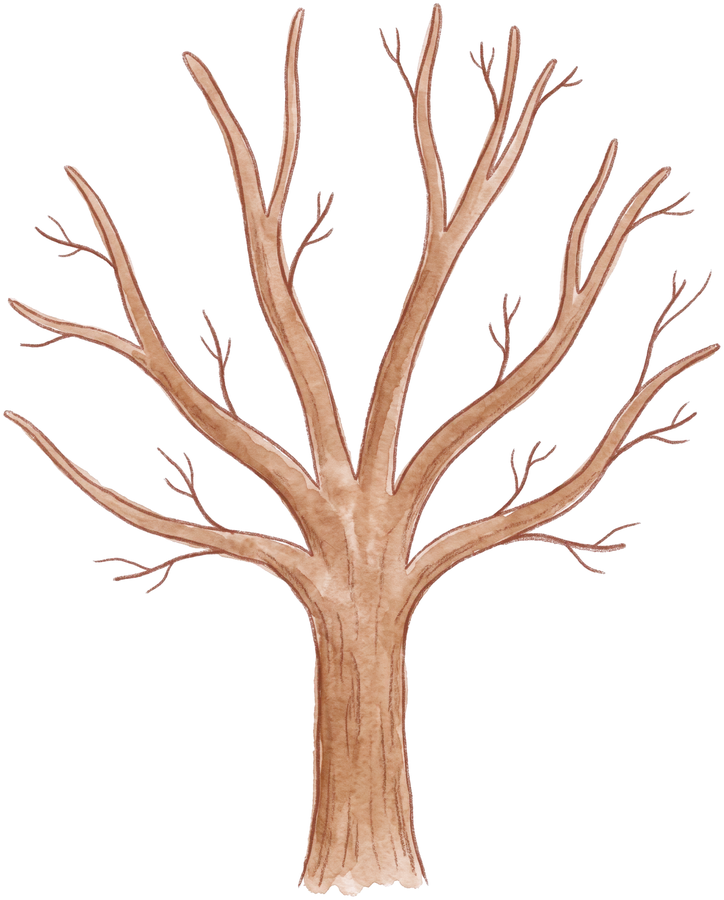 Thankful treeA printable tree and Fall's leaves, in words or pictures, and a leaf a day.
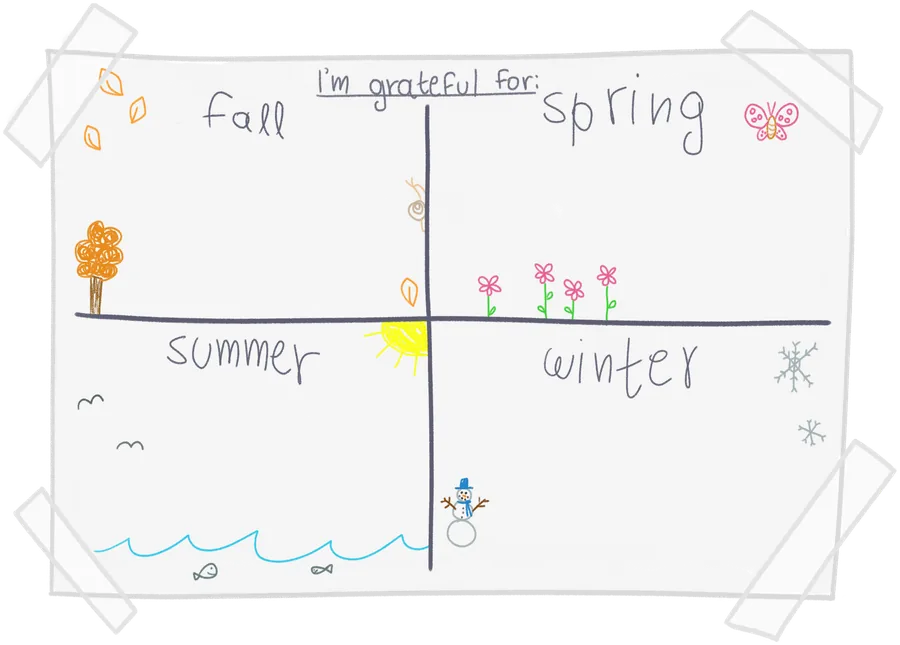 "I am thankful for" sheetsFall's four boxes as sheets by age: draw, trace or write, with a "because".
 Things to be thankful for100 ideas and questions by age, for dinner, the car or bedtime.
- Gratitude jarThe book's family box of gratitude: prompts, slips to print and a jar label.
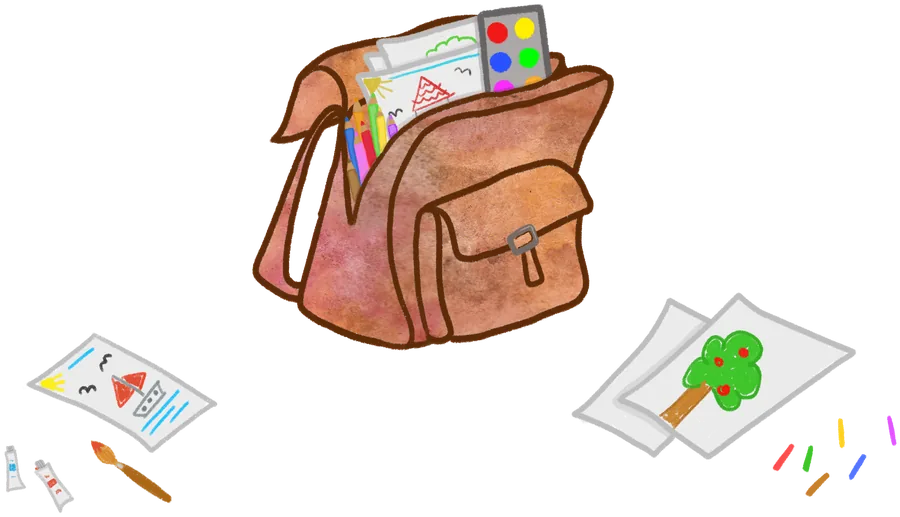 Gratitude journal for kidsDraw three things a day, like Fall's notebook: 7 days or 30.
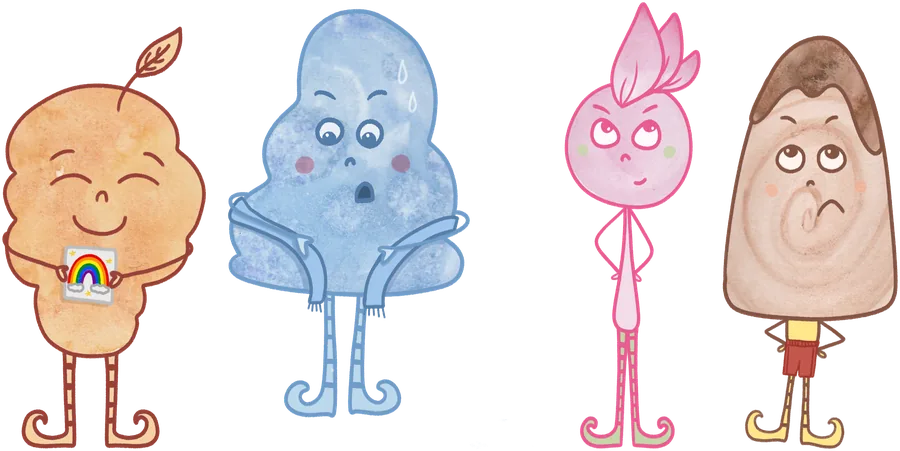 The four seasons for kidsFour siblings, four seasons: a chart, a wheel to spin and sorting cards.
 Gratitude coloring pagesThe book's own line drawings, with a thankful box to fill on every page.
Free tonight
Fall's 7 Thankful Nights
A short thankful moment at bedtime for 7 nights, with Fall and a gentle voice, on a phone or tablet. Night 1 is free and opens right away. If your child likes it, we can email you the other six, one a night.
Open night 1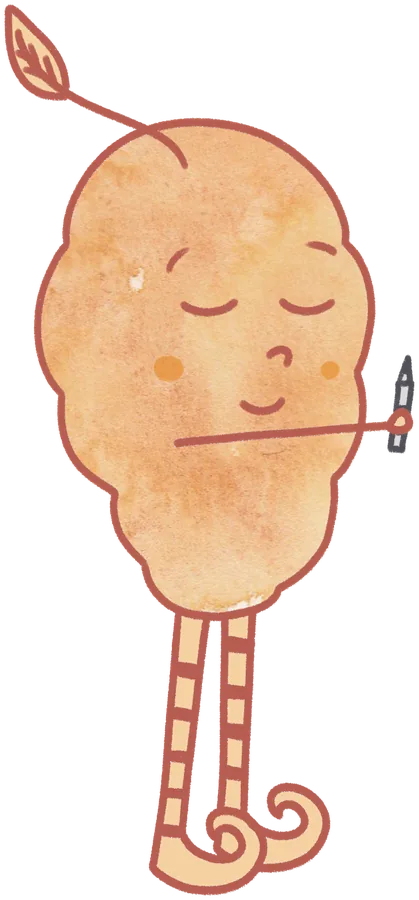
Meet the book
Finding Gratitude
Our picture book for ages 4 to 8 · coming this October
Four siblings, the four seasons, meet for one snowy evening: Fall full of joy, Spring a bit annoyed, Summer melting away and Winter in a rush.
A story about the love that siblings share, and how Fall found gratitude by changing the way he looks at his days.
Fall, his siblings and every picture on these pages come from it. The book isn't out yet.