Free printables · ages 4 to 8
Things to be thankful for
100 small, real things a child can be thankful for, and questions that get more than a shrug.
Our picture book Finding Gratitude ends with Fall asking the reader one question. Here is help with the answer, with ideas sorted by kind, 40 questions by age, rose bud thorn for any dinner, and question cards and a placemat for the Thanksgiving table.
What do YOU think? What things are you grateful for today?
Print · free, no sign-up
Free printables for home and the Thanksgiving table
The 100 things below as a list to color in, 24 question cards to cut out (one for each plate, grown-ups too), a thankful placemat for the kids' end of the table, and a Thanksgiving thankful board. Every sheet comes in US Letter and A4, in color and in black and white. No email, no account.
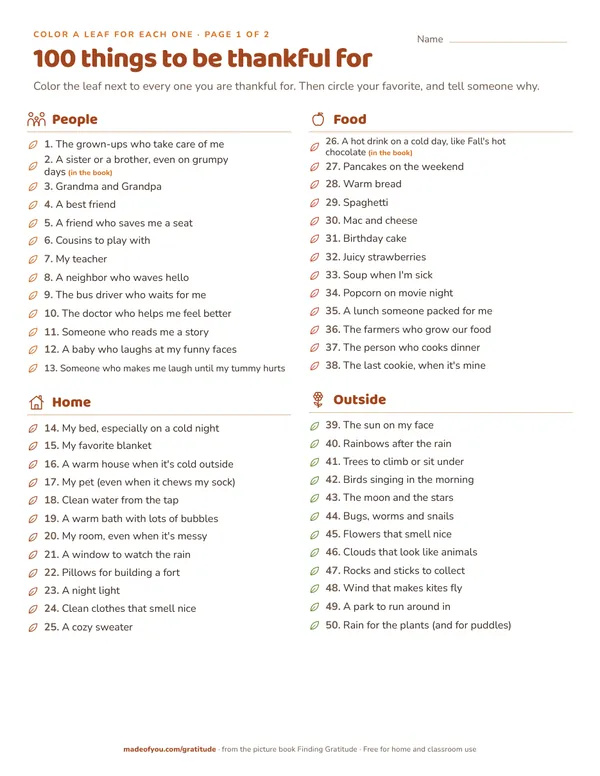
100 things to be thankful for
The whole list on two pages, with a leaf to color next to each one and lines to add your own. Then circle a favorite and say why.
Ages 4 to 8 · 2 pages · PDF
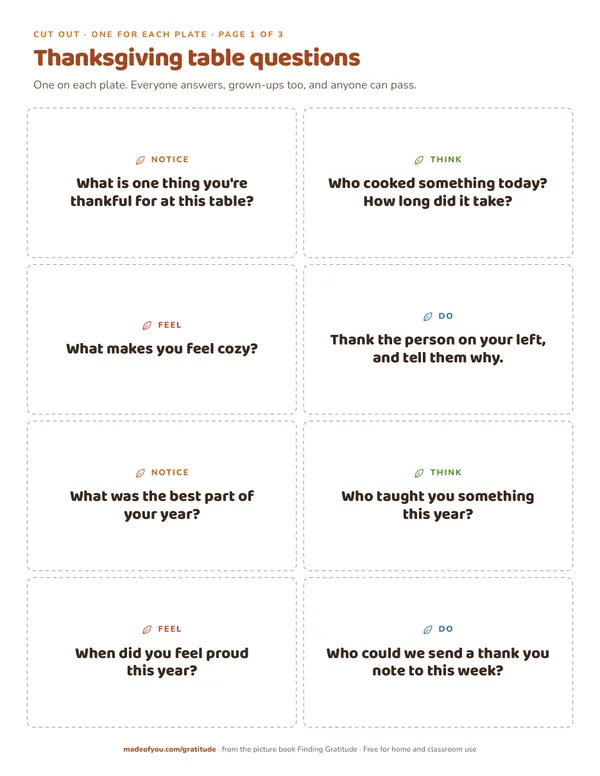
24 Thanksgiving table questions
Three pages of question cards to cut out, two for each step on every page (Notice, Think, Feel, Do). One on each plate; everyone answers, anyone can pass.
Ages 4 to 8 · 3 pages · PDF
Thankful placemat
For the kids' end of the table: four boxes to draw what they're thankful for, a space to draw everyone at the table, and three questions to ask a grown-up.
Ages 4 to 8 · 1 page · PDF
Thanksgiving thankful board
"This Thanksgiving I am thankful for": someone at my table, something yummy, something outside, someone to thank. One page to draw, one to write.
Ages 3 to 8 · 2 pages · PDF
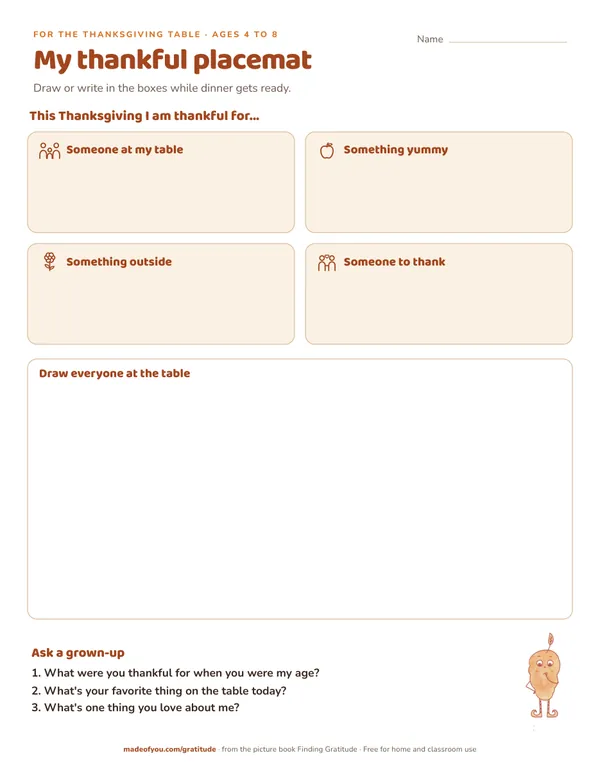
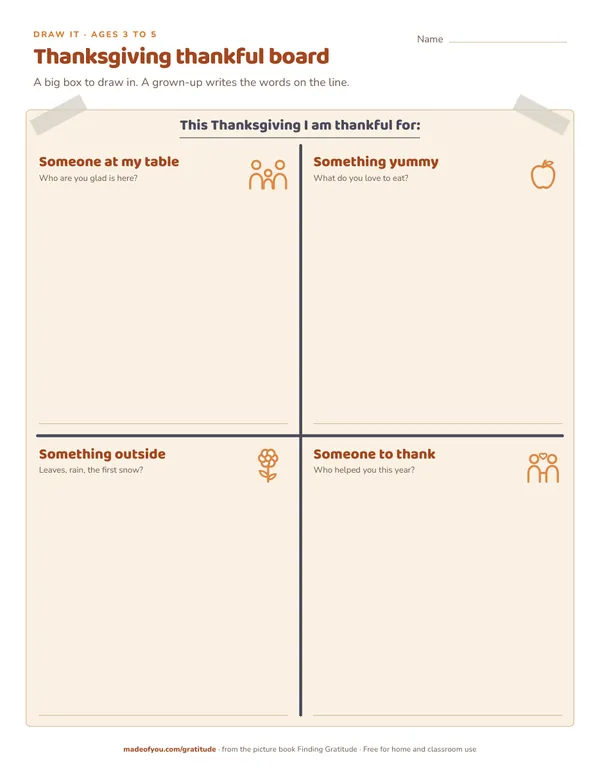
Free for home and classroom use. To pass them on, please share the link to this page and not the file.
Ideas for kids
100 things to be thankful for
Big words like “my health” mean little to a five year old. Small, real things mean a lot more, like the friend who saves a seat, a warm bath or the last cookie. Read one group aloud and let your child pick a favorite, or ask them to find one of each.
The ones marked in the book are what Fall and his siblings are thankful for in Finding Gratitude.
People
The ones who love you, and the helpers you see every day.
- 1.The grown-ups who take care of me
- 2.A sister or a brother, even on grumpy daysin the book
- 3.Grandma and Grandpa
- 4.A best friend
- 5.A friend who saves me a seat
- 6.Cousins to play with
- 7.My teacher
- 8.A neighbor who waves hello
- 9.The bus driver who waits for me
- 10.The doctor who helps me feel better
- 11.Someone who reads me a story
- 12.A baby who laughs at my funny faces
- 13.Someone who makes me laugh until my tummy hurts
Home
The cozy things you hardly notice until they're gone.
- 14.My bed, especially on a cold night
- 15.My favorite blanket
- 16.A warm house when it's cold outside
- 17.My pet (even when it chews my sock)
- 18.Clean water from the tap
- 19.A warm bath with lots of bubbles
- 20.My room, even when it's messy
- 21.A window to watch the rain
- 22.Pillows for building a fort
- 23.A night light
- 24.Clean clothes that smell nice
- 25.A cozy sweater
Food
Yummy things, and the people who make them.
- 26.A hot drink on a cold day, like Fall's hot chocolatein the book
- 27.Pancakes on the weekend
- 28.Warm bread
- 29.Spaghetti
- 30.Mac and cheese
- 31.Birthday cake
- 32.Juicy strawberries
- 33.Soup when I'm sick
- 34.Popcorn on movie night
- 35.A lunch someone packed for me
- 36.The farmers who grow our food
- 37.The person who cooks dinner
- 38.The last cookie, when it's mine
Outside
Sky, plants and animals, big and very small.
- 39.The sun on my face
- 40.Rainbows after the rain
- 41.Trees to climb or sit under
- 42.Birds singing in the morning
- 43.The moon and the stars
- 44.Bugs, worms and snails
- 45.Flowers that smell nice
- 46.Clouds that look like animals
- 47.Rocks and sticks to collect
- 48.Wind that makes kites fly
- 49.A park to run around in
- 50.Rain for the plants (and for puddles)

My body and my senses
What you can see, hear, smell, taste and do.
- 51.Legs that run and jump
- 52.Hands that draw and build
- 53.My nose, for smelling cookies
- 54.Ears to hear music
- 55.Eyes to see the people I love
- 56.Teeth for crunchy apples
- 57.A good night's sleep
- 58.A big belly laugh
- 59.Feeling better after being sick
- 60.Hugs
- 61.My brain, for good ideas
- 62.My voice, for singing loud
Play
Toys, games and the best kind of mess.
- 63.My favorite toy
- 64.A big box that becomes a rocket
- 65.Crayons and paper
- 66.Swings at the playground
- 67.A ball to kick
- 68.Books with pictures
- 69.Building blocks
- 70.Dress-up clothes
- 71.Bubbles
- 72.A game with my family
- 73.My bike or my scooter
- 74.Making music (even loud music)
- 75.Hide and seek
School
Learning, friends and the people who make school work.
- 76.Recess
- 77.Learning to read
- 78.Funny voices at story time
- 79.Friends in my class
- 80.The library
- 81.Art class and glue sticks
- 82.The people who cook school lunch
- 83.Show and tell
- 84.A backpack with lots of pockets
- 85.The crossing guard who keeps us safe
- 86.Learning something new
The seasons
In the book, the four seasons are siblings. Each one brings something.
- 87.Warm boots on the first cold dayin the book
- 88.Crunchy leaves to jump in
- 89.Apples and pumpkins
- 90.Honey-cakes, like Winter'sin the book
- 91.The first snow
- 92.Mittens and a scarf
- 93.Building a snowman
- 94.Flowers popping up in spring
- 95.Rain boots and puddles
- 96.Baby birds in a nest
- 97.Long, sunny summer days
- 98.Sand, shells and splashing
- 99.Ice pops that drip down my arm
- 100.A season I'm waiting for
For children who can't read yet, the same ideas come as pictures on the picture leaves of the thankful tree and the picture slips for the gratitude jar.
For grown-ups
When “what are you thankful for?” gets a shrug
Ask small
"What are you thankful for?" is a big question. "What was the yummiest bit of lunch?" is easy. Start there.
Go first
Say yours out loud, and make it small and real: "I'm thankful the bus was late, so I didn't miss it." Children copy what they hear.
Take the silly answers
"My socks" is a real answer. Ask what's good about the socks and who bought them, and you are already doing the Notice and Think steps.
Let them show it
Little ones can point, draw or pick a picture. A shrug is fine too; try again tomorrow.
Notice, Think, Feel, Do
40 gratitude questions for kids, by age
Each question belongs to one of four parts of gratitude described by researchers at the University of North Carolina. Notice is spotting the good thing, think is wondering why someone did it, feel is how it feels inside, and do is showing it. Little ones need a grown-up to ask, and one question at dinner or bedtime is plenty.
The Think questions are the ones most parents skip, and the ones worth adding from about age 5. More on the four steps in our guide to teaching gratitude.
Notice
Spot the good things, and the people behind them.
Ages 3 to 4
- What made you smile today?
- What's your favorite thing in this room?
- Who gave you a hug today?
Ages 5 to 6
- What was the best part of your day?
- Who helped you today?
- What do you have that you would really miss?
Ages 7 to 8
- What good thing happened today that you almost didn't notice?
- What everyday thing would you miss if it was gone?
- Who did something for you today that nobody asked them to?
- What did you see outside today that you liked?
Think
Wonder why someone did it. Did they have to?
Ages 3 to 4
- Who made your dinner?
- Who gave you that?
- Who helps you get ready in the morning?
Ages 5 to 6
- Why do you think your friend shared with you?
- Did they have to do that?
- What did they do to make it happen?
Ages 7 to 8
- What did they give up to help you: their time, their turn, a treat?
- Why do you think Grandma picked that present for you?
- How many people helped your lunch get to your plate?
- Did you earn it, or was it a gift?
Feel
How does it feel inside?
Ages 3 to 4
- Show me your happy face! What makes it come out?
- How did it feel when they played with you?
- What makes you feel cozy?
Ages 5 to 6
- How did it feel inside when they helped?
- Where do you feel happy: your tummy, your face, your hands?
- Which part made you feel the best?
Ages 7 to 8
- What's a word for how that felt?
- Can you feel thankful and sad at the same time?
- When did you feel safe and cozy this week?
- Who makes you feel brave?
Do
Find a way to show it.
Ages 3 to 4
- Shall we give them a hug or a high five?
- Shall we draw them a picture?
- Shall we say thank you together?
Ages 5 to 6
- How could we show them we liked it?
- What could you make for someone who helped you?
- Where could we hide a thank you note for them?
Ages 7 to 8
- Is there something kind you could do for someone else this week?
- Who would love a thank you note from you?
- How could you pass the good feeling on?
- What would you say to someone who made your week better?
The four steps come from Andrea Hussong (UNC), Greater Good, 2017; the idea of a daily question for each step from Greater Good in Action: Gratitude Questions for Kids. The questions are ours.
On a phone or tablet
Spin a gratitude question
Hand it to your child at dinner: they pick their age, spin, and ask the question to the whole table. It makes no sound, and nothing is saved or sent.
How old is your child?
Pick an age and spin. The wheel picks one of the four steps, and you get a question to ask at dinner, in the car or at bedtime.
A dinner game for every day
Rose, bud, thorn
A check-in many families and classrooms use, at dinner, in the car home or at bedtime. Everyone shares three things about their day. It takes two minutes, and it works all year, not only in November.
Rose
The best part of your day. A flower, a happy moment.
Bud
Something you're looking forward to. It hasn't opened yet.
Thorn
Something that was hard, or hurt, or went wrong.
How to play at dinner
- 1. A grown-up goes first, with a real thorn: “My thorn: I spilled coffee on my shirt before work.”
- 2. Everyone gets a turn. Little ones can share just one of the three. For ages 3 to 4, try “What was happy today? What was hard? What's next?”
- 3. Listen to the thorn. Don't fix it or hurry to the bright side. “That sounds hard” is enough.
- 4. End on the buds, so everyone leaves the table with something to look forward to.
Why the thorn is allowed
Feelings come first. A thankful habit that only takes happy answers can teach children to hide the hard ones. When a child can say “my thorn was when nobody played with me at recess” and be heard, the rose that comes next is a real one.
Children say themselves that being tired, cross or let down gets in the way of feeling grateful, and researchers suggest letting that disappointment be felt instead of talking it away. See the three things to keep in mind below.
In November
Thanksgiving conversation starters for kids
Put a question card on each plate, and before dessert everyone reads theirs out. The kids' end of the table gets the placemat and crayons while the food comes. Anyone can pass, and that includes grown-ups.
Thanksgiving is Thursday 26 November 2026. In Canada, Thanksgiving comes in October. And a thankful question works on any night of the year: the four seasons in the book find theirs on a snowy evening.
More for the table: a thankful tree to fill through November, a gratitude jar to read over dessert, and “I am thankful for” boards for every place.
Questions kids can ask the grown-ups
- 1.What was your favorite food when you were little?
- 2.What's the best present you ever got?
- 3.Who was your best friend when you were my age?
- 4.What's the silliest thing you did as a kid?
- 5.What were you thankful for when you were little?
- 6.What's your favorite thing about our family?
- 7.What made you laugh this year?
- 8.What did you learn from your grandma or grandpa?
- 9.If you had one superpower, what would it be?
- 10.What's one thing you love about me?
For grown-ups
Three things to keep in mind
Don't force the thank you
A thank you said on command can feel empty, and turns gratitude into a chore. Say your own thanks out loud, and invite theirs without pressure.
Let disappointment be felt first
When a gift or a day lets them down, name the feeling and let it pass before you talk about thanks. Gratitude sits next to hard feelings; it does not replace them.
Match what you expect to their age
Young children forget to say thanks because the skill is still growing, not because something is wrong. It comes with time, and with seeing you do it.
When the hard feeling is big, start there. Our calm-down ideas for kids help first; the thankful talk can wait for a calmer moment.
Questions
Grown-ups ask
What are some things kids can be thankful for?
Small, real things work best: a person (Grandma, a friend who saves a seat), home (a warm bed, a pet), food (pancakes, warm bread), outside (puddles, the moon), their body (legs that run, a nose for smelling cookies), play, school and the seasons. The list on this page has 100 of them in eight groups.
What are good gratitude questions for kids?
Short questions about today: what made you smile, who helped you, why do you think they did it, how did it feel, how could we show them. They follow four steps from researchers at the University of North Carolina: notice, think, feel and do. This page has 40, split by age, and a spinner that picks one.
What is rose, bud, thorn?
A quick check-in for dinner or bedtime. Everyone shares a rose (the best part of the day), a bud (something they are looking forward to) and a thorn (something that was hard). The thorn matters: it tells a child that hard feelings are welcome at the table too.
What if my child says they're thankful for nothing?
From a tired or cross child, that's a fair answer, so let it be. Name the feeling, try a smaller question ("what was the best part of recess?"), or say your own and move on. The thankful talk can wait for a better evening.
What are good Thanksgiving conversation starters for kids?
Questions kids can ask the grown-ups work well: what was your favorite food when you were little, who was your best friend at my age, what were you thankful for as a kid. Our 24 printable table cards mix questions for everyone, and anyone can pass.
At what age do children understand gratitude?
Toddlers can learn to say thank you before they can feel it. Around 5 to 7, many children start to see that someone made an effort for them, and from about 7 to 10 most children understand and show gratitude more reliably. With a 4 year old, saying thanks together and noticing nice things is plenty.
More gratitude
 Gratitude for kidsThe book's four activities, a short guide for grown-ups and every free sheet.
 Thankful treeA printable tree and Fall's leaves, in words or pictures, and a leaf a day.
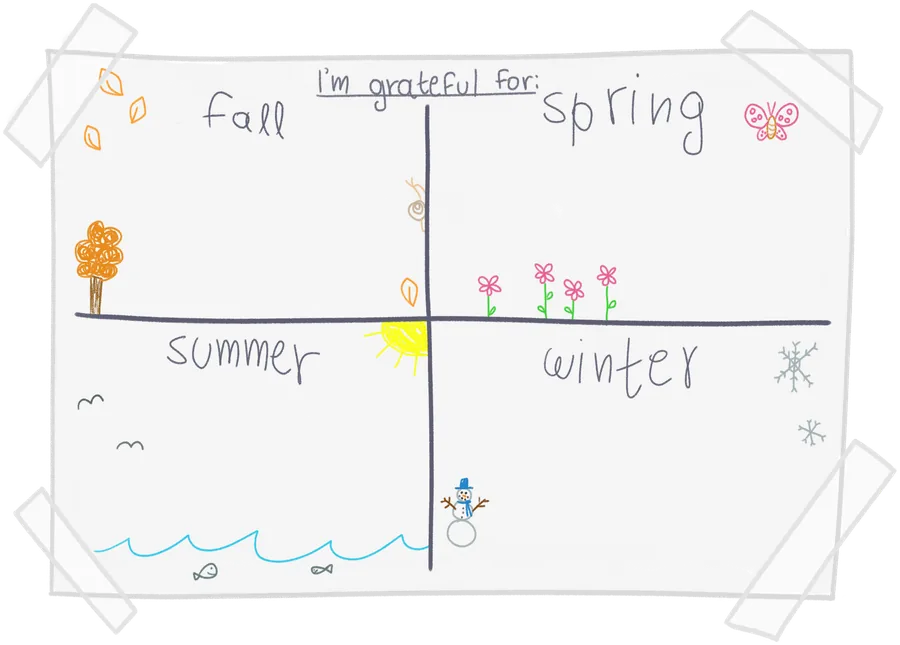 "I am thankful for" sheetsFall's four boxes as sheets by age: draw, trace or write, with a "because".
 Gratitude jarThe book's family box of gratitude: prompts, slips to print and a jar label.
 Thank you notes for kidsCards to fill in or draw in, and the book's hide-a-note game.
 Gratitude journal for kidsDraw three things a day, like Fall's notebook: 7 days or 30.
- The four seasons for kidsFour siblings, four seasons: a chart, a wheel to spin and sorting cards.
 Gratitude coloring pagesThe book's own line drawings, with a thankful box to fill on every page.
Free tonight
Fall's 7 Thankful Nights
A short thankful moment at bedtime for 7 nights, with Fall and a gentle voice, on a phone or tablet. Night 1 is free and opens right away. If your child likes it, we can email you the other six, one a night.
Open night 1
Meet the book
Finding Gratitude
Our picture book for ages 4 to 8 · coming this October
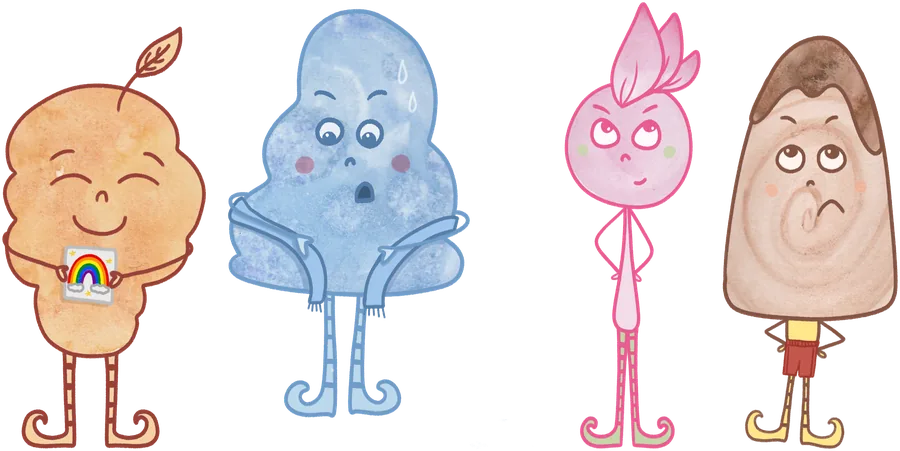
Four siblings, the four seasons, meet for one snowy evening: Fall full of joy, Spring a bit annoyed, Summer melting away and Winter in a rush.
A story about the love that siblings share, and how Fall found gratitude by changing the way he looks at his days.
Fall, his siblings and every picture on these pages come from it. The book isn't out yet.