
Free printables · ages 4 to 8
Thankful tree
A bare tree, a pile of leaves and one thankful thing on each. Then watch it fill up.
Fall, from our picture book Finding Gratitude, is the season of leaves, so his leaves make our thankful tree. Print a tree and leaves to write on, picture leaves for little ones who can't read yet, giant leaves for a classroom wall, or grow a tree on your phone or tablet, one leaf a day.
Print · free, no sign-up
Free thankful tree printables
A tree poster, leaves with “I am thankful for” and blank ones, picture leaves, twelve of Fall's own leaves, and for teachers a giant leaf per child and an “Our thankful tree” banner. Every sheet comes in US Letter and A4, in color and in black and white. No email, no account.
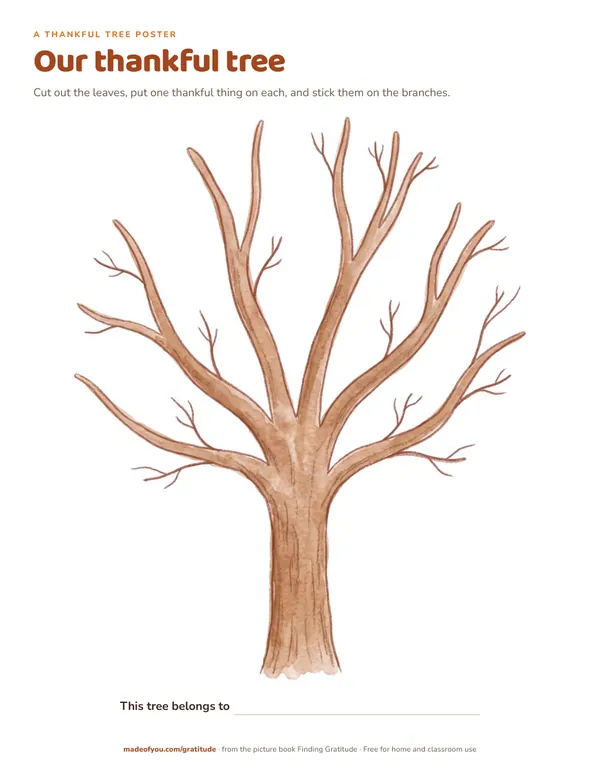
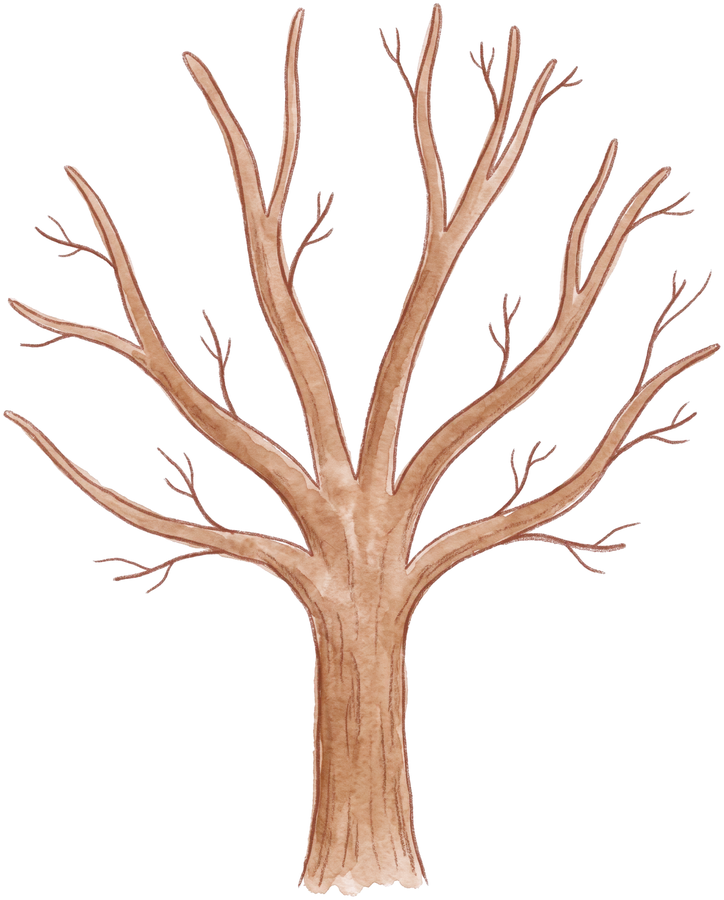
Thankful tree poster
A big bare tree to fill with leaves. Color: the painted tree. Black and white: the outline, to color in first.
Ages 4 to 8 · 1 page · PDF
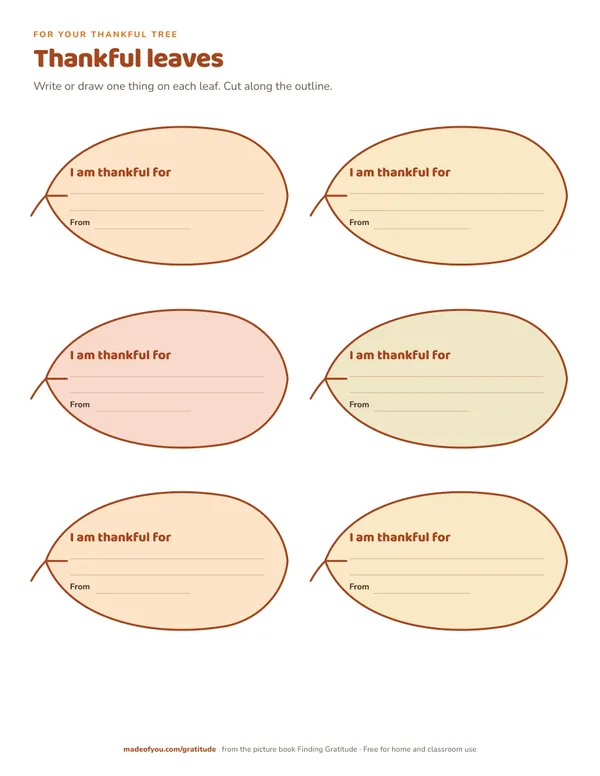
Thankful leaves to write on
Six big leaves a page: "I am thankful for" with lines and a "from", then a page of blank leaves.
Ages 5 to 8 · 2 pages · PDF
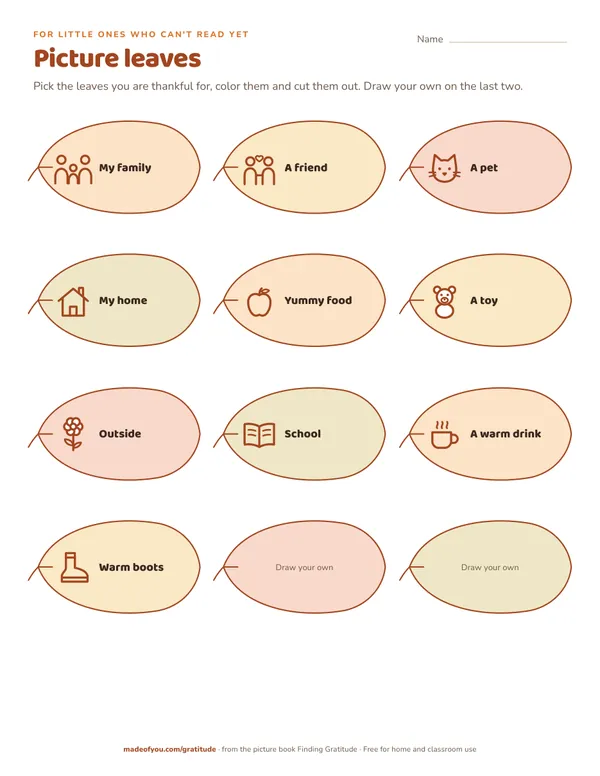
Picture leaves
For little ones who can't read yet: family, a friend, a pet, home, food, a toy, outside, school, a warm drink and warm boots, plus two to draw on.
Ages 3 to 5 · 1 page · PDF
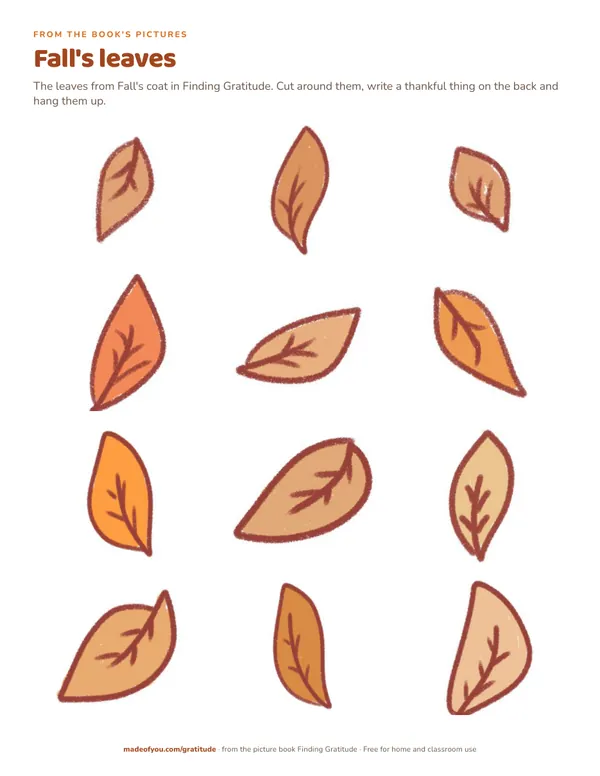
Fall's leaves
Twelve leaves from Fall's coat in the book, to cut out, write on the back and hang on the branches.
Ages 4 to 8 · 1 page · PDF
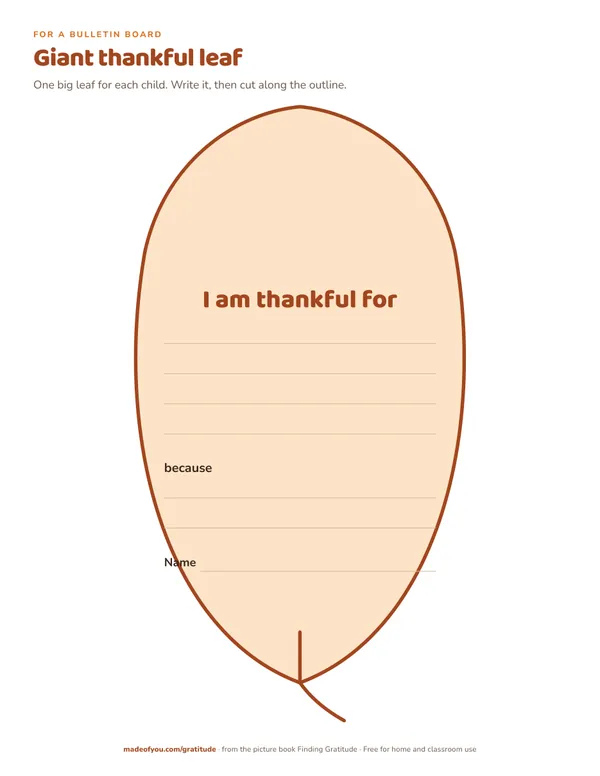
Giant leaves for a bulletin board
One big leaf a page: one to write on (with a "because" line) and one to draw on.
Ages 4 to 8 · 2 pages · PDF
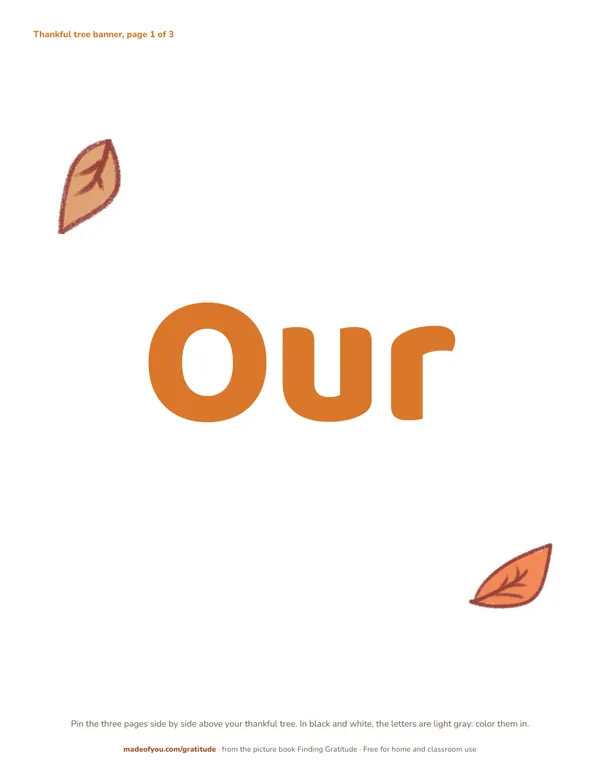
"Our thankful tree" banner
Three pages, one big word each. Pin them side by side above the tree. In black and white, the letters are light gray to color in.
Ages 4 to 8 · 3 pages · PDF
Free for home and classroom use. To pass them on, please share the link to this page and not the file.
On a phone or tablet
A leaf a day: grow your thankful tree
Each day, add one leaf. Your child picks a picture, or tells you a few words and you type them. Up to 30 leaves, with an idea for each one if you're stuck. When it's full (or whenever you like), print it with the list of every leaf.
Your tree
Idea for leaf 1 · Notice
Find 3 things at home that you like.
1. Pick a picture
The leaves stay on this phone or tablet. They are kept in this browser only. Nothing is sent anywhere, and no account is needed.
The ideas come from our 30 days of thanks. The paper calendar for November is on the gratitude page, if you'd rather color a leaf on the fridge.
How to
How to make a thankful tree
At home. Tape the tree poster to a wall or the fridge, or cut a trunk and branches from a paper bag. Or stand a few real twigs in a jar and hang the leaves with string. Keep the leaves, a pencil and the tape next to it, so adding one takes a minute.
At school. A bulletin board: the poster (or brown paper branches), the banner above, a giant leaf for each child. Add leaves at morning meeting through November, and put a name on each so families can find theirs at pickup.
The talking is the point. When a leaf goes up, ask one more question: who made that happen? Why do you think they did it? That's where a thank you turns into thinking about someone else.

In the book
I colored my memories and the moments when I felt grateful.
That's Fall, showing his siblings the notebook he keeps. A thankful tree is the same idea on a wall: one leaf for each moment.
What to put on a leaf, by age
Ages 3 to 4
Draw it, a grown-up writes
Use the picture leaves, or let them draw on a blank one. Ask what it is, and write their words on the back. Pointing at a picture counts.
Ages 5 to 6
One word and a picture
A word they can spell (or copy from you) and a little drawing. "Mom", "cat", "snow". Ask who is behind it: who gave it, who made it.
Ages 7 to 8
A sentence with "because"
"I am thankful for my bike because Grandpa fixed it." The because is where the thinking happens: why someone did something for them.
Questions to write on the leaves
“I am thankful for” is a fine start. To go a little deeper, write a question on each blank leaf, following the four steps of gratitude researchers at the University of North Carolina describe: notice, think, feel and do.
Notice
- Something nice I saw today
- A sound I love
- Something that keeps me warm
Think
- Someone who helped me, and why
- Who made my dinner?
- A present someone chose for me
Feel
- Something that made me feel cozy
- A moment I felt proud
- Something that made me laugh
Do
- A way I said thank you
- Something kind I did
- Someone I want to thank tomorrow
The four steps come from Andrea Hussong (UNC), Greater Good, 2017. The questions are ours.
In November
A Thanksgiving thankful tree
Start on 1 November with a leaf a day, and by Thanksgiving (Thursday 26 November 2026) the tree has 26 leaves. Or put a small tree on the Thanksgiving table with a pile of leaves and pencils: each guest adds one before dinner, and someone reads them all out over dessert. Little cousins can use the picture leaves.
In Canada, Thanksgiving comes in October, so start in September. And a thankful tree isn't only for autumn: in spring, swap in green leaves and keep going.
Want to see the leaves fall? Thankful leaves in your room lets Fall's leaves fall around you on a phone or tablet, each with a thankful thing on it.
What do YOU think? What things are you grateful for today?
Questions
Grown-ups ask
What is a thankful tree?
A bare tree, on paper or in a vase, that a family or a class fills with leaves. Each leaf holds one thing someone is thankful for. Bit by bit the tree fills up, and you can see how many good things there are. Many families make one in November for Thanksgiving, but it works in any month.
What do you write on thankful tree leaves?
One thing a leaf: a person, a pet, a place, a food, a moment. Little ones can pick a picture leaf or draw. Older children can add a because: "I am thankful for my bike because Grandpa fixed it." Or write a question on each leaf: who helped you today, what made you smile, what keeps you warm.
How do I make a thankful tree for a classroom bulletin board?
Print the tree poster, or cut a trunk and branches from brown paper. Pin the three page banner above it. Give each child a giant leaf (or a few small ones) to write or draw on, and add the leaves through November. One leaf a day at morning meeting works well, and a name on each leaf helps families find theirs.
My child can't write yet. Can they still make one?
Yes. Use the picture leaves (family, a friend, a pet, home, food, a toy, outside, school, a warm drink, warm boots) or a blank leaf to draw on. Ask what they drew and write their words on the back. On a phone or tablet, the leaf a day tree has the same pictures.
When should we start a Thanksgiving tree?
Start on 1 November and add a leaf a day, and you'll have 26 leaves by Thanksgiving, Thursday 26 November 2026. A week before works too: everyone adds leaves, and the tree goes on the table. In Canada, Thanksgiving is in October. And a tree in spring, with green leaves, is just as nice.
Where is the leaf a day tree saved?
Only in your browser, on that phone or tablet. Nothing is sent to us or to anyone else, and there's no account. If you clear the browser's data, the tree goes too, so print it (or save it as a PDF) when it's full.
Do gratitude jars and journals really work for young kids?
We see them as family rituals and a way to talk, not a cure. Research with children ages 4 to 8 is thin, and a daily list on its own has not been shown to make young children happier. What researchers do find is that parents who talk about gratitude and show it tend to have more grateful children. So the talking matters more than the jar.
More gratitude
 Gratitude for kidsThe book's four activities, a short guide for grown-ups and every free sheet.
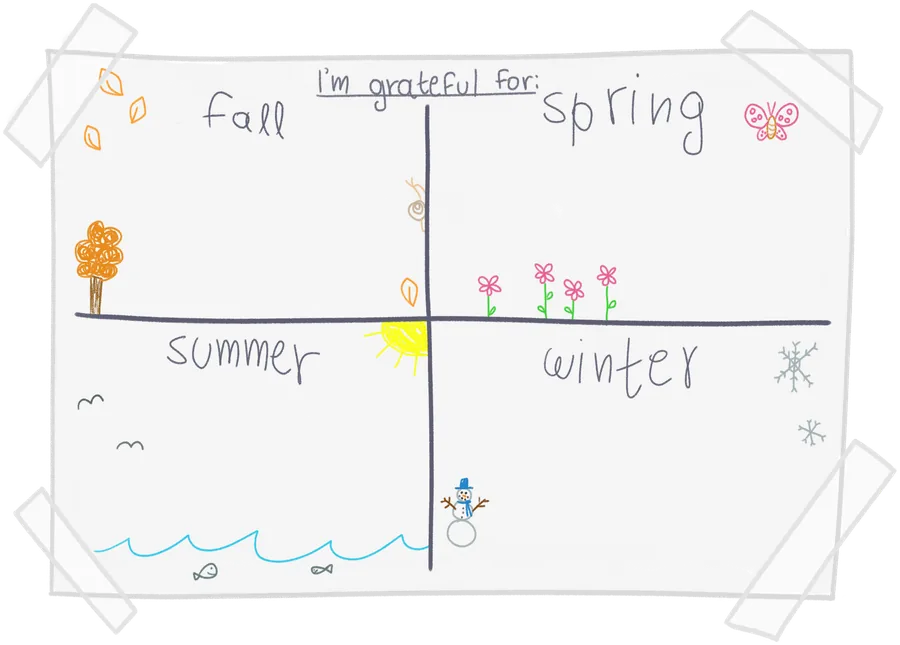 "I am thankful for" sheetsFall's four boxes as sheets by age: draw, trace or write, with a "because".
 Things to be thankful for100 ideas and questions by age, for dinner, the car or bedtime.
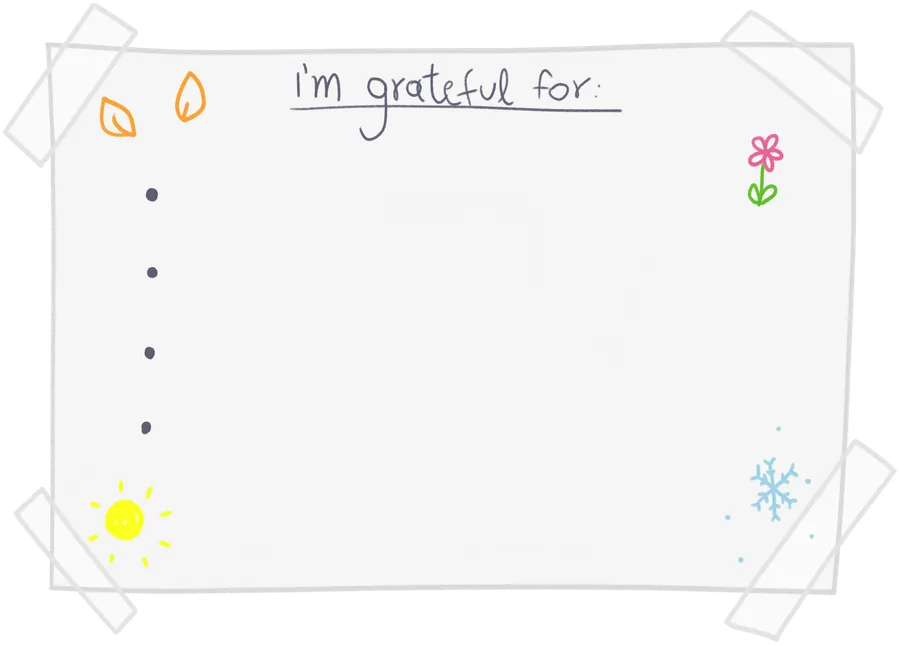 Gratitude jarThe book's family box of gratitude: prompts, slips to print and a jar label.
 Thank you notes for kidsCards to fill in or draw in, and the book's hide-a-note game.
 Gratitude journal for kidsDraw three things a day, like Fall's notebook: 7 days or 30.
 The four seasons for kidsFour siblings, four seasons: a chart, a wheel to spin and sorting cards.
 Gratitude coloring pagesThe book's own line drawings, with a thankful box to fill on every page.
Free tonight
Fall's 7 Thankful Nights
A short thankful moment at bedtime for 7 nights, with Fall and a gentle voice, on a phone or tablet. Night 1 is free and opens right away. If your child likes it, we can email you the other six, one a night.
Open night 1
Meet the book
Finding Gratitude
Our picture book for ages 4 to 8 · coming this October
Four siblings, the four seasons, meet for one snowy evening: Fall full of joy, Spring a bit annoyed, Summer melting away and Winter in a rush.
A story about the love that siblings share, and how Fall found gratitude by changing the way he looks at his days.
Fall, his siblings and every picture on these pages come from it. The book isn't out yet.