
History, legends and free printables
The candy cane story
Why are candy canes red and white? Nobody wrote it down, which has left a lot of room for stories.
History can tell you some of it, from a candy recipe printed in Philadelphia in 1844 to the priest who invented the machine that bends the hooks. Below that come the legends people tell, which one of them is religious, and why none has any proof. And since a candy cane is also something to make, we've added free printables, a craft that's safe for little hands, and Santa's candy cane hunt from our own book.

The short answer
Why are candy canes red and white?
For a six year old · read it aloud
Nobody knows for sure! A long, long time ago, candy canes were all white, like snow. Then, about 120 years ago, red stripes started to appear. Maybe somebody thought red and white looked bright and happy on the Christmas tree, or maybe they just liked it, but they never wrote it down.
So what do YOU think? If you were in charge of the stripes, what color would they be?
For grown-ups
There's no record of who first made candy canes red and white, or why. National Geographic says all we have are guesses and rumors, and researchers at Toronto Metropolitan University, writing in The Conversation, found no exact records of the candy cane's invention at all.
The date of the stripes is easier. Christmas cards show plain white canes until around 1900 and striped ones after it. The National Confectioners Association, the American candy makers' trade group, says candy canes came only in white for about 200 years, and that red stripes and peppermint became the norm around the turn of the century.
Striped candy is older than the striped cane. An 1844 recipe book from Philadelphia tells you to keep peppermint candy perfectly white except for its stripes, which are laid on in narrow strips before the candy is pulled into long sticks and twisted. The recipe doesn't say what color the stripes were, and the sticks were straight.
The rest is opinion. A candy historian quoted by History.com puts the red and white down to good marketing. Some people believe Bob McCormack's candy company in Georgia brought in the stripes in the 1920s, though nobody has shown it. Many churches give the colors a meaning, white for purity and red for Christ's blood, and that's one of the legends further down.
Sources, checked 12 Oct 2026: National Geographic, The Sweet and Sticky Story of Candy Canes (2015); The Conversation, The history of candy canes and why they taste so cool (2019); National Confectioners Association, Candy canes; Eleanor Parkinson, The Complete Confectioner (1844), Internet Archive; History.com, Who Invented Candy Canes?; Snopes, Did Candy Canes Originate as Religious Symbols?.
What's on record
Candy cane history, in the right order
We kept to what someone wrote down at the time or a patent office stamped, and where a date is only a guess, the line says so.
1600s, give or take
Plain white sugar sticks
Long before anyone bent a hook in them, people made sticks of pulled white sugar. Historians think they're the candy cane's grandparents, but nobody has a document or a date for the first one.
1844
A recipe with stripes
Eleanor Parkinson's The Complete Confectioner, printed in Philadelphia, has you pull hot peppermint candy over a hook on the wall until it turns white and shiny, lay colored strips on top, then pull it into long sticks and twist them. It's the oldest striped peppermint stick recipe we could read for ourselves, and its sticks are straight, with no color named.
1866 and 1874
The name, then Christmas
The first "candy canes" in English that historians point to are some "mammoth" ones in a shop window, in an 1866 magazine story. In 1874 a boy asks Santa for one in a children's magazine, which is the first time a candy cane and Christmas meet in print.
Around 1900
The stripes turn up
Christmas cards from before then show plain white canes, and from the start of the 1900s they show striped ones.
The 1920s
A candy company in Georgia
Bob McCormack, whose company in Albany, Georgia, later became Bobs Candies, starts making candy canes for his children, his friends and the shops in town. The hooks are bent by hand.
1921
A patent for bending canes
Brasher O. Westerfield of Detroit files a patent for a candy machine "designed principally for forming candy canes", granted in 1928. Whether a factory ever used it, we couldn't find out.
The 1950s
The priest and the hook machine
Father Gregory Keller, a Catholic priest from Little Rock and Bob McCormack's brother-in-law, invents a machine that twists and cuts the candy (1952), then one that bends the hooks (1957, patented in 1960), and gives his royalties to charity. By the end of the 1950s, Bobs was making 1.8 million sticks of candy a day.
1998
The biggest one
The largest candy cane in Guinness World Records is 36 feet 7 inches long (11.147 meters), made by the team at Fabiano's Chocolates and Ice Cream at Lansing City Market, Michigan, on December 5, 1998. Lay six grown-ups head to toe and you're about there.
True facts to read aloud
For the kitchen table, or the drive to Grandma's.
- Candy cane candy starts out golden brown. Then a machine called a puller stretches it again and again until it turns silky white.
- The red stripes are laid on top of the white, and a machine called a twister turns it all so the stripes spiral round and round.
- The hook comes last, from a machine with the best name in the factory: the crooker.
- Mint isn't really cold. Peppermint has menthol in it, which switches on the little sensors in your mouth that feel cold, so your brain gets tricked.
- Most people start at the straight end. In a candy makers' survey, 72 out of 100 people did. Which end do YOU start?
- About 90 out of every 100 candy canes are sold between Thanksgiving and Christmas.
- National Candy Cane Day is December 26 in the United States, the day after Christmas, and who picked it is a mystery.
Sources, checked 12 Oct 2026: Eleanor Parkinson, The Complete Confectioner (1844), Internet Archive; National Geographic, The Sweet and Sticky Story of Candy Canes (2015); Snopes, Did Candy Canes Originate as Religious Symbols?; New Georgia Encyclopedia, Bobs Candies; National Confectioners Association, Candy canes; US Patent 1,680,440 (filed 1921); US Patent 2,956,520 (filed 1957); Arkansas Catholic (2017); Guinness World Records, Largest candy cane; The Conversation, The history of candy canes and why they taste so cool (2019); History.com, Who Invented Candy Canes?.
The stories people tell
The legends of the candy cane
You'll hear these at school, at church and all over the internet, and some of them are lovely. None of them comes with proof. One is a Christian story, and we say that clearly, because it matters to the families who tell it.
J is for Jesus
A Christian storyThe story
A candymaker in Indiana bent his candy into a J for Jesus, the story goes, made it white for purity and added red stripes for Christ's blood. Some versions count three thin stripes for the Trinity, or call the cane a secret sign between Christians. Many churches tell it at Christmas, and there are picture books about it.
What we know
Nobody has found a record of it: the candymaker is never named, candy sticks are older than Indiana, and striped canes only show up in pictures around 1900. So we can't call it the candy cane's beginning. But a story doesn't need a date to mean something. If it's part of your family's Christmas, it's a lovely way to look at a candy cane. And the church does have a real link: a Catholic priest invented the machine that bends the hooks.
The choirmaster of Cologne
Set in a churchThe story
In 1670, they say, the choirmaster at Cologne Cathedral in Germany handed out sugar sticks to keep his young singers quiet through a long Christmas service, and bent them into shepherds' crooks for the occasion.
What we know
No one has found a document from 1670 or anywhere near it. The story first shows up in writing in the middle of the 1900s, and even the candy makers' association starts it with "legend has it". National Geographic calls it unsubstantiated.
The tree in Wooster, Ohio
Not religiousThe story
In 1847 August Imgard, who had come to Ohio from Germany, put up a Christmas tree, and the candy makers' association says he hung candy canes on it.
What we know
A 1938 article about that same tree lists paper chains, cookies and gilded nuts, without a single candy cane. If there were canes, they were probably plain white.
The hook is for the tree
Not religiousThe story
The hook was added so candy sticks could hang on Christmas trees.
What we know
We like this one best. A historian quoted by History.com says Germans may just as well have bent the sticks to hang them on their trees, but nobody wrote it down, so it stays a guess.
Sources, checked 12 Oct 2026: Snopes, Did Candy Canes Originate as Religious Symbols?; National Geographic, The Sweet and Sticky Story of Candy Canes (2015); Smithsonian Magazine (2012); History.com, Who Invented Candy Canes?; National Confectioners Association, Candy canes; The Conversation, The history of candy canes and why they taste so cool (2019).

Our own book
The Christmas Secret
A Christmas Eve picture book with a read-along · ages 3 to 7 · out on October 20
Here's one more legend, and we can vouch for this one, because we made it up. In The Christmas Secret, a girl on a frozen bench sees Santa's hot-air balloon float over the Golden Mountains with a red and white candy cane hanging from its ropes, and she sets off toward the mountains as fast as she can. Here's why:
They say that anyone who catches even one red and white drop from the candy cane in the sky can make a wish come true, no matter how crazy it is.

Santa's own trail
Santa's candy cane hunt
Santa wrote eight rhyming clues that send your child round the house along the girl's trail from the book, from a chair to the bookshelf, where a new book is waiting. Print the cards free on our Christmas scavenger hunt page, or get them in the candy cane pack below.
See Santa's candy cane huntPrint · free, no sign-up
Free candy cane printables
All three print in US Letter and A4. The facts sheet and the wish tags come in color, or in black and white for coloring in. The stripes sheet is black and white only: picking the colors is your child's job.
Our Christmas activity sheets have a candy cane to join up dot by dot, from 1 to 27, and the big word search has CANDY CANE hiding in it.
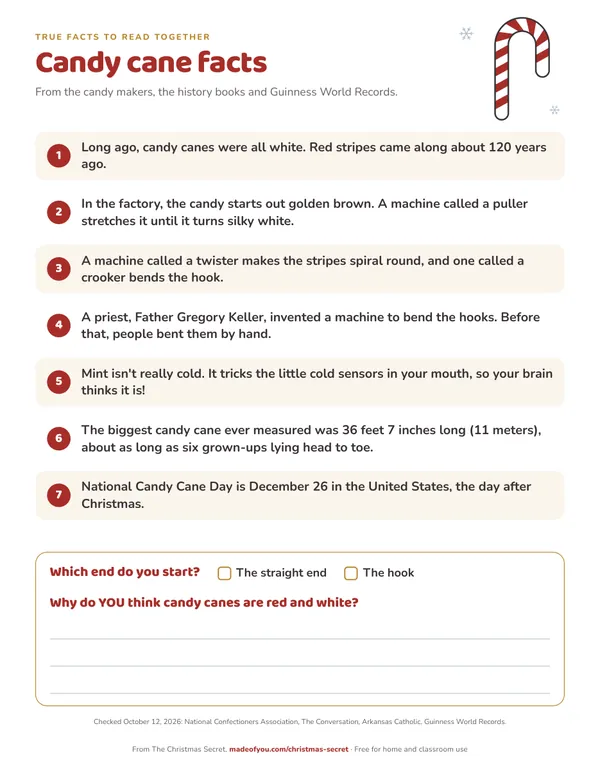
Candy cane facts
True facts to read together, from the machine that turns the candy white to the priest who invented the hook machine. Your child answers two questions at the bottom.
Ages 4 to 8 · 1 page · PDF
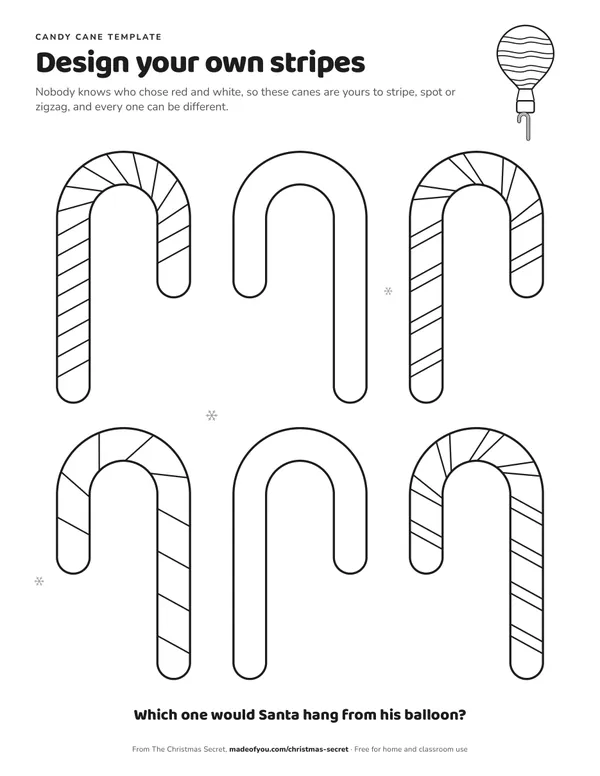
Design your own stripes
A candy cane template of big blank canes, some with bands to color and some left empty, so your child invents the stripes (red and white is allowed).
Ages 3 to 8 · 1 page · PDF
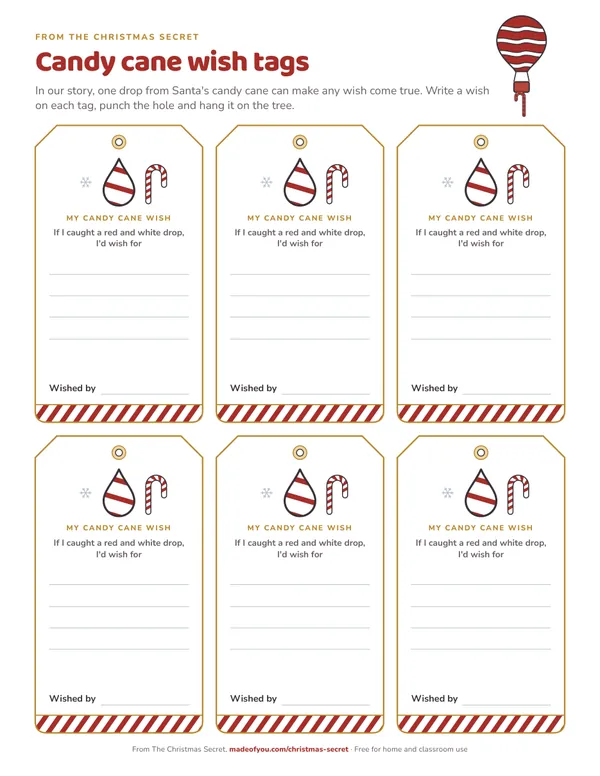
Candy cane wish tags
Write a Christmas wish on each tag and hang it on the tree. Every tag has a red and white drop from our story and a little candy cane.
Ages 3 to 8 · 1 page · PDF
Free for home and classroom use. To pass them on, please share the link to this page and not the file.
Two pipe cleaners and a pencil
A candy cane craft for little hands
Twist a red pipe cleaner round a white one and you've made the stripes the way the candy factories do, where a machine called a twister gives every real candy cane its spiral.
Ages 3 and up, with a grown-up · About 5 minutes
You need
- One red pipe cleaner and one white oneChenille stems, if that's what the craft box calls them
- A pencilFor bending the hook
- A ribbonIf it's going on the tree
How to make it
- Hold the two pipe cleaners side by side and pinch them together at one end.
- Twist them round each other all the way to the other end. Little hands can do the twisting while a grown-up holds the bottom.
- A grown-up folds a tiny bit over at each end, so the wire inside can't scratch anyone.
- Wrap the top around a pencil, then slide the pencil out to leave the hook.
- Hang it on the tree, or twist it around the ribbon on a present.
Why we left out the beads
Lots of candy cane crafts thread red and white beads onto a pipe cleaner. Beads are a choking hazard, and US toy safety rules treat parts that small as a danger to children under 3, so ours has none. There's wire inside a pipe cleaner too, so stay at the table while they twist.
Sources, checked 12 Oct 2026: US small parts rule, 16 CFR Part 1501.
Questions
Grown-ups ask
Why are candy canes red and white?
It's a mystery. Candy canes stayed plain white until around 1900, and no one wrote down who chose the red stripes or why. A candy historian guesses good marketing. White for purity and red for Christ's blood is what some churches teach, and that's a Christian legend, not a record of who made them. There's more in the long answer.
What does the candy cane shape mean?
Nothing anyone wrote down. The likeliest guess is a hook for hanging candy on the Christmas tree. Some Christians see a shepherd's crook or a J for Jesus in it and tell that story at Christmas, though there's no record of anyone making it for that reason. Until Father Keller's machine in the 1950s, the hooks were bent by hand.
Who invented the candy cane?
No one knows the name. Plain white sugar sticks were around long before anyone dated them, the oldest striped peppermint stick recipe we can read is from 1844, and the first person to bend one into a hook left no record. The machine that bends them does have an inventor: Father Gregory Keller, a Catholic priest from Little Rock. Here's the whole history.
When is National Candy Cane Day?
December 26 in the United States. The National Confectioners Association lists it, but who started it and why it's the day after Christmas are both unknown, and it isn't an official holiday. We suspect the candy canes still hanging on the tree have something to do with it.
Sources, checked 12 Oct 2026: National Confectioners Association, Candy canes; National Day Calendar, National Candy Cane Day.
Are candy canes safe for toddlers?
No. A hard candy cane is a choking hazard for little ones. The American Academy of Pediatrics lists hard candy among the foods to keep from children until 4 or older, depending on the child. After that, have them sit down to eat it, never running or playing with it in their mouth. For a toddler, color a cane on our stripes sheet together and cut it out instead. Nothing else on this page needs a real candy cane.
Sources, checked 12 Oct 2026: American Academy of Pediatrics, Choking Prevention (HealthyChildren.org).
Is the legend of the candy cane true?
Not as history. Nobody has found a record of the best known one, the Indiana candymaker's J for Jesus, or of the 1670 choirmaster in Cologne. Both are still told every Christmas, and the Christian one means a lot to many families. We go through all four legends and what's known about each.
More Christmas
Or see all of them on one page, from the weeks before Christmas to the night itself.
 Christmas EvePlan the evening together, print a card for Santa's plate and his boot prints, and find every Christmas page in the order it happens.
 24 Doors, the advent calendar by emailOne door by email every morning from December 1 to 24: a riddle, something to make, a kind mission, and now and then an animal that steps into your room.
 Christmas scavenger huntRhyming clues from one of Santa's elves for Christmas morning and Christmas Eve, and Santa's own candy cane hunt from our book, which ends at the bookshelf.
 Letter to Santa and wish listDraw it, trace it or write it: a letter to Santa for every age, a wish list, and Santa's real addresses.
- A letter from SantaSanta writes back, in his own handwriting: your child's name, two good things they did this year, and notes for Christmas morning.
 How many sleeps until Christmas?Count the sleeps with the little glass box from our story, and print a paper chain that loses a link every night.
 Christmas Eve box ideasWhat goes in the box at every age from 1 to 8, with box labels, name tags and a key for Father Christmas to print.
 Book advent calendarHow to make one on any budget, with 24 numbered tags to print and 24 picture books by age.
 Christmas picture booksTwelve new ones for 2026 and 24 classics by age, with how long each one takes to read aloud.
 Santa's reindeer namesLearn all eight in order with our rhyme, print the poster, and find out what real reindeer are like.
 Reindeer foodOats and seeds in a bowl, never glitter, with our own poem and bag toppers and tags with your child's name.
 Santa's nice listA certificate for kind things only, signed by Santa, and 24 kind things to do in December.
 Christmas gift tagsEveryone's names fit on one sheet of tags in the pictures of our book, and Santa's own tags come signed.
 Christmas elf namesSpin up an elf name from a first letter and a birthday month, and make it official with a badge or an elf ID card.
 Christmas activity sheetsSeven black and white sheets for ages 3 to 8, from a picture word search to bingo for a whole class, answers included.