Ages 4 to 8 · checked November 5, 2026
Picture books about gratitude and being thankful
Maybe nothing is ever enough at the moment, or you just want something good to read in November. Here are 15 picture books where being thankful comes out of a story, not a lecture, sorted by what your child needs, with how long each takes to read and how heavy it gets.
Before you scroll
- The books are grouped by what your child needs, not ranked.
- The best ones never say “be grateful”. A few that do are here too, because small children love them, and we say which.
- Titles link to the publishers, with no affiliate links. One book is ours, in its own labelled box.
At a glance
Which one for which child?
| If your child | Try |
|---|---|
| Is never satisfied and always wants more | Those Shoes, Last Stop on Market Street or Finding Gratitude (ours) |
| Is 3 or 4 and still learning to say thank you | Bear Says Thanks, Thank You, Omu! or The Thankful Book |
| Loves cooking, food or having friends over | Thank You, Omu! or Bear Says Thanks |
| Is reading on their own | The Thank You Book or Thanku: Poems of Gratitude |
| Needs a book for the Thanksgiving table | In November, Giving Thanks: A Native American Good Morning Message or We Are Grateful: Otsaliheliga |
| Loves fall leaves, or the four seasons | Finding Gratitude (ours), We Are Grateful: Otsaliheliga or Fletcher and the Falling Leaves |
| Is a dreamer who notices small things | Frederick or The Little Yellow Leaf |
For the child who always wants more
Noticing what you already have
These four never say "be grateful". A child wants something, and the story slowly shows them what they had all along. Two of them have real money worries in them, told gently, which is often what makes the point land.
Last Stop on Market Street
Matt de la Peña, illustrated by Christian Robinson
- Ages
- 3 to 5
- Kind
- Picture book
- Read aloud
- About 6 minutes
- How heavy
- A sad moment or two
After church, CJ and his grandmother ride the bus across the city, and CJ complains all the way: about the rain, about not having a car, about the older boys' music player. Each time, Nana shows him another way to look, and by the last stop he is glad to be where he is. Its publisher pitches it at 3 to 5, but the talk between CJ and Nana is the kind an older child gets more from.
How heavy: The family has no car, the last stop is a run-down street, and they're going to a soup kitchen. All of it is shown calmly, without pity.
Best for: A 5 to 7 year old who grumbles about what other children have, read with a grown-up who will talk about the soup kitchen afterwards.
G.P. Putnam's Sons (Penguin Random House), 2015. 32 pages. Newbery Medal and Caldecott Honor, 2016. Age range from the publisher. Publisher's page
Those Shoes
Maribeth Boelts, illustrated by Noah Z. Jones
- Ages
- 5 to 8
- Kind
- Picture book
- Read aloud
- About 6 minutes
- How heavy
- Some hard moments
Everyone at Jeremy's school has the same high-tops, and he wants a pair more than anything. His grandma says there is room for need, not want, and what he needs is winter boots. When he finally finds the shoes in a thrift shop, they're too small, and he buys them anyway. What he does with them in the end is the whole point, and the book never spells it out.
How heavy: Jeremy's grandma can't afford the shoes, he is teased at school for the donated pair he has to wear, and he squeezes into shoes that hurt.
Best for: A 6 to 8 year old who wants what "everyone at school" has. The closest book here to a real school week.
Candlewick Press, 2007. 40 pages. Now sold as a paperback and ebook only. Age range from the publisher. Publisher's page
A Chair for My Mother
Vera B. Williams
- Ages
- 4 to 8
- Kind
- Picture book
- Read aloud
- About 6 minutes
- How heavy
- Some hard moments
A girl, her mother and her grandmother drop coins into a big glass jar: tips from the diner where her mother works, and what Grandma saves on bargains. Since the fire took their furniture, there is nowhere soft to sit, and they are saving for one perfect armchair. When the jar is full they go from shop to shop to find it. Nobody says thank you as a lesson; the gratitude is in how much the chair means.
How heavy: A fire has burned everything the family owned before the story begins, and the pictures show the ashes. Nobody is hurt, and the neighbors' help is the warm part.
Best for: A child who is old enough to wait for something, and likes the idea of a family saving up together.
Greenwillow Books (HarperCollins), 1982. 32 pages. Caldecott Honor, 1983. Age range from the publisher's age group (its page gives no range of its own). Publisher's page
Frederick
Leo Lionni
- Ages
- 3 to 7
- Kind
- Picture book
- Read aloud
- About 5 minutes
- How heavy
- A sad moment or two
While the other field mice gather corn and nuts for winter, Frederick sits still. He says he is gathering sun, colors and words. Deep in winter, when the food is gone, the mice ask for his supplies, and he makes them feel warm just by describing the summer. It isn't a thank-you book: it's about storing up good moments, and the mice end up grateful for the one who did.
How heavy: By late winter the food has run out and the mice are cold and gloomy, until Frederick speaks.
Best for: A dreamy child, and anyone who wants a gentle way to talk about keeping the good moments to remember on a grey day.
Knopf (Penguin Random House), 1967. 40 pages. Caldecott Honor, 1968. Also a board book for 0 to 3. Age range from the publisher. Publisher's page
For the child who forgets the words
Saying thank you, and meaning it
Four books where thank you is said out loud, again and again, so a young child can join in. The first two show what a thank you can turn into. The last two suit a child who is starting to read alone.
Thank You, Omu!
Oge Mora
- Ages
- 4 to 8
- Kind
- Picture book
- Read aloud
- About 5 minutes
- How heavy
- A sad moment or two
Omu cooks a big pot of thick red stew, and the smell drifts across the city. A boy knocks to ask what it is, then a police officer, then more and more neighbors, and she gives each of them a bowl. Every visit ends with "Thank you, Omu!", which children love to shout. When the pot is empty, the neighbors come back, and the thank you turns into something they do.
How heavy: One sad moment: Omu finds her pot empty, with nothing left for her own dinner, just before the ending.
Best for: A 4 to 6 year old who likes to join in, and any child who loves cooking or sharing food.
Little, Brown Books for Young Readers (Hachette), 2018. 40 pages. Caldecott Honor and Coretta Scott King/John Steptoe Award for New Talent, 2019. Age range from the publisher. Publisher's page
Bear Says Thanks
Karma Wilson, illustrated by Jane Chapman · The Bear Books
- Ages
- 4 to 8
- Kind
- Picture book in rhyme
- Read aloud
- About 5 minutes
- How heavy
- Light all the way
Bear wants a dinner party, but his cupboard is bare. One by one his friends arrive carrying food, and Bear thanks each of them in a refrain children pick up fast. Then he feels bad that he has nothing to give, until his friends tell him what he does have: his stories. It never mentions Thanksgiving, so it works all year.
How heavy: Bear is lonely at the start and embarrassed that he has nothing to share, and that's all.
Best for: A 3 to 5 year old learning to say thank you, and families who already know Bear Snores On.
Margaret K. McElderry Books (Simon & Schuster), 2012. 40 pages. Age range from the publisher. Publisher's page
The Thank You Book
Mo Willems · Elephant & Piggie, the last one
- Ages
- 6 to 8
- Kind
- Early reader, all speech bubbles
- Read aloud
- About 6 minutes
- How heavy
- Light all the way
Piggie feels lucky and decides to thank everyone who matters. Gerald warns her she'll forget someone important, and keeps saying so as she thanks friend after friend from the earlier books. The someone turns out to be the child holding the book. It's a sweet farewell for fans; a child who has never met these two will miss many of the jokes.
How heavy: Nothing heavier than Gerald losing his temper, for laughs.
Best for: A 5 to 7 year old who is reading on their own, best if they already know Elephant & Piggie.
Hyperion Books for Children (Disney), 2016. 64 pages. Age range from the publisher. Publisher's page
Thanku: Poems of Gratitude
edited by Miranda Paul, illustrated by Marlena Myles
- Ages
- Grades 1 to 4
- Kind
- Poems
- Read aloud
- A poem or two a night, or about 15 minutes for all
- How heavy
- A sad moment or two
Each poem thanks something different, from a puppy and hot cocoa to dimples and a perfect stone from the beach, written by poets in many forms: sonnets, acrostics, shape poems and more. It's for dipping into, not reading in one go. It's the oldest-feeling book on this page, and a good one for a child who is starting to write.
How heavy: Nothing sad, except one gentle poem about the stories behind scars. A note at the back for grown-ups is about myths around Thanksgiving.
Best for: A 6 to 8 year old, or a younger child at one poem a night.
Millbrook Press (Lerner), 2019. 40 pages. About 30 poets, including Joseph Bruchac, Naomi Shihab Nye and Jane Yolen. Age range from the publisher (reviews say 6 to 10). Publisher's page
Short, and easy to talk about
Thankful lists to read together
No story in these three: each page names something to be thankful for. They are the quickest way into "what are you thankful for?" at dinner, and the easiest to read again and again.
The Thankful Book
Todd Parr
- Ages
- 4 to 6
- Kind
- Picture book, one thing a page
- Read aloud
- About 3 minutes
- How heavy
- Light all the way
Each bright page names one thing a child can be thankful for and says why: their hair, music, bath time, the library, and a few silly ones. It ends by asking the reader to find something every day. It is a list, not a story, and it doesn't pretend to be anything else; that is why small children ask for it.
How heavy: Nothing at all, apart from some silliness with underwear.
Best for: A 3 to 5 year old, and the grown-up who wants the shortest possible way to start the conversation.
Little, Brown Books for Young Readers (Hachette), 2012. 32 pages. Also a board book. Age range from the publisher. Publisher's page
Thankful
Eileen Spinelli, illustrated by Archie Preston
- Ages
- 4 to 8
- Kind
- Picture book in rhyme
- Read aloud
- About 4 minutes
- How heavy
- Light all the way
A rhyme runs through a long list of people and what each one is thankful for: a waitress, a doctor, a poet, a chef and many more. The pictures turn the list into a family day, with a brother and sister acting out every job at home, and it ends at bedtime. The pictures carry it more than the words.
How heavy: Nothing heavy. It comes from a Christian publisher, and one spread has a pastor thankful for God's word.
Best for: A 4 to 6 year old who likes pretend play, and families happy with a light touch of faith.
Zonderkidz (HarperCollins Christian Publishing), 2015. 32 pages. Also a board book. Age range from the publisher's own shop. Publisher's page
Giving Thanks: A Native American Good Morning Message
Chief Jake Swamp, illustrated by Erwin Printup, Jr.
- Ages
- 5 to 11
- Kind
- Picture book
- Read aloud
- About 3 minutes
- How heavy
- Light all the way
Chief Jake Swamp's version of the Mohawk morning thanks, the words Mohawk parents teach their children. It thanks the earth, the waters, the plants, the animals, the trees, the winds, the sun and the stars, one after another, as if they were all family. It has nothing to do with presents or a holiday, which makes it a good counterweight to both.
How heavy: Nothing heavy. It is a reverent thank you, ending with thanks to the Creator.
Best for: Any age from 4 up, read slowly in the morning or at the Thanksgiving table.
Lee & Low Books, 1995. 24 pages. 304 words. The Mohawk text is at the back. Age range from the publisher. Publisher's page
November, fall and the turning year
The seasons, and quiet noticing
For November evenings. The first two are about giving thanks through the year; the last two are fall stories about noticing and letting go, more wonder than thank you, and lovely at bedtime.
In November
Cynthia Rylant, illustrated by Jill Kastner
- Ages
- 4 to 7
- Kind
- Picture book
- Read aloud
- About 4 minutes
- How heavy
- Light all the way
A slow walk through the month: the trees going bare, birds leaving or staying, cats and dogs curling up in the warm, animals storing food. Then it comes indoors, where the house smells of squash and spice and the family gathers for a big meal to give thanks before winter. Quiet, warm, and over before anyone gets restless.
How heavy: Nothing at all. There are no Pilgrims in it either: the holiday is only a family meal.
Best for: A 4 to 6 year old at bedtime in November, and a family that wants a Thanksgiving book with no history to untangle.
Clarion Books (HarperCollins), 2000. 32 pages. Age range from the publisher. Publisher's page
We Are Grateful: Otsaliheliga
Traci Sorell, illustrated by Frané Lessac
- Ages
- 3 to 7
- Kind
- Picture book, nonfiction
- Read aloud
- About 6 minutes
- How heavy
- Some hard moments
A year in the life of a Cherokee family and community today, starting with the Cherokee New Year in the fall. Each season has its own reasons to say otsaliheliga, we are grateful: dances and ceremonies, elders' stories in winter, planting strawberries in spring, the Green Corn Ceremony in summer. It counts the hard times as part of it too. The back has a glossary and the whole Cherokee syllabary.
How heavy: In the fall, the community remembers ancestors who suffered on the Trail of Tears, and one family says goodbye to a relative leaving for military service. Both are told gently.
Best for: A 5 to 8 year old curious about other families, and the grown-up who wants gratitude as a habit all year, not one day.
Charlesbridge, 2018. 32 pages. Sibert Honor, 2019. Otsaliheliga is said oh-jah-LEE-hay-lee-gah. Age range from the publisher. Publisher's page
Fletcher and the Falling Leaves
Julia Rawlinson, illustrated by Tiphanie Beeke · Fletcher
- Ages
- 4 to 8
- Kind
- Picture book
- Read aloud
- About 5 minutes
- How heavy
- A sad moment or two
Fletcher, a young fox, thinks his favorite tree is ill: its leaves are going brown and falling. He tries to stick them back, chases off the animals carrying them away, and guards the very last one. Then after the first frost he finds the bare tree covered in shining icicles. It is about noticing and wonder more than saying thank you, and we have put it here for that.
How heavy: Fletcher is truly upset that his tree is losing its leaves, and cries when they blow away. The tree is fine.
Best for: A 3 to 6 year old who worries about change, read on a windy fall evening.
Greenwillow Books (HarperCollins), 2006. 32 pages. First published in the UK. The UK publisher, Graffeg, says ages 3 to 5. Age range from the publisher (US). Publisher's page
The Little Yellow Leaf
Carin Berger
- Ages
- 4 to 8
- Kind
- Picture book, cut-paper collage
- Read aloud
- About 3 minutes
- How heavy
- A sad moment or two
Every leaf on the oak falls in the fall except one little yellow leaf, which isn't ready. It hangs on through the frost, until it notices one other leaf still there, a red one, and the two let go together. It's about courage and a friend more than gratitude, with fall in every picture, and it's one of the most beautiful books on this page.
How heavy: The leaf is scared to let go, and some children ask what happens to it after it blows away.
Best for: A 4 to 6 year old who is nervous about trying something new.
Greenwillow Books (HarperCollins), 2008. 40 pages. Paperback reissued in 2024. Age range from the publisher. Publisher's page
Our own book
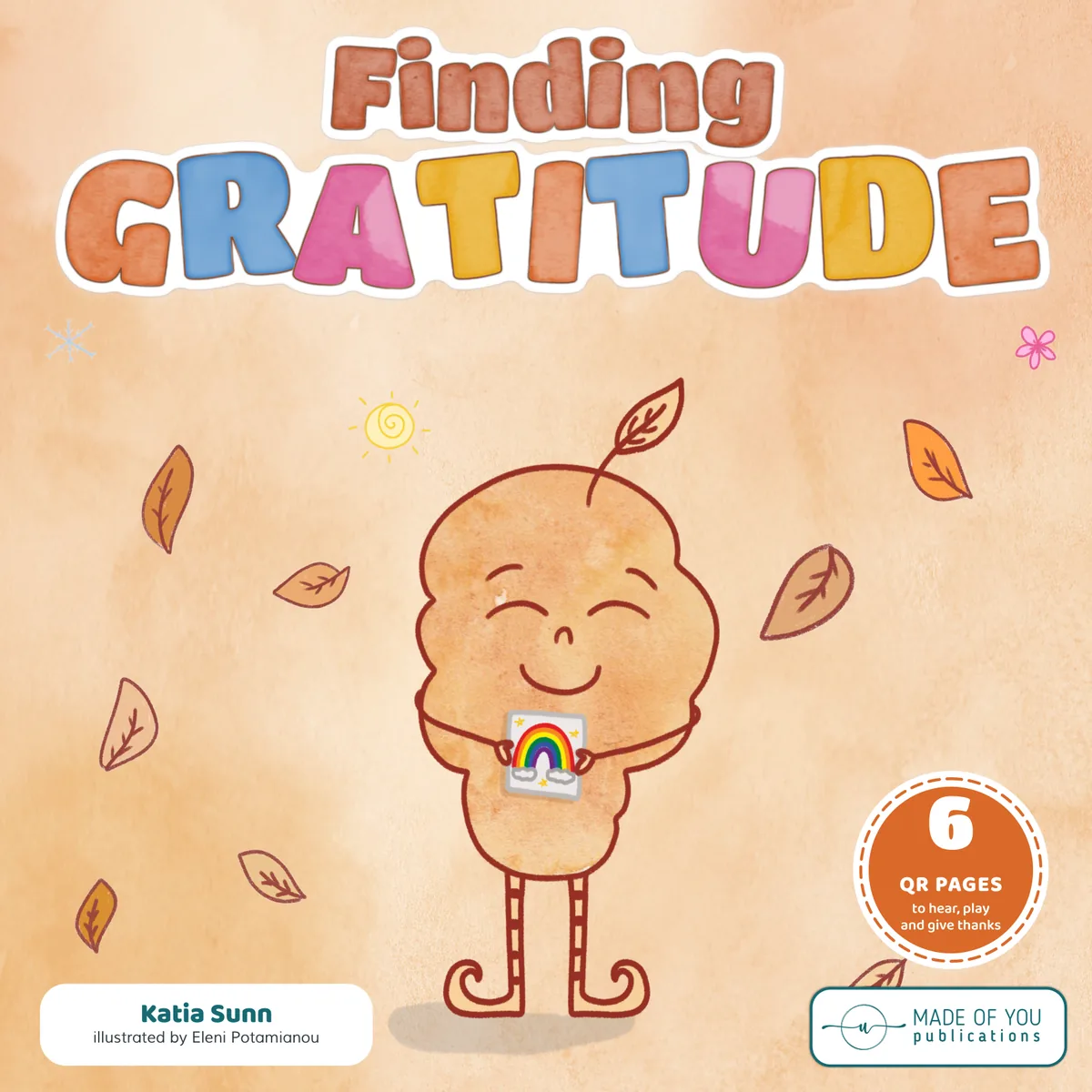
Finding Gratitude
by Katia Sunn · Made Of You, 2026
- Ages
- 4 to 8
- Kind
- Picture book
- Read aloud
- About 10 minutes, then four things to try
- How heavy
- A sad moment or two
Four siblings, who are the four seasons, meet in a snowy chalet for the one evening they are all together. Fall arrives late and soaking wet, and instead of being sad about everything he left behind, he takes out a notebook of drawings: the moments he felt grateful, like warm boots a friend lent him and a hot drink he finally stopped to enjoy. His siblings tease him, so he draws four boxes and goes first. Then the book turns to your child: what are you grateful for today?
Unlike Thank You, Omu! or Those Shoes, the gratitude here is said out loud: Fall explains what it means to him. What keeps it from being a lecture is the siblings, who have pranked each other for years and don't let him get away with anything. It never mentions Thanksgiving. At the back are four things to try together: a gratitude journal, a pause to notice, a thank you note to hide, and a family box of gratitude.
There are QR codes in the book to open on a phone or tablet, with no app and no account, and the book works without them. It came out in October 2026, so it has no reviews or track record yet, and it's a paperback printed by Amazon.
How heavy: Nothing frightening. The sad bit is one every child knows: the last days before you leave somewhere, and all the goodbyes. Spring is a little sarcastic with her brother before she comes round.
Best for: A 4 to 7 year old who loves stories about brothers and sisters, in the weeks around Thanksgiving or after a day that felt grey.
Checked November 5, 2026
How we chose
We started from what parents actually write when they ask for these books: a child who is “never satisfied”, who “rarely says thank you”, something to read “in November”. We looked first for stories where a child comes to see what they already have, because that is what a lecture can't do. Then we added the books where thank you is said out loud, for the youngest, and a few short lists, because they work at a dinner table.
For every book we read the publisher's page or a library record for the author, the format, the page count and the age range, and each card names where its age came from. Awards are only listed where the award's own list confirms them. Read-aloud times are our estimates. “How heavy” covers money worries, goodbyes and hard history as well as sad moments, taken from the publishers' descriptions and published reviews, and we say what happens so you can judge it for your own child.
We left out Thank You, Sarah, a funny book about the woman who campaigned for a national Thanksgiving, because it is about not giving up more than about being thankful, and we couldn't see how its crowd scenes show Native people. We also left out Grateful: A Song of Giving Thanks, which none of the reviews we use covered, and A Busy Year, now sold only as a board book. Katia wrote one of the books on this page, Finding Gratitude, so it sits in a separate box with what it can't do written out. Nobody paid to be here, and no publisher asked. A book we missed? Tell us at info@madeofyou.com.
Questions
What parents ask
- My 6 year old is never satisfied and rarely says thank you. Is there a picture book that would help her notice the good things she already has?
- Try a story where a child wants something and finds out what they already had, rather than a book that tells her to be grateful. Those Shoes is the closest to school life: a boy wants the shoes everyone has. In Last Stop on Market Street a boy grumbles across the city on a bus until his grandmother changes how he sees it. A Chair for My Mother shows a family saving up for one thing that matters. Read it once just for the story, and leave the talking for the second time.
- What are the best picture books about gratitude for kids?
- For ages 4 to 6, Thank You, Omu! and Bear Says Thanks, because thank you is said out loud and children join in. For a child who always wants more, Last Stop on Market Street and Those Shoes. For the shortest way to start a conversation, The Thankful Book. For gratitude as something you do all year, We Are Grateful: Otsaliheliga. Five books on this page have won the Newbery Medal, a Caldecott Honor or a Sibert Honor.
- What are the best picture books about being thankful to read with a 4 to 7 year old in November?
- In November is the quietest: the month going by, ending with a family meal. We Are Grateful: Otsaliheliga starts in the fall and goes through a whole year of giving thanks. Giving Thanks is a three minute Mohawk thank you to the natural world, good at the table. For bedtime on a windy evening, Fletcher and the Falling Leaves and The Little Yellow Leaf.
- Is there a Thanksgiving book that doesn't tell the Pilgrim story?
- Most of this page. In November has no Pilgrims at all, only a family meal. We Are Grateful: Otsaliheliga and Giving Thanks are by Cherokee and Mohawk authors and are about giving thanks, not the holiday. If your child is asking about the history itself, Keepunumuk: Weeâchumun's Thanksgiving Story (Charlesbridge, 2022, ages 3 to 7) tells the harvest of 1621 from the Wampanoag side. We left it off the list because it is more about history than about gratitude.
- Is there a picture book about the four seasons that also teaches being thankful?
- We Are Grateful: Otsaliheliga goes through the year season by season, with its own reasons to give thanks in each. Frederick ends with a little poem about the four seasons, and is about keeping good moments for the grey days. Ours, Finding Gratitude, makes the four seasons into four siblings, and Fall is the one who has learned to be grateful.
After the story, free
A thankful tree to print · “I am thankful for” sheets · 100 things to be thankful for · all the gratitude pages · kindness picture books